A short walk and a guided exercise are not the same thing
A walk outdoors is often recommended as a simple way to relieve stress. But does paying deliberate attention to nature produce a greater benefit than walking through it? A small randomised trial from Oregon State University examined that question by comparing guided outdoor mindfulness with unstructured walking over two weeks.
The results offered an intriguing but inconclusive signal. Participants assigned to guided mindfulness showed numerically larger improvements in mental well-being and perceived stress, yet neither advantage over walking was statistically significant. The distinction matters: the findings justify further testing, not claims that mindfulness is proven superior.
Why the researchers compared two active activities
Studies of nature and mental health often compare people who spend time outdoors with people who do not. That design can show whether nature exposure is associated with benefits, but it does less to isolate the role of attention, reflection or structured practice.
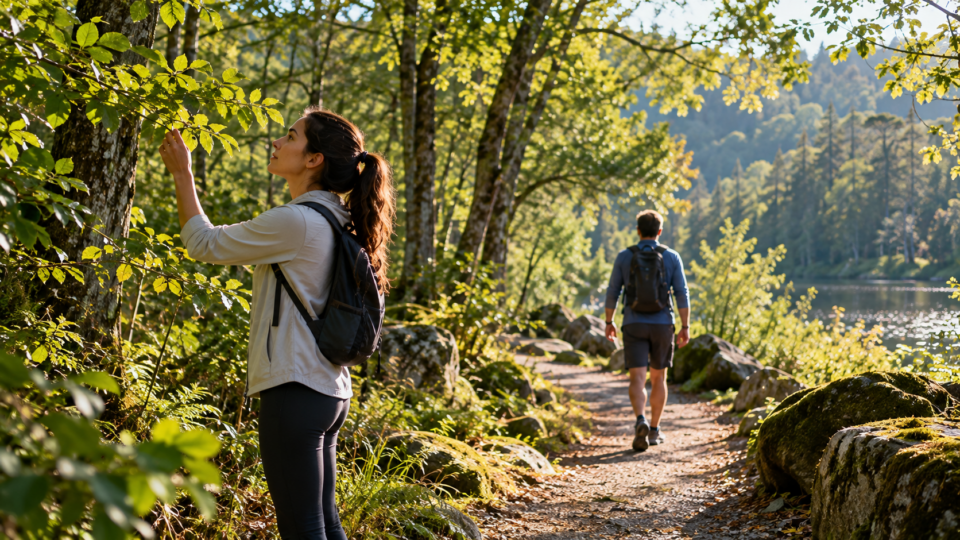
Sabine V. Huemer, Zhirui Hu and Makena Aiona-Agra instead compared two activities that both involved being outdoors. One group followed a 15-minute audio or video mindfulness sequence. The other was asked to take an unstructured walk outside for approximately 15 minutes. Both activities could plausibly reduce stress, making the comparison more demanding than a no-activity control.
The trial started much larger than it finished
Recruitment and retention proved to be major challenges. The team screened 179 people, obtained consent from 141 and collected intake questionnaires from 103, who were then randomised. Only 35 participants completed the two-week programme and final questionnaire.
The analysis of completers included 16 people in the mindfulness group and 19 in the walking group. Their ages ranged from 18 to 72, with a mean of 46.32 years. Most participants were based in Oregon, although others participated from elsewhere in the United States or internationally. Data collection took place between May and August 2025.
This steep reduction from 103 randomised participants to 35 completers is important when interpreting the results. It limits precision and raises the possibility that the people who stayed in the study differed from those who dropped out in ways the researchers could not measure.
What participants actually did
The mindfulness group used a fixed sequence intended to encourage awareness of natural surroundings without requiring specialist equipment. The comparison group walked outdoors without those structured prompts. The researchers collected self-reported measures before and after the two-week period.
Mental well-being, perceived stress and nature connectedness were the main outcomes. Nature connectedness refers to a person’s sense of emotional affiliation with the natural world. The researchers also analysed daily practice logs for 32 completers, including reported time spent practising and immediate stress ratings.
Because the intervention was remotely delivered, researchers did not directly observe each session. They also did not control all other outdoor activities participants may have undertaken, making it difficult to separate the effect of the instructions from differences in total practice time.
Well-being improved, but the between-group result was uncertain
The estimated difference in the change in mental well-being was 2.63 points in favour of mindfulness. Its 95% confidence interval ranged from minus 0.94 to 6.10 points, and the reported p-value was 0.126. Since the interval includes zero, the data did not establish a statistically significant advantage over walking.
Both groups’ average well-being scores increased. That is consistent with the possibility that both outdoor activities were helpful, although a trial without a no-activity comparison cannot determine how much of the improvement was caused by either activity rather than other changes over time.
A simulation using the observed variability suggested that approximately 126 participants would be required to detect an effect of this estimated size with 80% statistical power. The completed trial, with 35 people, was far smaller.
Stress scores followed a similar pattern
For perceived stress, the estimated difference in change was minus 2.02 points in favour of mindfulness, with a 95% confidence interval from minus 4.84 to 0.88 points and a p-value of 0.147. Once again, the result was not statistically significant.
The raw average stress decline was 4.13 points in the mindfulness group and 2.11 points in the walking group. These figures show why the researchers considered the signal worth following up, but the uncertainty means the apparent difference could reflect sampling variation.
Both groups also increased their nature-connectedness scores, with no statistically significant difference in improvement between them. Exploratory mediation tests did not find evidence that greater nature connectedness explained changes in stress or well-being.
One exploratory result deserves caution
The researchers investigated whether participants’ initial mental well-being affected the outcome. An exploratory three-way interaction suggested that people who began with lower well-being might gain more from guided mindfulness. The interaction was statistically significant, with a reported chi-squared value of 6.80 and p = 0.009.
However, this particular analysis was not preregistered and was based on only 35 completers. Effects discovered in small samples can be unstable, especially when researchers explore several possible relationships. The result is best viewed as a question for a larger study, not a basis for targeting treatment.
Participants did not spend equal time practising
Although both groups were initially asked to aim for approximately 15 minutes per day, recorded practice time diverged. Among the 32 participants with usable logs, the walking group averaged 425.8 total minutes, compared with 223.9 minutes in the mindfulness group. The difference was statistically significant, with p = 0.007.
This complicates a simple interpretation of the experiment as a comparison of identical exposure durations. A person taking longer walks may gain benefits from extra movement or additional time outdoors. Conversely, structured mindfulness may be easier to complete in a shorter session.
An exploratory analysis suggested that more accumulated mindfulness practice was associated with larger reductions in perceived stress, but participants chose how much to practise. That relationship therefore cannot establish a causal dose-response effect.
The dropout problem changes the picture
When the researchers incorporated all 103 randomised participants with baseline data using missing-data methods, the estimated mental well-being advantage became smaller. It was 1.96 points using full-information maximum likelihood and 1.50 points using multiple imputation. Both confidence intervals crossed zero.
Those methods help test how sensitive the result is to incomplete follow-up, but they depend on assumptions about missing responses that cannot be verified fully. With so many participants not completing the trial, the researchers appropriately presented their estimates as preliminary.
The study was also heavily reliant on self-reported psychological scales and practice logs. It did not measure objective stress biomarkers or attention restoration, and it was not designed to diagnose or treat a mental health condition.
What the findings mean for everyday life
The findings do not show that guided mindfulness is better than a regular outdoor walk. They do show why the way people engage with a green space is a worthwhile research question. A structured exercise may offer a different experience from an ordinary walk even when both take place in the same environment.
For individuals choosing a low-cost outdoor activity, the evidence from this trial does not justify abandoning walking in favour of a particular guided programme. Both activities were feasible for some participants, and both groups reported improvements, but the small sample and missing follow-up prevent firm conclusions.
For employers, universities and community organisations considering nature-based well-being initiatives, the practical lesson is to test participation and outcomes rather than assume that a more structured programme must deliver a better result.
What a stronger trial would need
A future study would need substantially more participants and better retention. Researchers could assign equal time outdoors to both groups and measure actual exposure more closely. An additional indoor mindfulness group would help distinguish the effects of being outside from those of following a guided attention exercise.
Preregistered subgroup analyses could test whether people with lower starting well-being genuinely benefit more. Objective or independently measured outcomes, alongside self-reported stress and well-being, would also improve confidence in the results.
For now, this two-week experiment provides a useful preliminary estimate rather than a definitive answer. Mindful attention to nature remains a plausible route to well-being, but the evidence from this particular trial is not strong enough to establish a measurable advantage over walking.
Source Information
Study title: Does attention matter more than exposure? A pilot RCT of nature-based mindfulness for mental well-being and stress
Authors: Sabine V. Huemer, Zhirui Hu and Makena Aiona-Agra
Journal: Frontiers in Psychology, volume 17, article 1905841
Published: 24 September 2026
Research design: Two-week pilot randomised controlled trial comparing guided nature-based mindfulness with unstructured outdoor walking
Participants: 103 randomised; 35 completed final assessments, including 16 in mindfulness and 19 in walking
Location and data collection: Primarily United States, May to August 2025