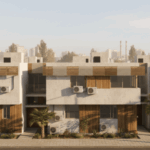





Highly reflective roofs produced larger simulated daytime surface cooling than vegetated roofs during a Riyadh heatwave. The results come from weather modelling, not measured citywide retrofits.
What researchers studied
Researchers modelled rooftop heat mitigation across different urban building types in Riyadh, Saudi Arabia, an arid city exposed to intense summer heat. They used the Weather Research and Forecasting model with building-energy and urban-canopy components, incorporating building heights and local climate zones. Four interventions were compared with a baseline roof reflectivity of 0.20: green roofs covering 50% or 100% of eligible roof areas, and reflective roofs with albedo values of 0.84 or 0.95. Albedo describes the proportion of incoming sunlight reflected by a surface.
What they found
Relative to the modelled baseline, 50% and 100% green-roof scenarios reduced average daytime surface temperature by 0.66°C and 1.23°C respectively. The two reflective-roof scenarios produced larger average reductions of 3.44°C and 4.62°C. The most reflective configuration reduced the simulated daytime surface urban heat-island signal by up to 5.26°C. Modelled air-temperature changes were smaller and varied by neighbourhood type, reaching up to 0.93°C in compact low-rise zones and 0.98°C in open high-rise zones. These values should not be confused with measured indoor temperature changes.
What it means
The study suggests that roof reflectivity may be a particularly useful heat-mitigation consideration for arid urban settings. Green roofs showed smaller cooling effects in the simulations but may offer other benefits, including changes in moisture exchange and potentially ecological value. City planners could use such comparisons to prioritise pilot projects by building form and climate zone. The authors’ analysis does not show that any particular retrofit is universally preferable on cost, water use, maintenance or occupant comfort.
Important limitation
Results depend on the weather model, roof assumptions and one selected heatwave. They were not validated through a citywide installation or across many seasons. Actual benefits would depend on roof materials, maintenance, building use and local weather, and the simulated surface-temperature reduction should not be presented as guaranteed cooling for residents.
Source Information
Study: WRF assessment of local climate zone dependent cooling effects of cool and green roofs during a Riyadh heatwave
Authors: Amjad Azmeer, Buri Vinodhkumar, U. N. Athira, Furqan Tahir, Harsh G. Kamath, Krishna K. Osuri and Sami G. Al-Ghamdi
Journal / Source: Frontiers in Environmental Science
Published: 19 November 2026