







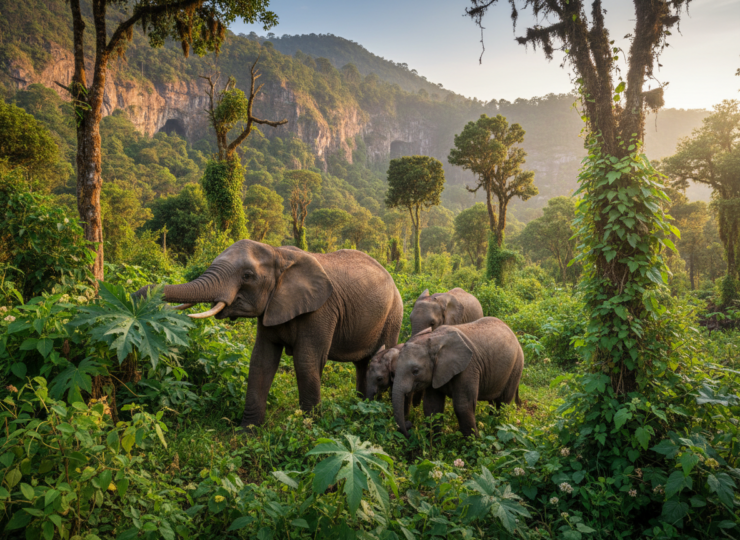
African elephants living around Mount Elgon in Kenya may deliberately seek plants, clays and other natural materials when they are unwell, according to a study that brings Indigenous ecological knowledge together with botanical identification and behavioural classification.
The findings do not prove that elephants diagnose and treat illnesses in the human sense. They do, however, document a striking set of first-hand observations from people who have spent decades alongside the animals. Across eight interviews, local experts identified 39 resources linked to unusual elephant feeding or possible medication behaviour. Thirty-five were plants and four were soils, minerals or clays.
Long-term local knowledge reveals an unusual feeding repertoire
Researchers worked in a 344.9 square kilometre area of the Mount Elgon region, a biologically rich volcanic landscape on the Kenya-Uganda border. The mountain combines diverse vegetation with caves containing mineral-rich deposits that elephants have long visited.
Between October 2023 and September 2024, the team conducted semi-structured interviews with eight members of the Sabaot Indigenous community. Participants included four wildlife community scouts, two guides and two local elders, one a retired agricultural officer and the other a former Kenya Wildlife Service ranger. They ranged from 35 to 78 years old, and every participant had accumulated more than 20 years of experience living in the study area and observing the local elephant population.
The researchers deliberately selected participants with extensive elephant knowledge as well as familiarity with traditional medicinal practices. The interviews asked about plants and other materials elephants were seen consuming, the circumstances in which those resources were targeted, and whether the same materials had recognised medicinal uses among local people.
Plant reports were not left at the level of vernacular names. The team collected voucher specimens with informants, deposited them in the East African Herbarium at the National Museums of Kenya, and had them identified by experienced taxonomists. Accepted scientific names were also checked against Kew’s Medicinal Plant Names Service.
Thirty-nine resources met the study’s relevance criteria
From the interviews, 39 resources met the researchers’ criteria for inclusion. Of these, 35 were plant resources and four were substrates such as clay or soil. Informants explicitly described 34 of the 39 resources, or 87%, as having traditional human medicinal uses. Twenty-five of the 39 resources, about 64%, were associated with treatment of specific human ailments.
All eight interviewees said people in the region believe wild African elephants use natural resources to self-medicate. More specifically, 25 of the 39 resources, or 64.1%, were explicitly assigned a medicinal function for elephants by the informants. All 25 were plant species, and all also had local ethnomedicinal uses.
The behavioural accounts went beyond simply noting that elephants ate plants also used by people. Informants described elephants consuming resources in unusual ways, targeting them in connection with particular ailments, seeking them only infrequently or seasonally, and in some cases travelling substantial distances to obtain them without feeding normally along the way.
Researchers classified the reported behaviours using a framework for animal medication. Ten plants were placed in a category where informants considered the resource medicinal for elephants but the available observations could not establish whether it was deliberately sought as treatment or consumed as a medicinal food. Eight plant species received the strongest behavioural classification used in the study, indicating reports of visibly sick elephants seeking the plants for perceived therapeutic purposes or adults providing the resource to offspring.
Eight plants stood out in the strongest behavioural category
The eight plants classified in this strongest category were Aloe arborescens, Bersama abyssinica, Coleus barbatus, Dombeya burgessiae, Dombeya rotundifolia, Dombeya torrida subsp. torrida, Ficus natalensis and Kuloa usambarensis.
Some of the most intriguing accounts involved maternal behaviour. Local observers described cases interpreted as adult elephants providing medicinal resources to calves. Such observations raise the possibility that medicinal foraging could involve social learning or care, although the study was not designed to test how elephants acquire or transmit knowledge about particular plants.
The overlap with human traditional medicine is noteworthy but must be interpreted carefully. A plant used medicinally by people is not automatically medicine for an elephant. Likewise, the presence of pharmacologically active compounds does not establish that an animal intentionally consumes a plant for a therapeutic effect. The value of the study lies in narrowing a very large natural diet to specific resources and behaviours that can now be tested more directly.
Why local ecological knowledge matters
Animal self-medication, known as zoopharmacognosy, has been reported across a growing range of species. Demonstrating it rigorously is difficult because researchers need to distinguish ordinary feeding, nutritional supplementation and accidental exposure from behaviour specifically associated with preventing or treating illness.
Long-lived animals such as elephants make that challenge especially demanding. Rare feeding events may occur over periods far longer than a conventional field project. The Mount Elgon study therefore treats the accumulated observations of experienced local people as a source of testable behavioural evidence rather than as a substitute for experimental confirmation.
This approach also connects wildlife biology with ethnobotany. Nine species in the elephants’ diet with relatively high reporting frequencies had previously documented ethnomedicinal uses, and the same nine had previously identified pharmacological properties. That convergence provides useful candidates for chemical and behavioural follow-up studies.
Clay consumption may have more than one function
Mount Elgon is famous for elephants entering caves and consuming mineral-rich earth. The researchers discuss two broad explanations for such geophagy. One is supplementation, in which soil supplies minerals or trace elements missing from the diet. The other is protection, in which clay or soil could reduce gastrointestinal problems, bind harmful compounds or otherwise support health.
These explanations are not mutually exclusive. A material can provide nutrients while also having protective properties, and the function may vary with an animal’s physiological state. The present interview-based evidence cannot resolve those mechanisms, but it identifies specific substrates and circumstances that future field and laboratory work can investigate.
The evidence is suggestive, not proof of intentional treatment
The study has important limitations. Its evidence comes from eight purposively selected informants, all men, rather than systematic direct observation of a representative elephant sample. The reports are retrospective and can be influenced by memory, interpretation and culturally shared beliefs about elephant behaviour.
There was also no experimental test showing that consuming a reported plant improved an elephant’s health. Chemical activity demonstrated in human medicine or laboratory research does not necessarily translate to a therapeutic dose or effect in wild elephants. For that reason, the researchers consistently describe the behaviour as putative self-medication.
Future work could combine direct behavioural monitoring, health observations, plant chemistry, faecal or other non-invasive biomarkers, and detailed tracking of when particular resources are consumed. Such evidence would help distinguish deliberate therapeutic targeting from seasonal diet shifts, mineral supplementation or ordinary foraging.
Conservation implications extend beyond elephants
If some of these resources are genuinely important to elephant health, conservation may need to protect not only habitat area but access to particular plants, caves, soils and knowledge-rich landscapes. The study also highlights the scientific value of Indigenous and local expertise, especially for rare animal behaviours that may be missed by shorter research projects.
The strongest conclusion is therefore not that elephant medicine has been proven. It is that decades of local observation have produced a detailed, botanically anchored set of hypotheses. Those hypotheses now give researchers a much sharper starting point for testing how wild elephants use the chemical and mineral resources in their environment when health is compromised.
Source Information
Study: African elephants putatively self-medicate with medicinal plants in the Mount Elgon region, Kenya
Authors: Fabien Schultz and colleagues
Journal: Scientific Reports, volume 16, article 28904
Published: 24 September 2026
DOI: 10.1038/s41598-026-53610-4