



A mountain gathering that scientists might have missed
In the remote mountains of northeastern India, large herds of a little-known mammal gather at particular sites during the rainy season.
Some gatherings of Mishmi takins involved more than 500 animals at once, according to a new conservation study.
The researchers did not find these places by searching the mountains at random.
They used knowledge shared by Indigenous communities to identify important locations before placing cameras and conducting field surveys.
The work offers a detailed picture of seasonal movement and social behaviour in an animal that is difficult to study.
It also demonstrates a practical way to bring community knowledge and ecological fieldwork together.
The findings were published in Frontiers in Conservation Science on 14 October 2026.
Meet the Mishmi takin
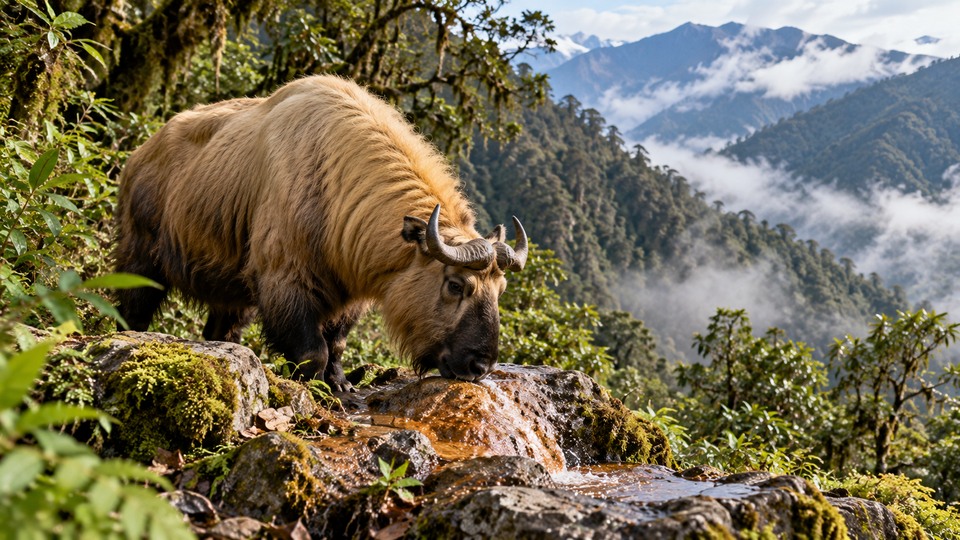
The Mishmi takin is a large, thick-coated mountain ungulate found in the eastern Himalayan region.
Its scientific name is Budorcas taxicolor taxicolor.
It belongs to a group of hoofed mammals adapted to steep, often inaccessible landscapes.
The species uses forest, mountain and high-altitude habitats at different times of year.
Researchers describe it as poorly studied compared with many better-known large mammals.
Its remote range makes repeated field observation difficult.
The study describes the takin as Vulnerable on the IUCN Red List and subject to legal protections.
Knowing where the animals gather and travel can therefore be important for conservation planning.
The people who knew where to look
Researchers worked with knowledge holders from Idu Mishmi, Digaru Mishmi, Miju Mishmi and Meyor communities.
These communities have long-standing relationships with the forests and wildlife of Arunachal Pradesh.
Local observations included where takins travel, which habitats they use and when they form large groups.
Knowledge holders also identified mineral-rich sites that attract animals.
These details gave the field team starting points for its surveys.
The researchers treated this information as ecological evidence to investigate, rather than as informal background.
They then compared the accounts with camera-trap records and direct observations.
This combination was central to the study’s design.
How the research was carried out
Fieldwork and interviews took place between June 2021 and September 2023.
The team interviewed 114 respondents using structured and informal questions.
Participants included experienced hunters, elders, forest dwellers, community knowledge holders and ritual specialists.
Researchers used photographs to help verify that respondents were identifying the correct animal.
They recorded sightings, habitats, seasonal movements, group sizes, behaviour and perceived threats.
The field team then visited relevant sites and installed cameras.
Camera locations were informed by community reports of congregation areas, salt licks and movement routes.
The approach was designed to combine complementary kinds of observation.
What the cameras recorded
The study describes camera-trap deployment at 118 locations.
It reports more than 17,000 photographic records, with a later results section giving a figure of 17,300 captures.
These records supported observations of takin activity and use of gathering sites.
A photographic capture is not the same as a different individual animal.
One takin may be recorded repeatedly, and groups can pass a camera more than once.
The researchers therefore did not treat the capture total as a population count.
Instead, the photographs helped establish when and where animals appeared.
They also provided evidence about behaviour around important locations.
The remarkable summer gatherings
Some seasonal congregation events involved more than 500 takins present simultaneously.
These events occurred during the June-to-August period.
The animals were not necessarily part of one permanently united herd.
Direct observations indicated that ordinary social groups were commonly about 18 to 40 individuals.
Multiple groups could gather at the same place, creating a much larger temporary aggregation.
That difference matters when interpreting the headline number.
The study did not count 500 different animals across the entire region.
It documented large gatherings at particular times and places, with uncertainty about repeat sightings across dates.
Why salt licks drew attention
Salt licks are places where animals can obtain minerals from soil or water.
Community reports repeatedly pointed to these sites as important for takins.
The research team found that they were associated with seasonal gathering and several behaviours.
Animals were observed drinking, feeding, resting and interacting at congregation areas.
The study also describes mating-related and lactation observations at these locations.
These findings make salt licks more than isolated feeding spots.
They may function as focal points in seasonal movement and social activity.
Protecting them could therefore matter for more than one aspect of the animals’ lives.
The seasonal journey through the mountains
Respondents described takins moving between habitats as seasons changed.
The general pattern involved lower-elevation forests in colder periods and higher mountain habitats during warmer, wetter months.
Spring reports frequently placed animals in forested habitats.
Rainy-season observations included high-altitude areas and salt licks.
Autumn accounts suggested movement through transitional habitats.
The exact pattern varied between districts and locations.
Camera-trap evidence supported the use of identified congregation sites.
It did not amount to continuous tracking of individual animals along complete migration routes.
What the interviews revealed
Most respondents described seasonal migration as part of takin ecology.
Among Digaru, Meyor and Miju Mishmi respondents, the study reported unanimous affirmative responses to the migration question.
Among Idu Mishmi respondents, approximately 89 percent agreed that takins migrate.
These figures reflect the answers of interviewed knowledge holders.
They are not percentages of all residents or measurements of animal movements.
The broad agreement gave researchers a reason to investigate seasonal habitats.
Field observations and camera records then provided complementary evidence.
The result is stronger than relying on either interviews or cameras alone.
A landscape that is difficult to survey
The Mishmi Hills contain steep elevation changes and extensive forests.
The study area includes the Dibang Valley and Anjaw districts of Arunachal Pradesh.
The broader landscape ranges from lower river valleys to alpine zones above 4,500 metres.
Weather, distance and terrain can make routine wildlife surveys difficult.
Animals may also be hard to detect when they move through dense cover.
Local residents can accumulate observations over many years and seasons.
That experience may reveal places worth checking with scientific instruments.
The new study illustrates this advantage without suggesting that every community report is automatically correct.
How community knowledge was analysed
The researchers organised interview information into categories such as habitat, season, migration, behaviour and threats.
They also applied exploratory statistical methods to investigate variation between respondents.
One analysis examined patterns linking travel distance, reported group size and ecological knowledge.
Another considered how habitat types and seasons appeared together in the data.
These techniques helped researchers describe the structure of the information.
They did not convert all memories into precise measurements.
Respondents differed in how far they travelled and what they had personally seen.
Recognising those differences is important when interpreting local ecological accounts.
Different experiences produced different insights
The study found that ecological knowledge was not distributed identically across respondents.
Some people provided detailed observations about movement and behaviour.
Others contributed more information about perceived threats or unusually large gatherings.
People who travelled farther could encounter different habitats and animal groups.
That helps explain why accounts were not always identical.
The researchers described several exploratory knowledge profiles.
These profiles should not be interpreted as rigid categories of Indigenous expertise.
They are a way of understanding how different experiences contribute to a broader ecological picture.
What the study says about threats
Respondents identified natural predators including tigers, leopards, bears and dholes.
The relative importance of reported threats differed between the two main districts.
Tiger-related concerns appeared prominently in both areas.
The researchers also documented reports of human influences, including hunting and habitat disturbance.
These accounts reflect local perceptions and observations.
They do not provide direct estimates of how many takins each predator kills.
Nor do they establish the annual effect of hunting on the population.
They help identify questions and places for future conservation monitoring.
Why cultural practices matter
The research also discussed customary rules and cultural relationships involving wildlife.
Traditional restrictions and practices can influence how people interact with animals.
Some respondents described changes in hunting practices and the strength of customary taboos.
Such observations are part of the conservation context.
They should not be simplified into a claim that Indigenous communities are responsible for wildlife decline.
The study presents community members as partners who contribute valuable ecological understanding.
Their observations helped direct surveys toward places scientists needed to examine.
Long-term conservation plans may be stronger when they involve these knowledge holders in decisions.
The conservation value of a gathering site
A location used by many animals during a short seasonal window may deserve particular attention.
Disturbance at that site could affect several social groups rather than one small herd.
The same may apply to routes connecting forests, salt licks and high-altitude habitats.
The researchers suggested prioritising congregation sites and associated movement corridors.
This is a conservation implication drawn from the observed patterns.
The study did not test a new protected-area policy or measure its effectiveness.
It also did not map every route used by every takin.
Further monitoring would help determine which places are most consistently important.
What 17,300 photographs cannot tell us
Large camera-trap datasets can sound like a census.
In this study, they were not.
The photographs were concentrated at locations selected because takins were expected to appear.
That targeted design was useful for documenting activity and behaviour.
It was not designed to estimate the total number of takins in the Eastern Himalayas.
Individual animals could appear in multiple images.
Cameras also sampled accessible or identified sites rather than every possible habitat.
The number of captures therefore cannot be translated into population growth or abundance.
A dedicated population study would require a different sampling design.
Other conservation reporting on Research Today has examined the evidence recovered from South African field sites and gaps in what scientists know about biodiversity. The takin research addresses a different but related challenge: finding reliable evidence in places that are difficult to survey.
The limits of local and field observations
Interviews can be influenced by memory, experience and differences in where people travel.
Reports of group size can be difficult to verify precisely.
Camera traps are also limited by placement and seasonal accessibility.
The study’s large congregation estimates should be read as observations of events, not formal population totals.
Its statistical analyses were exploratory.
The results cannot establish all migration pathways or the population’s overall trend.
Even so, independent field evidence supported several key community observations.
That makes the combined approach a useful starting point for conservation research.
A lesson for other elusive species
Wildlife scientists often work in places where long-term datasets are scarce.
In those settings, community observations can help identify questions and likely survey sites.
Cameras, direct observations and structured interviews can then be used together.
This is not a competition between traditional knowledge and scientific methods.
The study illustrates how the two can complement each other.
It also raises questions about fair participation and respect for community expertise.
Researchers need to recognise who contributes information and how it is used.
The approach may be relevant to other hard-to-study species, although it needs adaptation to each setting.
What happens next
Future work could monitor identified gathering sites across additional years.
Individual tracking could test the proposed migration routes more directly.
More systematic camera placement might support population estimates.
Repeated observations could reveal whether gathering sizes change over time.
Researchers could also examine how roads, hunting pressures and habitat change affect movement.
Community participation would remain valuable because local observers can notice changes between formal survey visits.
The new study does not answer every conservation question.
It identifies places and behaviours that future work can investigate more precisely.
The bottom line
A new study of the Mishmi takin combined 114 community interviews with fieldwork and more than 17,000 camera-trap records.
The researchers documented seasonal movements and important gathering sites in India’s Eastern Himalayas.
Some congregation events involved more than 500 animals at one time.
Those numbers are not a census of the species.
The study’s main contribution is showing how Indigenous ecological knowledge can guide and strengthen wildlife surveys.
Its findings support closer attention to salt licks, seasonal gathering areas and movement corridors.
The broader message is that people who know a landscape well can help scientists ask better questions about the wildlife living there.
Source Information
Original research: Integrating traditional ecological knowledge with ecological surveys for conservation of the Mishmi Takin in Eastern Himalaya, India.
Authors: Pariyal Jagannath Gaurav, Sirumai Khusiali Kri and Govindan Veeraswami Gopi.
Journal: Frontiers in Conservation Science. Published 14 October 2026.
Methods: Interviews with 114 Indigenous knowledge holders between 2021 and 2023, field observations and camera trapping at 118 locations in Arunachal Pradesh, India.