






A community-based malaria programme that repeatedly tested people and treated those who were positive was associated with substantially lower malaria prevalence in rural Ghana, according to a new peer-reviewed study.
Researchers followed 11 communities in the Pakro subdistrict of Ghana’s Eastern Region over two years. Seven communities received five rounds of mass test and treat, while four communities served as controls. Across 5,309 participants, adjusted malaria prevalence at the end of the study was 84% lower in intervention communities than in control communities.
The reduction was even larger among children aged 15 years or younger, where adjusted prevalence was 89% lower. The findings suggest that repeated community screening and prompt treatment may help reduce the reservoir of malaria infections that persists among people who do not necessarily feel ill.
Asymptomatic malaria remains a transmission challenge
Malaria control does not depend only on identifying people who arrive at clinics with fever or other symptoms. In endemic areas, some infected people carry malaria parasites without obvious illness. These asymptomatic infections can remain part of the human reservoir from which mosquitoes acquire parasites and continue transmission.
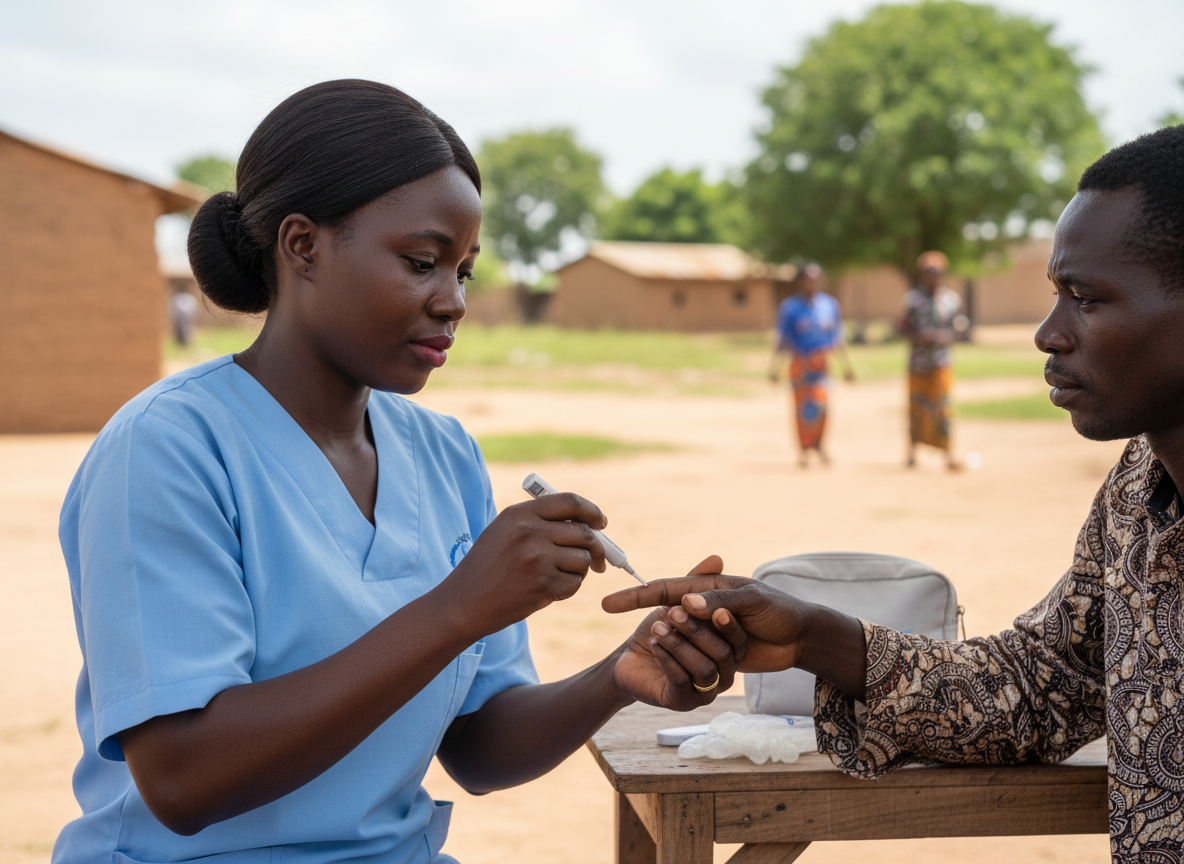
Mass test and treat, often abbreviated as MTaT, aims to reduce this hidden reservoir by taking testing into communities. People are screened regardless of whether they report symptoms, and those who test positive receive antimalarial treatment.
The new study, published in Scientific Reports on 25 September 2026, examined whether repeated MTaT could reduce malaria prevalence in a moderate-transmission setting.
How the Ghana study was conducted
The researchers conducted a two-year quasi-experimental study in 11 communities in the Pakro subdistrict. Seven communities received the intervention and four acted as controls.
The intervention consisted of five rounds of community-based mass testing delivered through trained community health volunteers. Residents were screened using malaria rapid diagnostic tests. People with positive results were treated with artemether-lumefantrine, a commonly used artemisinin-based combination therapy.
A total of 5,309 people participated. Of these, 4,000 lived in intervention communities and 1,309 lived in control communities. Intervention coverage increased during the study, from 70.6% in March 2020 to 90.7% in March 2022.
The primary outcome was malaria prevalence measured using rapid diagnostic tests, with particular attention given to children aged 15 years or younger. The researchers analysed participants according to their assigned study communities and used mixed-effects Poisson regression to account for the clustered community design and relevant baseline differences.
Malaria prevalence was 84% lower after adjustment
After adjustment for baseline malaria prevalence and insecticide-treated net use, malaria prevalence in intervention communities was 84% lower than in control communities.
The adjusted prevalence ratio was 0.16, with a 95% confidence interval from 0.13 to 0.20. The result was statistically significant at p below 0.001.
A prevalence ratio of 0.16 means that, after the specified adjustments, prevalence in the intervention communities was estimated at about 16% of that observed in the control communities. Expressed as a relative reduction, this corresponds to 84%.
Children showed the largest relative reduction
Among children aged 15 years or younger, the adjusted prevalence ratio was 0.11. This corresponded to an 89% lower malaria prevalence in intervention communities compared with controls. The 95% confidence interval ranged from 0.08 to 0.14, with p below 0.001.
The effect was also substantial among participants older than 15 years. In this group, malaria prevalence was 74% lower in intervention communities, with an adjusted prevalence ratio of 0.26 and a 95% confidence interval from 0.18 to 0.33. This result was also statistically significant at p below 0.001.
The age-stratified findings are important because children frequently carry a substantial malaria burden in endemic settings. At the same time, the reduction among older participants suggests that the programme’s association was not confined to a single age group.
Community coverage increased over time
The proportion of the target population reached by MTaT rose from 70.6% at the start of the intervention period to 90.7% by March 2022. High coverage is particularly relevant for a strategy designed to reduce community-level parasite reservoirs because infections that remain undetected can continue to contribute to transmission.
The intervention also relied on trained community health volunteers rather than requiring all screening to occur in conventional health facilities. This delivery model may be important in settings where access, travel time and the absence of symptoms reduce the likelihood that infected people will seek routine testing.
What the findings could mean for malaria control
The results support the possibility that repeated active case detection can complement established malaria-control measures in moderate-transmission settings. Rather than waiting for symptomatic cases to present for care, MTaT attempts to identify infections that would otherwise remain unnoticed.
The study does not imply that mass testing should replace insecticide-treated nets, routine diagnosis, vector control or other established measures. The statistical analysis itself adjusted for insecticide-treated net use, and malaria transmission is shaped by multiple interacting factors.
Instead, the findings suggest that community testing and treatment could potentially form part of a broader malaria-control package where asymptomatic infection remains common and sufficient testing, treatment and community-health capacity are available.
Important limitations
The study was quasi-experimental rather than a conventional individually randomised clinical trial. Communities, rather than individual participants, formed the intervention and comparison groups. This makes careful adjustment for baseline differences important and means residual differences between communities cannot be ruled out completely.
The research was also conducted in 11 communities within one subdistrict of Ghana. Malaria transmission intensity, mosquito ecology, treatment access, population mobility and existing control programmes vary across regions, so the exact magnitude of the observed reduction should not automatically be generalised to every malaria-endemic setting.
Rapid diagnostic tests were used to measure malaria prevalence. These tests are practical for community programmes but do not have the same analytical sensitivity as some molecular methods for detecting very low-density infections.
Finally, the results reflect a programme implemented over two years and five intervention rounds. They do not establish how durable the reduction would be after repeated testing stopped, nor do they by themselves determine the most cost-effective frequency or coverage threshold for implementation elsewhere.
Why the study matters
The scale of the adjusted association is notable. Across more than 5,000 participants, intervention communities had substantially lower malaria prevalence, with the largest relative reduction observed among children.
The study also provides evidence from a real community-delivery model in which trained health volunteers repeatedly screened residents and treated positive cases. That makes the research relevant not only to malaria epidemiology but also to questions about how active case detection might be implemented outside major clinical centres.
Further studies can now examine whether similar effects are reproduced in other transmission settings, how long reductions persist, how MTaT interacts with vector-control measures and whether the health gains justify the resources required for repeated community-wide screening.
Source Information
Study: Mass test and treat (MTaT) for malaria prevalence in a moderate transmission setting, a quasi-experimental trial from rural Ghana
Authors: Ndong Ignatius Cheng, Chuo Ennestine Chu, Xue Wu, Michael Ooko, Effah Baafi Yaw Jnr, Ndong Henry Ndang, Brandon Nji Amambua-Ngwa, Emily Amponsah, George Asumah Adu, Nana Yaw Peprah, Keziah Malm, Nuredin Mohammed, Olumide Ogundahunsi, Umberto D’Alessandro, Alfred Amambua-Ngwa, Michelle S. Hsiang and Collins Stephen Ahorlu
Journal: Scientific Reports
Published: 25 September 2026
DOI: 10.1038/s41598-026-69670-5
Study design: Two-year quasi-experimental community study
Sample: 5,309 participants from 11 communities in the Pakro subdistrict of Ghana’s Eastern Region