



Warming is generally expected to melt the world’s great ice sheets, adding water to the oceans and raising sea levels. But the relationship between a warmer planet and the amount of ice left on Antarctica is more complicated than temperature alone.
New research suggests that East Antarctica, home to most of the continent’s ice, could resist extreme warming much longer than some earlier models predicted. In simulations that allowed the atmosphere, ocean and ice sheets to influence one another over 100,000 years, heavier snowfall and increased cloud cover helped protect large areas of the eastern ice sheet.
The study, published in Nature Climate Change on 30 October 2026, found that East Antarctica remained relatively resilient even when global temperatures rose by around 11°C above pre-industrial conditions in an extreme, idealized experiment. West Antarctica, however, suffered extensive ice loss, and Greenland proved much more vulnerable at lower warming levels.
This finding is not evidence that climate change is harmless, that sea levels will stop rising or that the East Antarctic ice sheet is safe under every possible future. The simulations still indicated an Antarctic contribution of approximately six metres of global mean sea-level rise under the most extreme long-term conditions. Instead, the research reveals how atmospheric feedbacks can change estimates of polar ice loss.
Why the world’s largest ice sheets matter
Ice on land contributes to sea-level rise when it melts or flows into the ocean. The Greenland and Antarctic ice sheets together hold enough frozen water to transform coastlines if substantial amounts were lost over long periods.
Antarctica’s grounded ice represents approximately 58 metres of global mean sea-level equivalent, while Greenland’s ice sheet holds roughly seven metres. These are potential contributions from complete loss of the ice, not predictions for this century or the next.
Antarctica itself is not one uniform block of ice. The West Antarctic ice sheet contains large areas resting on bedrock below sea level, leaving it particularly sensitive to warm ocean water reaching beneath floating ice shelves. The much larger East Antarctic ice sheet includes an extensive high-elevation interior grounded on more stable terrain, although its coastal basins also face risks.
The two regions can therefore respond very differently to warming. Ocean heat can accelerate melting and ice flow around vulnerable coastal margins, while changes in snowfall influence how much new ice accumulates over the continent.
Many long-term studies have represented these processes separately, prescribing a simplified climate to an ice model. That approach is useful but can miss feedbacks: an ice sheet changes the surface elevation, which changes weather, which in turn affects snowfall and melting.
Researchers Kyung-Sook Yun and Axel Timmermann examined whether those feedbacks alter the long-term survival of the polar ice sheets.
A climate model that responds to the changing ice
The team connected a global Earth system model, CESM version 1.2, to the Penn State University ice sheet–ice shelf model. The resulting framework, called CPIM1, allowed the atmosphere, ocean and the ice sheets in both hemispheres to evolve together.
The experiment used an asynchronous coupling approach to make extremely long simulations computationally possible. The ice-sheet model advanced through 1,000-year periods using climate conditions calculated from ten-year intervals of the Earth system model. The changing ice then supplied updated topography and other conditions back to the climate model.
This is not the same as directly simulating every day of 100,000 years with a fully detailed weather model. It is a computational method designed to capture important feedbacks on very long time scales while keeping the calculation manageable.
The researchers first established a relatively stable pre-industrial reference simulation with atmospheric carbon dioxide at approximately 285 parts per million. They then tested a range of constant elevated carbon dioxide levels, from twice the reference concentration up to 12 times that level.
Each idealized experiment extended over 100,000 years, allowing the researchers to investigate how polar ice might approach a new long-term state under sustained climate forcing.
These fixed, very high carbon dioxide conditions are not emissions forecasts. They are sensitivity experiments that reveal how the model responds to different levels of persistent warming.
West Antarctica lost ice while the east resisted
The results revealed sharply different responses between the western and eastern halves of Antarctica. Global warming exceeding approximately 2°C above the pre-industrial reference led to substantial long-term ice loss in West Antarctica and Greenland.
In the simulations, the ice-volume losses associated with that lower warming threshold corresponded to roughly 2.5 metres of sea-level equivalent from West Antarctica and around one metre from Greenland, measured over the long-term experiment rather than as imminent changes.
Greenland continued retreating under stronger forcing. The authors identified an approximate 6°C global warming threshold beyond which its ice sheet disappeared over the modelled long term.
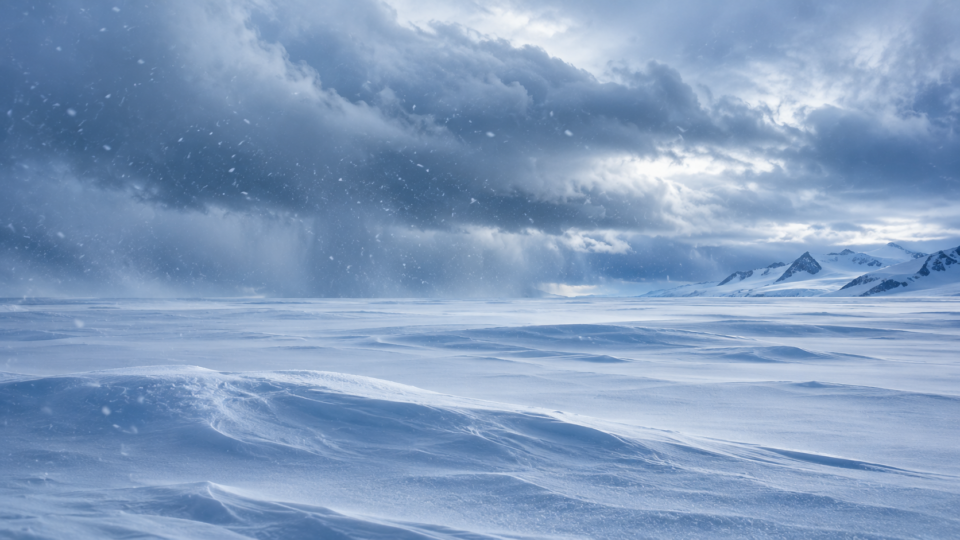
East Antarctica behaved differently. Although coastal and marine-based areas retreated and some regions thinned, the loss slowed markedly when retreat reached more land-based parts of the ice sheet.
Even under a modelled warming level of approximately 11°C, the huge eastern interior remained relatively stable over the experiment, contrasting with earlier projections of possible near-complete Antarctic collapse at very high warming levels.
The simulations still showed major Antarctic mass loss. The authors estimated that the Antarctic ice sheet as a whole contributed about six metres of sea-level equivalent under the most extreme long-term forcing. Relative stability is not the same as no damage.
Why warmer air can add more snow
One central explanation is that warmer air can hold more moisture. When atmospheric circulation carries that moisture over a cold, high-elevation ice sheet, it can fall as snow, adding mass to the ice.
This process does not automatically prevent melting. If temperatures rise enough, more precipitation may fall as rain, while warmer air and ocean water increase losses. The crucial question is whether snow accumulation rises faster than the processes removing ice.
In the East Antarctic simulations, accumulation increased by approximately 11.5% for each degree of local warming, compared with an increase of about 8.7% per degree in the processes responsible for ice loss.
West Antarctica showed the opposite balance. Its modelled losses increased by approximately 6.8% per degree, while accumulation rose by about 3.9% per degree. This difference helps explain why the two regions did not respond alike.
Although the researchers’ accumulation measure included snowfall and rainfall, East Antarctica’s high interior remained cold enough for precipitation to fall predominantly as snow even in the strongest warming experiments. Some areas of the eastern ice sheet thickened by hundreds of metres.
These are modelled sensitivities, not observations proving that present-day Antarctic snowfall is already increasing at exactly those rates.
Changes in winds reinforced the snowfall
More atmospheric moisture was only part of the mechanism. The model also simulated changes in circulation that moved additional moisture toward the Antarctic continent.
As the climate warmed, the belt of Southern Hemisphere westerly winds shifted closer to the pole. That movement altered moisture transport, favouring convergence and precipitation around East Antarctica’s margins and elevated interior.
For high-elevation regions of Antarctica, the researchers attributed approximately 62% of the increased precipitation to the warmer atmosphere’s moisture-holding capacity and around 38% to circulation changes.
The authors contrasted this with Greenland, where changes in atmospheric movement partially offset the increased moisture available in warmer air. Consequently, two large polar ice sheets exposed to global warming did not necessarily gain snowfall through the same processes.
Topography matters too. East Antarctica’s high plateau encourages moisture-bearing air to rise and produce precipitation while maintaining very low temperatures inland. The model’s evolving ice elevations helped capture feedbacks that a fixed-climate approach could miss.
Clouds supplied another protective influence
The study also investigated a less obvious factor: greater polar cloudiness. Clouds can change the energy reaching an ice surface, and their effect depends on season, cloud properties and the surrounding environment.
In these simulations, increased clouds reduced the sunlight reaching parts of the polar ice sheets. Lower incoming shortwave radiation helped moderate surface melting, particularly when combined with sustained snow cover.
The effect complemented the increase in precipitation, though the authors found the snowfall response particularly important for East Antarctica’s relative resilience.
Changes in sunlight are not a universal protection against warming. Clouds can also trap outgoing heat, and their overall climatic influence can vary. What matters here is the net effect represented by this particular coupled modelling framework.
Why older models predicted much greater losses
To examine the role of atmospheric changes, the researchers compared the coupled experiment with simplified ice-sheet simulations in which aspects of precipitation and solar radiation forcing were held fixed.
Under an extremely elevated carbon dioxide scenario, the Antarctic ice sheet lost around 25% of its initial modelled volume when those atmospheric changes were represented. A comparison without their full influence produced losses approaching 70%.
This contrast is a central result of the paper. It suggests that neglecting evolving snowfall and atmospheric circulation can greatly change estimates of the ice sheet’s long-term response.
It would be misleading, however, to treat 25% as a universal forecast of Antarctic loss or 70% as the consensus prediction being overturned. Both numbers arise from particular model configurations under extreme long-term forcing.
The authors also noted that differences in ice-sheet models themselves may contribute to disagreement with other research. Their findings therefore support improved coupled modelling, not the claim that all previous warnings about Antarctica were incorrect.
What the results do—and do not—mean for sea level
Higher resilience in East Antarctica does not erase the vulnerability of West Antarctica or Greenland. Even one metre of global mean sea-level rise would have far-reaching implications for coastlines, infrastructure and low-lying communities.
The approximately six metres of Antarctic sea-level equivalent associated with the study’s most extreme simulation is substantial. It describes the loss of grounded ice over an extremely long period, not a prediction that sea level will rise six metres by 2100.
For South Africa and other coastal countries, the research reinforces why long-term sea-level assessment must consider both atmospheric and ocean-driven processes. The paper did not model specific changes in sea level at Cape Town, Durban or any other city.
Related Research Today reporting on temporary carbon storage and delayed climate effects likewise illustrates that climate responses can unfold over time scales much longer than ordinary policy cycles.
Another study covered by Research Today on southern African extreme rainfall considered a different climate mechanism and time frame. Taken together, these stories show why regional impacts cannot be inferred simply from a global temperature average.
Important limitations of the 100,000-year experiment
The researchers used a complex coupled model, but it still simplified aspects of polar climate and ice dynamics. Its atmospheric component had a relatively coarse horizontal resolution of approximately 3.75 degrees, insufficient to resolve every coastal glacier or ocean circulation feature.
The model also did not explicitly represent all narrow ocean cavities beneath floating ice shelves. Processes such as hydrofracturing, rapid ice-cliff failure and interactions between warm subsurface water and particular grounding lines can substantially affect how quickly ice is lost.
Some of these processes were explored through additional sensitivity tests, but the complete range of possible ice-sheet behaviour cannot be captured in one model framework.
The technique accelerated the climate calculation relative to ice-sheet evolution. That is useful for investigating eventual long-term outcomes, but may affect the timing of intermediate changes and rapid events.
The simulations also kept carbon dioxide fixed at highly elevated levels for extraordinary periods. Actual emissions, atmospheric concentrations and temperature trajectories may rise, stabilize or fall in ways unlike these experiments.
And while the work provides physical explanations for regional differences, it does not independently verify them across every available coupled climate-and-ice-sheet model. Future comparisons at higher resolution are needed to understand which effects are robust.
Climate modelling uncertainty cuts both ways. Missing stabilizing effects can overstate projected loss in one experiment, while missing rapid ocean-driven or ice-dynamic processes can understate loss in another.
Why the finding changes the research question
The study demonstrates the importance of examining both how ice disappears and how it accumulates. A warmer world can increase melting and snowfall simultaneously, with the balance depending on geography, altitude, winds and surrounding seas.
That finding adds to a broader issue addressed by Research Today reporting on climate-model assumptions and future cooling demand: modelled outcomes depend on how the physical processes that matter are represented.
For future ice-sheet research, the most useful approach may be to combine improved atmospheric circulation, snowfall, ocean heat and glacier dynamics in high-resolution models that can test the same forcing conditions.
The result also cautions against framing Antarctica’s future as a simple choice between complete stability and inevitable immediate collapse. The continent includes distinct regions, each responding to multiple interacting processes.
Resilience is not immunity
In the new simulations, East Antarctica retained a surprisingly large share of its ice despite extreme and prolonged warming. Stronger snowfall, changes in wind-driven moisture transport and reduced sunlight under cloudier skies helped explain that result.
At the same time, West Antarctica experienced major losses and Greenland showed an even clearer vulnerability under sustained high warming. The experiment’s projected long-term contribution to sea level remained enormous in human terms.
The lesson is therefore not that warming will spare the world’s ice sheets. It is that accurate projections must capture the competing processes that remove ice and replenish it, particularly as those processes respond to one another over long periods.
Looking for studies on this topic? Use the Research Today Research Paper Finder to search scholarly research by topic, question, author or keyword.
Source Information
Study title: Atmospheric stabilization of the East Antarctic ice sheet under warming
Authors: Kyung-Sook Yun and Axel Timmermann
Journal: Nature Climate Change
Publication date: 30 October 2026
Study design: Long-term coupled Earth system and ice-sheet modelling using CESM1.2 and the Penn State University ice sheet–ice shelf model, with atmospheric feedback and sensitivity experiments
Sample or scope: Idealized 100,000-year simulations of Greenland and Antarctic ice sheets under pre-industrial carbon dioxide and five constant elevated CO₂ conditions, from 2× to 12× pre-industrial concentrations; additional uncoupled comparison tests
Key finding: Enhanced snowfall and atmospheric feedbacks limited long-term East Antarctic ice loss even at approximately 11°C modelled warming, while West Antarctica and Greenland suffered substantial losses; Antarctic ice loss still represented approximately six metres of global mean sea-level equivalent in the most extreme experiment