








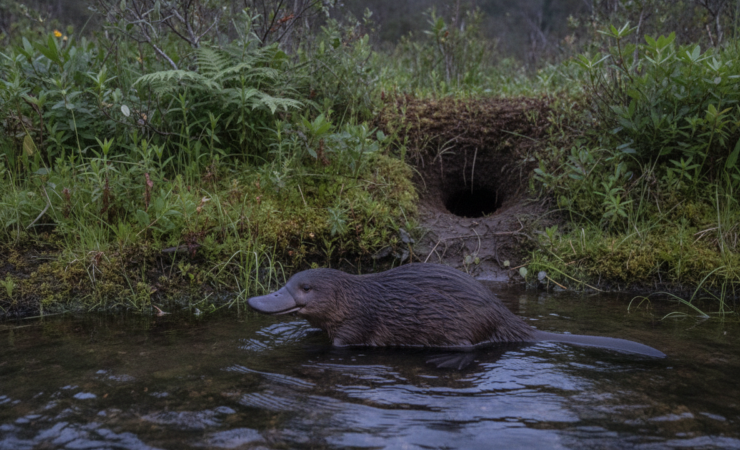
Tasmanian platypuses appear to conduct the core of their breeding season in November and December, around two to three months later than populations on mainland Australia, according to a detailed field study combining reproductive ultrasound, hormone measurements, sperm detection and long-term electronic monitoring.
The findings sharpen an unusually uncertain part of platypus biology. Scientists have long known that reproduction occurs later at more southerly latitudes, but precise evidence from wild Tasmanian animals has been limited. The new work matters beyond natural history because the timing of breeding determines when females may be occupying nesting burrows and when disturbance near waterways could carry the greatest conservation risk.
The researchers conclude that current advice to avoid potentially disruptive activities such as earthworks around waterways from December to April should be extended to include November. Their evidence suggests that reproductive activity is already well underway during that month.
Following reproduction from anatomy to behaviour
The study drew on fieldwork in the Inglis Catchment in north-west Tasmania between August 2011 and August 2013. Researchers captured 154 individual platypuses, including 63 adult females and 76 adult males, as well as smaller numbers of juveniles and subadults. Twelve animals were recaptured.
Rather than relying on a single marker of reproduction, the team assembled several independent lines of evidence. Abdominal ultrasonography was used to examine reproductive organs in 61 animals. Blood samples were collected for assays of progesterone, testosterone and 17β-oestradiol. Cloacal swabs were examined microscopically for sperm. A separate in-stream antenna system recorded the movements of microchipped animals over 548 days.
This multi-method design is important because each measure captures a different stage of the reproductive cycle. Changes in testis size and sex hormones can reveal physiological preparation for breeding, sperm indicates reproductive readiness, ovarian follicles provide direct anatomical evidence in females, and movement patterns can reveal behaviour consistent with mating and subsequent use of nesting burrows.
Male reproductive anatomy peaked in spring
The researchers successfully imaged the left testis in 35 platypuses. For 24 animals, images in two perpendicular planes allowed testis volume to be calculated. Testis volume differed significantly across sampling months, with a one-way analysis of variance producing F(4,19) = 4.83 and p = 0.011. Post hoc comparisons showed that testes measured in October were significantly larger than those measured in January.
The timing fits a reproductive cycle that builds through spring and then declines after the main breeding period. Male serum testosterone followed a seasonal pattern as well, while female progesterone concentrations were lowest during autumn and increased through spring.
Microscopic evidence added another layer. Sperm were detected in cloacal swabs from eight adult males, with one male testing positive on two separate captures. Positive detections occurred from October through January: sperm were found in 3 of 10 adult male captures in October, 4 of 11 in November, 1 of 7 in December and 1 of 8 in January. No sperm were detected in the other months represented by 45 samples.
That distribution does not mean every male was reproductive at the same time, but it places male reproductive readiness squarely around the late-spring and early-summer period identified by the other measures.
Female ultrasound offered rare evidence
Female reproductive anatomy is especially difficult to monitor in wild platypuses. Of 23 adult females examined by abdominal ultrasound, the researchers identified structures consistent with an active left ovary in two animals, one captured in November and the other in December 2012. The structures contained features consistent with ovarian follicles at different stages of development.
For the November female, the ovarian structure measured approximately 10.8 by 10.7 millimetres. In the December female it measured approximately 11.3 by 16.5 millimetres. Both animals were sampled again later, and progesterone and oestradiol concentrations were lower at their second captures. In one female, progesterone fell from 4.05 ng/mL in late November to 1.11 ng/mL in May. In the other, it declined from 3.44 ng/mL in mid-December to 2.51 ng/mL the following August.
The low number of visible ovaries should not be interpreted as evidence that only two females were reproductively active. The authors explain that the active ovary is enlarged for a relatively short period and that females may retreat into burrows around egg laying. Outside that window, the ovary is only a few millimetres wide and difficult to distinguish from surrounding tissue during brief field ultrasound examinations.
More than 2,000 electronic observations revealed a behavioural pattern
The most revealing evidence came from remote monitoring. An in-stream antenna positioned in a creek between two farm dams recorded microchip detections as animals moved through the site. Across 548 days, the system logged 2,117 observations involving eight platypuses.
Three resident females generated more than 500 observations each, while one resident male was recorded 214 times. The male’s activity was concentrated particularly strongly in November and December.
In five of six examined female-year patterns, researchers observed a sequence that was consistent with breeding and nesting behaviour. Females first showed frequent and irregular movements during and shortly after the period of high male activity. This was followed by a 12 to 30 day period with very few detections. Afterwards, the females returned to a more moderate and regular movement pattern, often around dusk and dawn.
The authors interpret this combination of male presence, irregular female activity and subsequent absence as strong evidence that breeding activity occurs primarily in November and December. The pattern is particularly useful because it links physiological evidence from captured animals with repeated behaviour observed remotely in the wild.
Tasmania appears to run two to three months later
Previous work on mainland Australian platypuses has generally placed the breeding season between August and October. In the Tasmanian study, the seasonal changes in testis size and reproductive hormones were broadly similar in shape, but their peaks occurred later, from October through December. Sperm were detected only from October to January, and the two ultrasound observations of ovarian follicles occurred in November and December.
Taken together, the evidence indicates a shift of roughly two to three months relative to mainland populations. That difference is biologically plausible given the species’ broad latitudinal range and earlier observations that breeding becomes later toward the south.
Importantly, the study does not suggest a single exact mating date for all Tasmanian platypuses. Reproduction is a seasonal process and individuals can vary. One female, for example, showed an oestradiol result in February that could indicate unusually late ovulation, although the authors caution that it might also have been an aberrant measurement.
Why one month matters for conservation
The practical implication is straightforward. If females are mating and beginning the reproductive sequence in November, disturbance around waterways during that month could overlap with a sensitive period that existing December-to-April recommendations do not fully cover.
Earthworks, bank disturbance and other activities near water bodies can potentially affect burrows or alter the local environment used by breeding animals. The researchers therefore recommend extending the precautionary period to begin in November.
The result also illustrates why region-specific reproductive data matter. A management calendar derived from mainland populations can miss meaningful biological differences in Tasmania. For a species with a geographically variable breeding season, conservation timing may need to reflect local ecology rather than a single national schedule.
Important limitations
The study combines unusually diverse evidence, but several limitations temper the conclusions. The field data were collected between 2011 and 2014, even though the paper was published in 2026. Environmental conditions and population behaviour can vary between years, so contemporary monitoring would help establish whether the timing remains consistent.
Some analyses also involved modest samples. Testis volume could be calculated for 24 animals, and active ovaries were identified in only two adult females. The remote-monitoring interpretation relied heavily on four resident animals at one monitoring site, although additional tagged animals were detected occasionally.
The behavioural sequence is strongly suggestive of breeding and nesting but does not directly record mating, egg laying or hatching. Likewise, hormone concentrations and anatomical changes are indicators of reproductive state rather than direct measures of reproductive success.
These constraints make replication across additional Tasmanian catchments valuable. Even so, the convergence of anatomy, hormones, sperm detection and behaviour gives the November-to-December conclusion considerably more weight than any single measure would provide alone.
Source Information
Study: “When do Tasmanian platypuses breed? Anatomical, physiological and behavioural evidence”
Authors: James Macgregor, Patricia Fleming, Sarah Munks, Joanne Connolly, Carly Holyoake, Ian Robertson, Rebecca Donaldson, Rebecca Lonsdale and Kristin Warren
Journal: Australian Journal of Zoology
Publication: 21 September 2026, Volume 74, Issue 5
DOI: 10.1071/ZO26006