







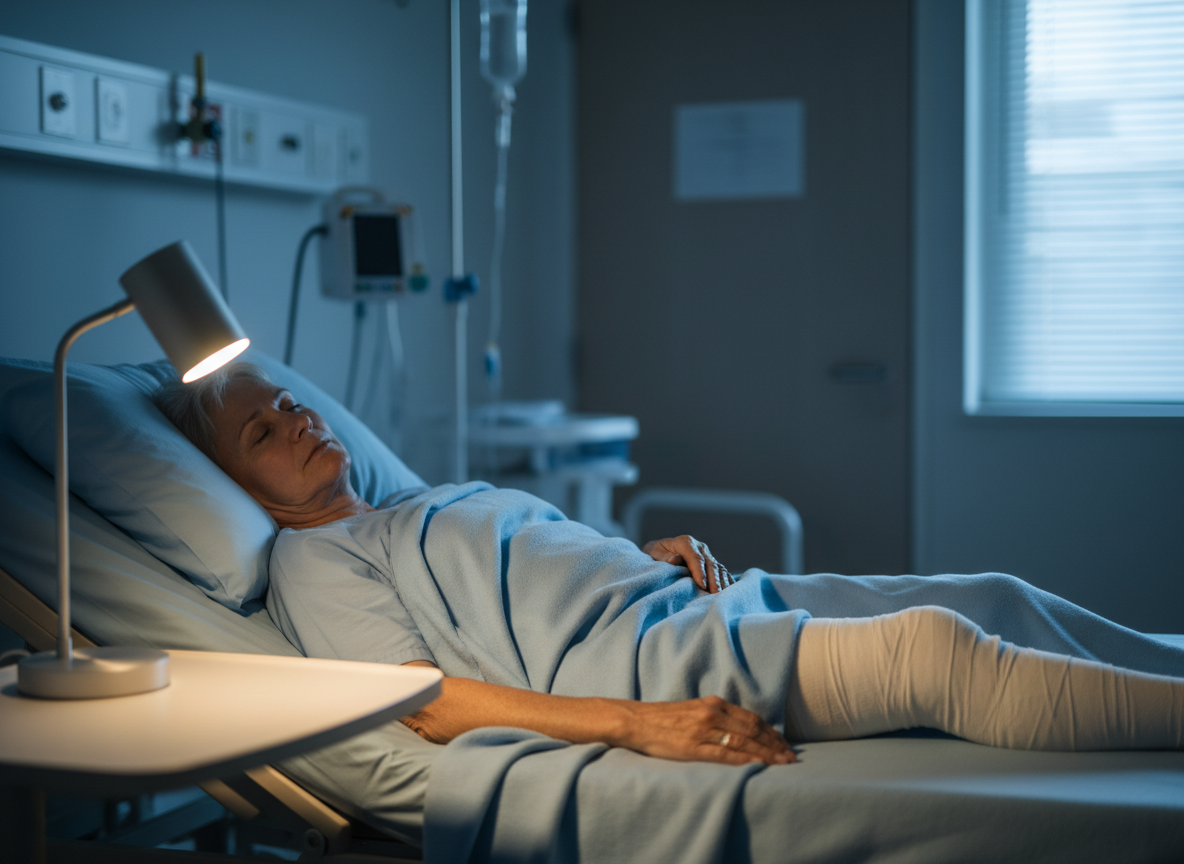
Sleep before surgery may offer clinicians an early clue about how well patients recover after knee replacement.
A prospective study published in Scientific Reports on 24 September 2026 followed 70 patients undergoing primary total knee arthroplasty and found that poorer preoperative sleep quality predicted worse postoperative sleep and greater pain.
Poorer sleep was also associated with reduced knee range of motion and lower independence in daily activities 90 days after surgery.
The findings do not prove that improving sleep before surgery will improve recovery. However, they suggest that a simple preoperative sleep assessment could help identify patients who may need additional support during rehabilitation.
Researchers followed patients before and after knee replacement
The study included 70 patients undergoing primary total knee arthroplasty at a university hospital between February 2023 and December 2024.
Total knee arthroplasty is commonly used to treat severe knee disease when pain and impaired function can no longer be managed adequately with less invasive treatment.
Recovery can vary substantially between patients, which makes identifying potentially modifiable predictors of postoperative outcomes clinically useful.
The researchers assessed participants before surgery and again 30 and 90 days afterwards.
They measured sleep using the Pittsburgh Sleep Quality Index, pain using a Visual Analog Scale, knee range of motion using goniometric measurement, and independence in activities of daily living using the Modified Barthel Index.
Sleep before surgery predicted sleep after surgery
Preoperative sleep quality was a strong predictor of postoperative sleep quality.
In the researchers’ regression model, the association had a beta coefficient of 0.970 and was statistically significant at p<0.001.
Because higher Pittsburgh Sleep Quality Index scores indicate poorer sleep, the finding means that patients who entered surgery with worse sleep tended to continue experiencing poorer sleep during recovery.
This matters because surgery itself can disrupt sleep through pain, changes in mobility, hospital routines and medication use.
Poorer preoperative sleep also predicted greater pain
The researchers also found that preoperative sleep quality significantly predicted postoperative pain intensity.
The regression coefficient was 0.091, with a p value of 0.046.
This association is consistent with a growing body of research linking sleep disturbance and pain sensitivity.
Sleep and pain can influence one another in both directions. Pain can make it difficult to sleep, while disrupted sleep can alter pain perception and make discomfort more difficult to tolerate.
The new study cannot establish which biological mechanisms produced the observed association, but it adds prospective evidence in patients undergoing knee replacement.
The relationship extended to physical recovery
Sleep was not only related to pain.
At the 90-day assessment, poorer sleep quality was negatively correlated with knee range of motion and activities of daily living.
In practical terms, patients with worse sleep tended to show poorer physical movement and lower functional independence.
Range of motion is particularly important after knee replacement because rehabilitation aims to restore the patient’s ability to bend and straighten the knee sufficiently for everyday movement.
Activities of daily living capture a broader aspect of recovery by assessing how independently a person can manage ordinary tasks.
Sleep may be a useful preoperative screening measure
The practical appeal of sleep quality is that it can be assessed before an operation using a standardised questionnaire.
If poor sleep identifies patients at greater risk of pain or slower functional recovery, clinicians may be able to use it alongside other preoperative information when planning care.
The authors suggest integrating routine sleep assessment into perioperative care and considering sleep-focused nursing interventions alongside pain management and rehabilitation.
That recommendation should be interpreted as a direction for clinical practice and further research rather than proof that treating sleep problems will necessarily improve surgical outcomes.
The study cannot prove that poor sleep caused poorer recovery
The research was prospective, which is useful because sleep was assessed before later recovery outcomes were measured.
However, it was an observational cohort rather than a randomised trial.
This means the study can identify predictive relationships but cannot establish that poor sleep itself caused greater pain or poorer function.
Other characteristics could contribute to both sleep disturbance and recovery.
For example, pre-existing pain, psychological factors, general health, medication use and other conditions can affect both sleep and postoperative outcomes.
The sample was relatively small
The study included 70 patients from a single university hospital.
A sample of this size can identify statistically significant relationships, but estimates may be less precise than those from larger multicentre studies.
Results from one hospital may also not generalise perfectly to patients treated in other healthcare systems or rehabilitation settings.
Larger studies would help determine how consistently preoperative sleep predicts recovery across different patient groups.
Sleep was measured mainly through a questionnaire
The Pittsburgh Sleep Quality Index is a widely used measure, but it reflects participants’ reported experience of sleep rather than directly measuring brain activity or movement throughout the night.
Future studies could combine questionnaires with objective measures such as actigraphy or polysomnography to examine whether specific aspects of sleep are especially important for recovery.
Randomised trials could then test whether improving sleep before surgery actually changes pain, mobility or independence afterwards.
The findings add sleep to the wider picture of surgical recovery
Knee replacement recovery depends on many interacting factors.
Surgical technique, rehabilitation, baseline mobility, pain, age, general health and psychological wellbeing can all influence outcomes.
The new findings suggest that sleep deserves attention within that broader picture.
A short sleep assessment before surgery is comparatively simple and non-invasive.
If future trials show that sleep interventions improve recovery, sleep could become a practical target in prehabilitation programmes designed to prepare patients before major joint surgery.
Source Information
Study Title: Preoperative sleep quality as a predictor of postoperative pain, function, and recovery after total knee arthroplasty: a prospective cohort study
Authors: Melike Durmaz, Ayyüce Tuba Koçak, Emine Selda Gündüz, Egemen Odabaşı, Ebubekir Eravşar, Bahattin Kerem Aydın and colleagues
Journal: Scientific Reports
Published: 24 September 2026
Sample: 70 patients undergoing primary total knee arthroplasty at a university hospital between February 2023 and December 2024.
Method: Prospective cohort study with assessments before surgery and at 30 and 90 days after surgery. Measures included the Pittsburgh Sleep Quality Index, Visual Analog Scale, goniometric range of motion and Modified Barthel Index. Analyses included Friedman tests, Bonferroni-adjusted comparisons, correlations and multiple regression models.
Main finding: Preoperative sleep quality significantly predicted postoperative sleep quality (β=0.970, p<0.001) and pain intensity (β=0.091, p=0.046). Poorer sleep was also negatively correlated with range of motion and activities of daily living at 90 days.
DOI: 10.1038/s41598-026-70578-3