








Physical education is often expected to do more than improve fitness. Schools also look to sport and movement lessons to teach cooperation, confidence, emotional control and resilience. A newly published research synthesis suggests that these benefits are plausible, but the evidence is considerably less settled than the number of studies might suggest.
Researchers reviewing 74 reports representing 70 distinct trial families found positive average psychological outcomes in a broad statistical analysis. Yet their more tightly documented evidence for core social-emotional skills rested on just three independent trial families. Its confidence interval was so wide that it could not establish a reliable average improvement. The distinction matters for teachers and policymakers who may be tempted to treat any physical education programme as a proven social-emotional intervention.
The systematic review, published in Frontiers in Psychology on 7 October 2026, examined interventions delivered within primary-school physical education. Its central message is not that PE lacks psychological value. It is that outcomes, teaching approaches and study quality vary too much to promise the same benefit from every lesson.
Why the psychological promise of PE needs testing
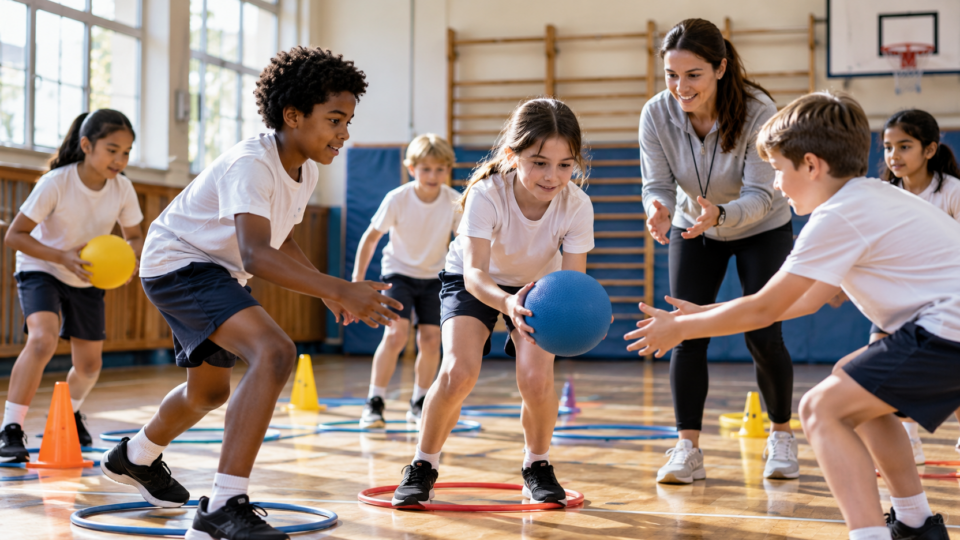
A school gymnasium provides a concentrated social environment. Children take turns, cope with losing, negotiate rules, work with teammates and receive immediate feedback on what they can do. Those experiences can create opportunities to practise patience, cooperation and emotion regulation. They do not automatically demonstrate that those abilities improve outside the lesson.
A pupil who enjoys a game more may feel more motivated to attend PE, but this is different from learning to manage anger or show empathy in the classroom. Similarly, feeling competent at a sport is not the same as having general self-confidence or stronger mental health. Treating all these outcomes as interchangeable can inflate what research appears to show.
The review therefore separated core social-emotional competencies, such as self-control, emotion regulation, empathy, cooperation and relationship skills, from adjacent psychological outcomes, including enjoyment, motivation, perceived competence, self-concept and wellbeing. The categories are analytical choices rather than universally agreed boundaries, but they make the claims more specific.
There is related evidence that school environments and adult behaviour matter for social-emotional development. For context, Research Today previously covered a meta-analysis linking teachers’ and students’ social-emotional skills. That study examined associations across classrooms; the new review asks a different question about interventions embedded specifically in physical education.
Researchers screened hundreds of records and separated overlapping studies
Lebin Li, Yao Huang, Di Zhang and Jiaqing Meng searched Web of Science, ERIC, PsycINFO and PubMed for English-language peer-reviewed research published between January 2000 and 31 May 2026. Eligible participants were primary-school children, and the interventions had to be delivered within PE or have a clearly identifiable PE component.
The researchers initially assembled 924 records. After removing 80 duplicates and one erratum or related version, they screened 843 records. They sought 131 full-text reports, could not retrieve 12, assessed 119 and excluded 45. The resulting review included 74 reports from 70 trial families.
That last distinction is crucial. Several papers can come from one intervention, and one trial can report numerous psychological measures at multiple times. Counting every publication or statistical result as an independent experiment would create false precision. The researchers linked related reports into trial families and used multilevel meta-analysis with cluster-robust uncertainty estimates to account for dependence between results.
The evidence covered varied PE approaches, including cooperative games, dance, yoga, exergaming, mastery-oriented instruction, responsibility-based teaching and enriched movement programmes. Comparisons included usual PE, alternative curricula and minimal provision. Randomized and nonrandomized controlled studies were considered, while uncontrolled before-and-after designs and short-term experiments were handled separately.
The team also distinguished analyses whose sampling uncertainty could be supported by reported study information from broader analyses that required additional assumptions about clustered classes or other missing variance details. This choice produced two useful views of the evidence: a narrower but very small source-informed set, and a larger set with more assumptions.
The most directly supported evidence was much smaller than 70 trials
The source-informed controlled analysis of core social-emotional competencies contained five effect estimates from three independent trial families. Its pooled standardized effect was Hedges’ g = 0.947, with a 95% confidence interval from -0.774 to 2.667. The unadjusted p-value was 0.141, rising to 0.424 after the study’s correction for multiple testing.
The positive point estimate looks large. But its interval includes negative values, no change and very substantial positive values. With only three contributing families, the analysis cannot tell readers that a typical PE intervention produces a large improvement in empathy or self-control. The model’s prediction interval, from -2.387 to 4.280, was wider still, although prediction intervals themselves are unstable with so few independent studies.
The adjacent psychological analysis drew on 13 effects from five trial families. It estimated g = 0.215, with a 95% confidence interval from -0.386 to 0.817 and a Holm-adjusted p-value of 0.424. Measures included motivation, enjoyment, physical self-perceptions, confidence and wellbeing. Again, the estimate pointed in a positive direction but was not precise enough to establish a dependable average benefit.
Combining the two source-informed groups produced 18 effects from eight families and a pooled estimate of g = 0.421. Its 95% confidence interval was -0.001 to 0.843, narrowly including zero, with p = 0.0504. The authors did not interpret this borderline result as definitive confirmation. Nor did they find persuasive evidence that core and adjacent psychological outcomes differed reliably in their response to PE.
A broader analysis found a positive average, with important qualifications
When the researchers expanded the controlled analysis to include studies for which they could reconstruct or assume missing uncertainty information, the evidence grew to 126 effects from 28 trial families. The average became g = 0.381, with a 95% confidence interval of 0.135 to 0.627 and p = 0.004.
That result supports a positive average across the included controlled comparisons. It should not be discarded merely because the larger model needed additional assumptions. But neither should it be presented as independent confirmation of the smaller analysis: the two models share studies, and the broader model includes outcomes and designs with different levels of reporting completeness.
In the broader model, core outcomes yielded g = 1.024, with a confidence interval from -0.074 to 2.122, while adjacent outcomes yielded g = 0.359, with an interval from 0.102 to 0.615. The first remained uncertain; the second showed a positive average under the broader model’s assumptions.
The authors tested how much their findings depended on assumed intraclass correlations, a parameter relevant when children are taught in the same class or school and their results are not statistically independent. Changing this assumption from 0.01 to 0.10 barely shifted the broader pooled estimate, from 0.384 to 0.379. Omitting three reports with documented source ambiguities left 95 effects from 25 families and produced g = 0.338, with a 95% confidence interval from 0.142 to 0.534.
These checks suggest the positive average is not entirely dependent on one particular clustering assumption or those three reports. They do not resolve other possible biases, the diversity of interventions or uncertainty about what an average standardized effect means for an individual school.
Why a positive average does not predict what happens in a particular classroom
The studies differed in what they taught, what they measured and how they were implemented. A cooperative learning programme with explicit reflection on conflict is not psychologically identical to a dance programme designed to improve enjoyment or a games-based curriculum aimed at movement competence.
Statistical heterogeneity was substantial. The authors reported approximate I-squared values of 87.42% for core outcomes and 88.97% for adjacent outcomes in the source-informed models. These figures describe how much of the observed variation may reflect differences beyond sampling error under the fitted models. They are not percentages of children helped or harmed.
For the broader controlled analysis, the model-based prediction interval stretched from -0.913 to 1.676. This range illustrates why a positive overall mean does not guarantee a positive effect in every comparable setting. It should also be read cautiously because prediction intervals depend on modelling assumptions and the composition of the evidence base.
One example in the source research is especially revealing: a programme could increase perceived teacher support while producing an unfavourable contrast in physical competence. Another intervention could increase enjoyment while lowering vigorous physical activity. A desirable change in one dimension is not proof of gains across all dimensions.
What about studies without control groups?
The reviewers did not simply add every before-and-after change to the controlled results. They analysed 30 uncontrolled change effects from six families separately. That analysis yielded g = 0.128, with a 95% confidence interval from -0.377 to 0.632 and p = 0.544.
Uncontrolled designs cannot reliably separate intervention effects from normal maturation, changes elsewhere in school or repeated exposure to a questionnaire. A child might report higher confidence at the end of a term for reasons unrelated to a particular PE lesson. This is why the absence of a comparison group changes the strength of the conclusion, even when the same outcome scale is used.
Short-term designs were also kept separate. A burst of enjoyment immediately after an activity may be valuable in its own right, but it does not establish durable improvements in empathy, emotional regulation or wellbeing months later.
The review’s own methods reveal limits to certainty
Although the study applied sophisticated statistical techniques and made its data and analysis code available, the authors documented important methodological constraints. The review was not prospectively registered, and contemporaneous documents recording its original planned decisions could not be recovered. Some outcome definitions and analysis rules evolved as the work progressed, so later decisions cannot be treated as if they were fixed before the evidence was examined.
One author performed the initial screening, extraction, coding and methodological appraisal. All four authors subsequently reviewed the decisions, but this was not fully independent duplicate review. That leaves greater scope for linked errors than a process in which two independent reviewers perform each stage and resolve disagreements.
The search included English-language studies only. Some historical search details could not be fully reconstructed, although the team documented a later PubMed rerun and its differences from the original export. Certain original reports had inconsistent sample denominators, baseline imbalances or incomplete variance information. The authors did not conduct a formal GRADE certainty assessment.
The very small number of independent families in the narrow models also limits attempts to identify publication bias. Exploratory small-study diagnostics were inconclusive, not evidence that missing or selectively reported studies are absent. In other words, even an elaborate statistical model cannot manufacture independent trials that were never conducted or adequately reported.
What teachers and school leaders can use now
For a school deciding how to design PE, the findings support a more specific approach than simply adding movement time and assuming emotional development will follow. If cooperation is the goal, activities need roles that require genuine cooperation, feedback on how children worked together and opportunities to reflect on what happened. If self-control is the goal, pupils need supported opportunities to practise responses to frustration and conflict.
Those are plausible instructional principles drawn from the study’s theoretical discussion, not interventions the review proved universally effective. The researchers could not reliably rank named teaching models or isolate the psychological mechanisms responsible for improvement.
Evaluation should also match the intended goal. Enjoyment questionnaires may be appropriate for measuring enjoyment, but they should not stand in for observed empathy. Confidence in catching a ball is not interchangeable with broader self-esteem. Teachers, peers and independent observers may provide useful perspectives alongside pupils’ own reports.
Schools also need to document what actually happened during the programme. Duration, participation, teaching quality, adherence to the planned lesson and adaptations for different learners can help explain why one implementation succeeds while another does not. Without these details, a weak result could mean either that the proposed approach does not work or that it was never delivered as intended.
The question is not whether PE matters, but which outcomes it can reliably deliver
Physical education has clear educational value as a setting for movement, games, skill development and shared experience. The new review addresses a narrower question: how confidently can schools claim that PE interventions improve particular psychological outcomes?
Its answer is measured. Across a broader controlled evidence base, average psychological effects were positive. Yet the more directly documented analyses of core social-emotional skills and adjacent outcomes were too sparse and imprecise for strong universal claims. Different lessons may help different children in different ways, and the field needs better independent trials to identify which combinations are dependable.
The next generation of research should specify the psychological skill being targeted, measure it with suitable instruments, document how teaching was delivered and follow children long enough to test whether gains persist outside the gym. Until then, PE can be designed with social and emotional goals in mind, but the research does not justify promising that those goals will automatically be achieved.
Source Information
Study: Li, L., Huang, Y., Zhang, D. and Meng, J. “Psychological outcomes of primary-school physical education interventions: a systematic review and multilevel meta-analysis.”
Journal: Frontiers in Psychology, Volume 17, Sport Psychology.
Published: 7 October 2026.
DOI: 10.3389/fpsyg.2026.1962805.
Study design: Systematic review and multilevel meta-analysis of 74 reports from 70 trial families of primary-school physical education interventions, with separate source-informed controlled, broader controlled, uncontrolled before-and-after and short-term analyses. Searches covered January 2000 to 31 May 2026.