




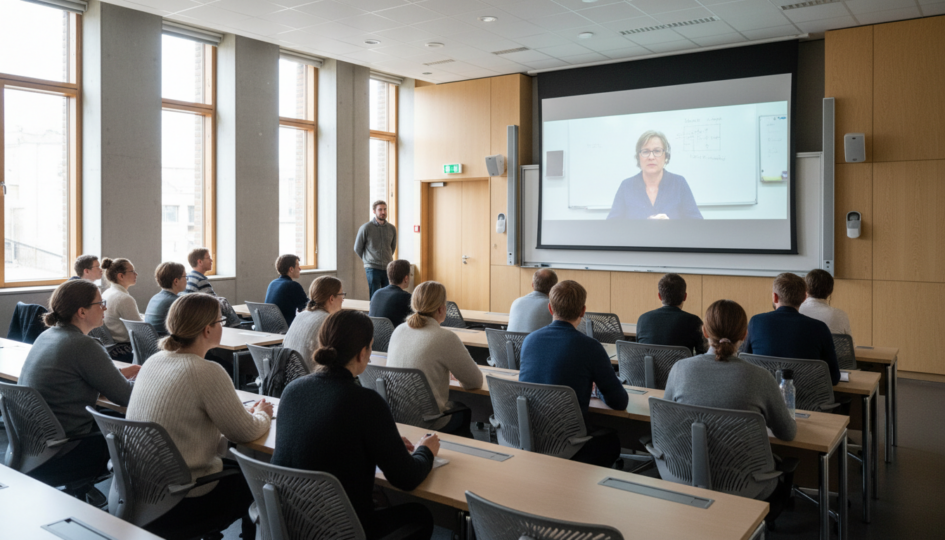
The lecturer was there, but not always in the same room
Students attending university lectures by video link reported learning less than when the lecturer was physically in their classroom, even though both groups were sitting in university teaching rooms rather than studying from home.
The finding comes from a Swedish study of 282 social work students taught across two campuses. It offers a more precise picture of hybrid education than the familiar comparison between classroom teaching and students watching from their bedrooms.
Researchers found that perceived learning was markedly higher when the lecturer was physically present. Yet the students’ overall satisfaction depended on a wider combination of concentration, social connection, technical reliability and the quality of remote teaching.
That distinction matters because universities increasingly connect campuses to widen access without duplicating entire teaching teams. A working video connection alone does not guarantee an equivalent experience.
A difference of 1.51 points on a five-point scale
The study asked students to rate how much lecture content they believed they had absorbed under two conditions: with the lecturer in their classroom and with the lecturer speaking from the other campus.
The average score for perceived learning with the lecturer physically present was 4.21 out of five. For sessions delivered remotely, the average was 2.70.
That is a difference of 1.51 points on the same rating scale, a substantial gap in students’ own assessment of their learning.
The paper reports a standardised effect size of 1.24 for this comparison. That is a large difference by conventional statistical benchmarks, although it measures reported experience rather than independently tested knowledge.
Students at both campuses showed the same general preference for the lecturer’s physical presence. The pattern therefore could not simply be explained by one campus having unusually dissatisfied students.
Importantly, this does not establish that students actually learned 36% less, or any other percentage. A five-point self-report score is not an examination mark, and converting the difference into a learning-loss percentage would be misleading.
How the two-campus system worked
The research was conducted in an undergraduate social work programme at Mälardalen University in Sweden. Students attended classes in Eskilstuna or at the smaller campus in Karlshamn.
During a typical lecture, one campus shared a room with the lecturer. Students at the other campus watched and participated through a live videoconferencing connection.
Both groups could ask questions in real time. The lecturer could see the two classrooms and respond to raised hands, rather than delivering a prerecorded video.
Across the study period, the same lecturer taught the relevant sessions at both locations. The lecturer was physically based at Eskilstuna for approximately 80% of lectures and at Karlshamn for the other 20%.
The satellite campus also had a locally based senior lecturer present during most sessions. That teacher helped facilitate discussion, supported students and could draw attention to questions.
Practical seminars were generally conducted separately on each campus, with local teaching support. The remote component was therefore part of a broader teaching system, not the students’ only contact with academic staff.
This arrangement makes the comparison unusually useful. Both groups travelled to campus and participated in an organised classroom setting, while the physical location of the main lecturer varied.
Who took part in the research
Researcher Sylvia Olsson collected questionnaire responses across three consecutive semesters: spring 2025, autumn 2025 and spring 2026.
A total of 282 students completed the study questionnaire. Of these, 214 were based at Eskilstuna and 68 at Karlshamn.
Students were recruited from the social work programme, so the results reflect a particular subject, institution and teaching structure rather than a random sample of university students internationally.
Across the three collection periods, 384 eligible enrolments were counted and 282 questionnaires were returned, an overall response rate of 73.4%.
Response rates varied substantially by semester, falling from 94.7% in the first collection to 67.0% and then 38.3%.
Because the surveys were anonymous, the researcher could not establish whether any individual student responded in more than one semester.
This is a useful limitation to keep in mind. The 282 questionnaires cannot automatically be treated as 282 independently tracked students with measured progress over time.
Students were asked about seven aspects of teaching
The questionnaire covered overall satisfaction, perceived learning with the lecturer present, perceived learning with the lecturer remote, ability to focus, community between campuses and technical problems.
It also asked how much technical difficulties affected learning. The measures were deliberately brief and tailored to the specific hybrid teaching arrangement.
Most responses used five-point scales. Higher scores generally indicated a more positive experience, although some questions used reverse coding.
The researcher reviewed the questionnaire with teaching staff and piloted it with ten other students before using it in the main study.
However, the instrument was not subjected to a full formal psychometric validation. That limits how confidently its individual questions can be interpreted as precise measures of complex experiences.
Statistical analyses compared the campuses, examined correlations and used a regression model to investigate which reported experiences were associated with overall satisfaction.
The satisfaction result was more complicated
Across the entire sample, the average overall satisfaction score was 2.89 out of five, suggesting mixed rather than overwhelmingly positive experiences.
Students at the smaller satellite campus initially reported higher overall satisfaction than those at the main campus.
That may sound surprising because the satellite students experienced the lecturer remotely during most sessions. It shows why satisfaction cannot be reduced to the amount of face-to-face contact.
Once the analysis accounted for teaching-related and technical experiences, the campus difference in satisfaction was no longer statistically significant.
The strongest independent predictors included perceived learning during remote sessions, ability to concentrate, sense of community and technical difficulties.
Together, the model’s predictors explained 57.4% of the variation in reported satisfaction. That figure describes the fit of the statistical model, not a causal share of satisfaction created by particular interventions.
The result suggests that students can value the overall organisation and support of a course while still feeling they absorb less material during remote-lecturer sessions.
Technology is not just a background detail
Technical problems were common in the survey. On a scale where higher values indicated more frequent difficulties, the average score was 3.95 out of five.
The perceived impact of technical problems on learning averaged 3.38. These responses indicate that technical reliability was a visible part of students’ day-to-day experience.
Even brief audio interruptions can matter when a lecturer is explaining unfamiliar concepts, responding to questions or moving between discussion and presentation.
A classroom can have a large screen and a stable connection most of the time yet still struggle with microphone placement, camera angles or delayed interaction.
The study does not identify a single piece of equipment as the cause of poorer experiences. It instead points to the broader importance of dependable communication during remote teaching.
For university managers, this means that technology spending should be judged by the learning interaction it enables, not merely whether a lecture can be transmitted.
Why concentration and belonging matter
Students reported difficulty maintaining focus and building a sense of community across the two campuses.
The average sense-of-community score was 2.17 out of five, comparatively low alongside the other reported measures.
Students may be physically surrounded by classmates while still feeling disconnected from the lecturer or the wider group participating at the other location.
Hybrid classrooms therefore face two distinct tasks: maintaining attention to the academic content and creating a shared learning environment across physical spaces.
The research suggests these experiences matter for satisfaction even after other factors are considered.
However, the study did not experimentally test whether a particular discussion format, seating arrangement or teaching technique would improve concentration or belonging.
Those are plausible directions for improvement, but they remain ideas to test rather than proven solutions from this dataset.
A lesson for multi-campus universities
Universities serving geographically dispersed communities often face a difficult choice between widening access and maintaining a rich classroom experience.
Connecting campuses allows students to remain near home while participating in courses that might otherwise be available only in a larger city.
The Swedish example illustrates the value of that access model. Students in a smaller location could attend the same core lectures without relocating.
At the same time, the results caution against assuming that equal access to a video feed produces equal perceptions of learning.
An effective multi-campus system may need deliberate lecturer interaction with both rooms, local teaching support, reliable audio and opportunities for students to participate meaningfully.
These elements are not interchangeable. A local facilitator may help with discussion, while technical reliability may determine whether the lecturer can respond clearly to questions.
The paper supports treating hybrid teaching as a complete educational design problem rather than a simple broadcasting exercise.
What the findings could mean in South Africa
The research was conducted in Sweden, and its findings cannot be assumed to describe South African students or institutions directly.
Nevertheless, South African universities also serve students across different locations and face pressure to expand access while managing teaching resources.
A multi-campus lecture may be attractive when specialist lecturers cannot travel between sites for every class.
The study offers a useful set of questions for evaluating such arrangements: do remote-campus students feel they understand the material, can they concentrate, do they experience technical interruptions, and do they feel part of the same academic community?
Those questions go beyond asking whether a classroom is connected to the internet or whether a lecturer delivered the scheduled material.
They also suggest that student satisfaction surveys should distinguish between a course’s overall organisation and students’ confidence in what they actually learned.
Research Today has previously reported on how students use technology for learning, where the design of the learning experience also mattered more than simple technology exposure.
The distinction between satisfaction and learning
One of the study’s most important contributions is the separation of two outcomes that are often treated as if they were the same.
Satisfaction asks whether students feel positive about the teaching experience as a whole. Perceived learning asks how much they believe they understood or retained.
A student may appreciate the convenience of a satellite campus, the support of a local teacher and the organisation of a course while still finding remote lectures harder to follow.
Conversely, a demanding in-person session may feel less comfortable but still be judged highly effective for understanding a difficult topic.
Neither response is necessarily contradictory. The measures capture different dimensions of education.
The study does not show whether actual examination performance followed the same pattern as perceived learning. That would require objective assessments linked to the teaching conditions.
Related Research Today coverage of AI tutors used by South African student teachers similarly illustrates why engagement and the quality of learning support should be assessed separately.
What the study cannot prove
This was an observational questionnaire study, not a randomised trial assigning students to teaching conditions.
Students reported their own perceptions, and the study did not independently test what they had learned in each type of lecture.
The same students may have answered surveys in multiple semesters, but anonymous collection prevented researchers from tracking repeated participation.
Response rates declined across the study period. If students who chose not to respond had systematically different experiences, the overall estimates could be affected.
The sample was limited to one Swedish university’s social work programme. Different disciplines, class sizes, teaching cultures or technical systems could produce different results.
The locally based teacher at the satellite campus was also part of the teaching environment. That makes it difficult to isolate the effects of lecturer location from every other aspect of support.
Although regression can identify associations while accounting for several measured factors, it cannot establish that fixing technical problems or increasing community will necessarily cause satisfaction to rise.
These caveats do not erase the observed differences. They clarify which conclusions are supported and which require further testing.
The next research questions
Future studies could combine student surveys with examination results, short comprehension tests and direct observations of classroom interaction.
Researchers could compare the same teaching material under different lecturer-location arrangements while controlling more closely for course difficulty and timing.
Another useful approach would test whether structured participation, local facilitation or improvements to audio quality change students’ experiences.
Multi-campus studies across several universities would help establish whether the Swedish findings generalise beyond one social work programme.
Longer-term research could also examine whether students’ sense of community changes as they spend more semesters in the same hybrid system.
Such evidence would help institutions decide which investments produce meaningful improvements rather than simply making remote delivery more convenient.
The bottom line
Among 282 Swedish social work students, perceived learning was substantially higher when the lecturer taught in the same room than when the lecturer appeared by live video link.
Overall satisfaction told a more complex story. Focus, community, technical problems and the quality of remote teaching were important correlates, and the statistical model explained 57.4% of satisfaction differences.
The lesson is not that hybrid teaching cannot work. It is that physical lecturer presence, student satisfaction and the wider classroom experience should be evaluated as separate but connected parts of teaching quality.
For institutions expanding access through connected campuses, a video connection is the beginning of the design challenge, not the end.
Source Information
Study title: Lecturer presence is linked to perceived learning, while pedagogical and technical factors are linked to satisfaction in synchronous hybrid teaching.
Author: Sylvia Olsson, Mälardalen University, Sweden.
Journal: Frontiers in Education, published 14 October 2026.
Design: Questionnaire-based observational study of 282 undergraduate social work students at two Swedish campuses across three semesters.