








Student engagement during group work is often treated as if it were a stable condition: a learner is engaged, distracted or somewhere in between. New research suggests that the reality can be much more dynamic. In a closely observed cooperative science task, high school students moved repeatedly among on-task, off-task and idle states, often on the scale of seconds rather than minutes.
The peer-reviewed study, published in npj Science of Learning on 30 September 2026, combined behavioural observation, detailed interaction analysis and electroencephalography, or EEG, to examine engagement from several angles at once. The researchers found that students typically changed engagement states every 10 to 30 seconds. More importantly for learning, students who spent longer on task performed better on the subsequent test.
Why group engagement is difficult to measure
Cooperative learning can give students opportunities to explain ideas, challenge one another, divide complex tasks and build shared understanding. Yet measuring whether each person is genuinely engaged is difficult. A student who is quiet may be thinking carefully, waiting for a turn, momentarily disengaged or simply watching others work. Conversely, visible activity does not necessarily mean that the activity is relevant to learning.
This is one reason engagement is commonly described as multidimensional. Behaviour, attention, cognition and social interaction can overlap without being identical. The new study sought to make that complexity measurable by placing conventional behavioural coding alongside fine-grained analysis of conversation and neural activity.
Thirty-six students built a cell model together
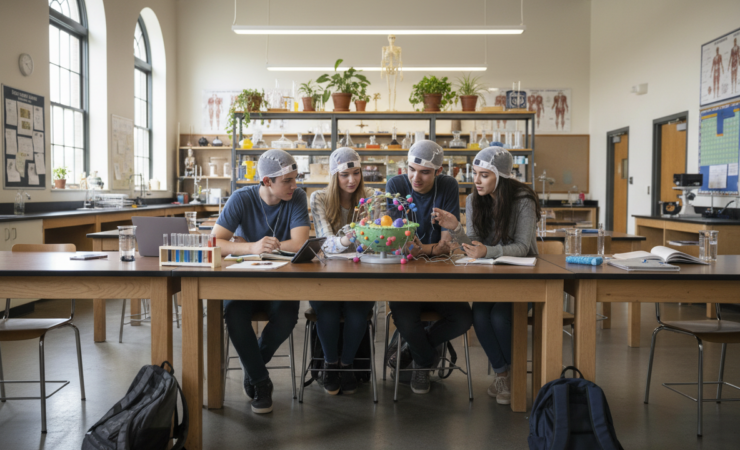
The study involved nine groups of high school students, with four students in each group, for a total of 36 participants. Each group completed a cooperative science-learning activity in which the students worked together to create a model of a cell.
During the activity, the researchers recorded the students’ EEG brain activity. The sessions were also videotaped, transcribed and coded after the task. This allowed the team to compare what students were visibly doing and saying with patterns in neural activity rather than relying on a single indicator of engagement.
The behavioural coding distinguished three broad states. Students could be on task, meaning their behaviour was directed towards the learning activity; off task, when attention or behaviour moved away from it; or idle. The distinction between idle and off-task behaviour is especially important because inactivity can look ambiguous to an observer.
Engagement changed quickly
Video analysis showed that engagement was highly fluid. On average, students alternated among on-task, off-task and idle states every 10 to 30 seconds. That finding challenges simple snapshots of classroom engagement. A learner classified at one moment may occupy a different state shortly afterwards, particularly during collaborative work where attention shifts between speaking, listening, manipulating materials and waiting for peers.
The amount of time spent on task also mattered. The researchers reported that on-task duration significantly predicted test performance. The result does not mean that every brief pause or off-task moment harms learning. Instead, it indicates that the cumulative distribution of engagement across the session contained meaningful information about later performance.
EEG added a different view of idle moments
The neural measurements produced another notable result. The researchers examined activity in theta frequencies, approximately 4 to 7 Hz, and alpha frequencies, approximately 8 to 12 Hz. During idle states, both theta and alpha activity were statistically indistinguishable from off-task states but differed significantly from on-task states.
This matters because an idle student can be difficult to classify from appearance alone. Behaviourally, a learner may simply seem inactive. In this experiment, however, the measured theta and alpha patterns during idle periods resembled the off-task state more closely than the on-task state.
The finding should not be interpreted as a universal neural signature that can diagnose whether any student is paying attention. EEG signals are sensitive to context, measurement choices and movement, and engagement itself is not reducible to a pair of frequency bands. Rather, the study shows how neural and behavioural information can provide complementary evidence when researchers investigate fast-changing group interactions.
What the findings mean for classrooms
For teachers, one implication is that engagement during group work may be better understood as a trajectory than as a fixed label. Brief observation can miss rapid transitions. A student seen during an idle interval could have been deeply involved seconds earlier and may re-enter the task moments later.
The results also support paying attention to how cooperative activities are structured over time. If longer cumulative on-task participation is associated with stronger test performance, classroom designs that repeatedly bring learners back into substantive discussion and task-relevant action may be more informative than simply trying to eliminate every moment of apparent distraction.
For education researchers, the work demonstrates the value of combining methods. Video can capture visible behaviour, transcripts can reveal the content and sequence of interaction, and EEG can contribute information that is not obvious from observation alone. None of these measures is a complete account of engagement, but together they can expose patterns that a single measurement approach might miss.
Important limits to the study
The experiment was deliberately intensive rather than large. It involved only nine groups and 36 high school students completing a particular cooperative cell-model task. That makes the multimodal dataset unusually detailed, but it also limits how confidently the exact timing patterns can be generalised to other age groups, subjects, schools or forms of group work.
The association between time on task and test performance also does not by itself establish that increasing on-task time will cause an equivalent improvement in achievement. Students who understand the material more easily, feel more confident or work within more effective groups may both remain on task for longer and perform better afterwards.
Finally, EEG recorded during authentic social interaction is analytically challenging. The strength of the study is therefore not a claim that brain recordings should replace classroom observation. Its contribution is showing that engagement can change rapidly and that behaviour and neural measures can illuminate different parts of that process.
A more dynamic picture of learning together
The study presents cooperative engagement as something students continually enter, leave and re-enter. Across a single group-learning session, those transitions unfolded every few tens of seconds, while the total time students remained on task was linked to how well they performed afterwards.
That more dynamic picture may help explain why engagement is so difficult to judge from a classroom glance. Group learning is not simply a collection of continuously attentive individuals. It is an evolving social process in which attention, participation and inactivity shift rapidly, and understanding those shifts may require researchers to watch both what learners do and how their underlying cognitive state changes.
Source Information
Study: Davidesco, I., Liu, Y., Chaloner, K. et al. “The dynamics of student engagement in cooperative science learning: a multimodal approach.”
Journal: npj Science of Learning
Published: 30 September 2026
DOI: 10.1038/s41539-026-00457-z