









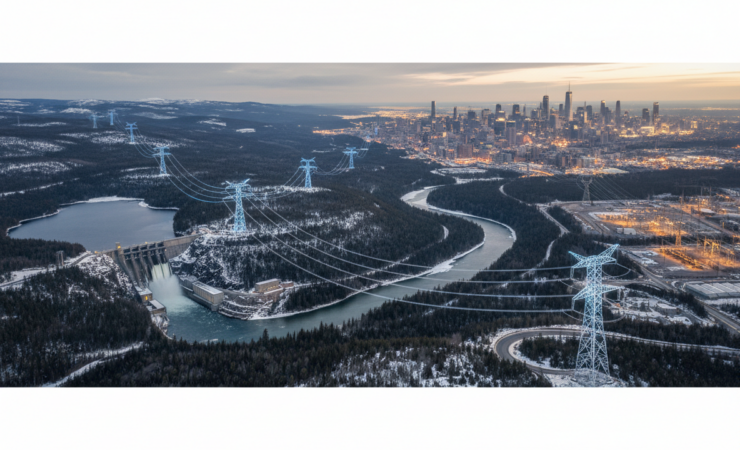
Tariffs on electricity imported from Canada could make New York’s power system more expensive, more carbon intensive and less resilient during periods of severe stress, according to a new modelling study based on a decade of electricity-market data.
The research, published in Nature Communications on 1 October 2026, examined how trade barriers affecting electricity from Ontario and Quebec could alter the operation of the New York Independent System Operator, or NYISO. The analysis combined historical market records from 2015 to 2024 with simulations of electricity prices, generation, emissions and grid reliability.
The central finding is that cross-border electricity is not simply another imported commodity. Because the Canadian and New York grids are physically interconnected, changing the price or availability of imports can affect which power stations run, how much reserve capacity remains available and how the system responds when generators fail.
Canadian electricity plays a small but strategically important role
Researchers Siyuan Wang and Fengqi You of Cornell University first reconstructed how electricity has moved between New York and neighbouring power systems. New York is connected to Ontario’s Independent Electricity System Operator and Hydro-Québec in Canada, as well as PJM Interconnection and ISO New England in the United States.
Across 2015 to 2024, Canadian electricity supplied an average of 9.89% of New York’s load. Ontario contributed 4.25% and Quebec 5.64%. Total net imports from all neighbouring systems typically supplied between 10% and 20% of demand.
Those averages, however, conceal periods when cross-border supply became much more important. Canadian imports exceeded 20% of New York’s hourly load during 492 hours across the decade, equivalent to 0.56% of all hours studied. At five-minute resolution, imports occasionally supplied more than 30% of instantaneous demand and reached a maximum of about 45%.
This matters because Ontario and Quebec have electricity mixes rich in nuclear and hydropower. Quebec’s system is dominated by hydropower, while Ontario draws heavily on nuclear, hydro and wind. These resources can therefore displace more expensive or higher-emission fossil-fuel generation in New York.
Ten years of bids show where tariffs begin to bite
To estimate how tariffs might change market behaviour, the researchers analysed approximately 165 million records from NYISO’s day-ahead electricity market between 2015 and 2024. The records included bids from generators, electricity buyers and interregional traders.
They then introduced hypothetical tariff costs into a marginal supply-and-demand model and recalculated which electricity offers would remain competitive. Two broad scenarios were tested: tariffs affecting Ontario imports alone, and tariffs affecting imports from both Ontario and Quebec.
The response was nonlinear. When tariffs applied only to Ontario, imports from that province fell to very low levels once the tariff exceeded roughly 55%. When both Ontario and Quebec were affected, the comparable threshold rose to about 90%. The researchers attribute the higher threshold partly to the strong cost advantage of Quebec hydropower.
These are not universal tariff thresholds. They emerge from historical New York market conditions, including natural-gas prices, electricity demand, renewable output and the availability of alternative imports during the study period. The study therefore treats them as estimates grounded in the 2015 to 2024 market rather than fixed values that must hold in the future.
Natural-gas prices were especially important. Because gas-fired generation often sets New York’s marginal electricity price, Canadian power remained competitive under higher tariffs when gas was expensive. During some high-price periods, including early 2015 and 2022, roughly 70% of baseline Canadian imports persisted even under a simulated 100% tariff.
Higher prices do not translate into an overall economic gain
Tariffs changed more than import volumes. As lower-cost Canadian bids became less competitive, the simulations shifted generation toward New York plants and other neighbouring US power systems. Marginal electricity prices increased at the same time.
Some participants could benefit. New York generators may receive higher prices, competing exporters can gain market share and governments can collect tariff revenue. But the researchers’ welfare decomposition found that these gains did not offset losses to electricity consumers and Canadian exporters. The model therefore produced a net deadweight loss as mutually beneficial trades were removed from the market.
The analysis also suggests that the consequences could spread beyond New York. Electricity that is no longer exported from Canada could remain available to Canadian consumers, while increased demand for replacement power from neighbouring US systems could tighten those markets. The study did not model every regional spillover in full, so these broader effects should be interpreted as plausible consequences rather than complete forecasts.
Replacing Canadian power also changes the emissions profile
The environmental effect follows from the type of electricity being displaced. When low-carbon Canadian imports declined in the simulations, New York and neighbouring US systems relied more heavily on fossil-fuel generation.
The researchers estimated generation and emissions changes using data from 2018 to 2023. Tariffs reduced access to Canadian hydro and nuclear-rich electricity and increased fossil generation in the United States. Although Ontario could reduce some gas-fired generation when exports fell, the overall modelled effect was an increase in carbon dioxide-equivalent emissions and New York power-purchase costs compared with the tariff-free baseline.
The finding has particular relevance for New York’s statutory climate goals. The state aims for 70% renewable electricity by 2030 and a zero-emission grid by 2040. Quebec’s large hydropower reservoirs can also provide dispatchable flexibility that complements variable wind and solar generation, meaning the value of cross-border links may extend beyond the direct carbon intensity of imported electricity.
The strongest effects appear when the grid is under stress
The researchers separately tested reliability during summer peaks and severe winter conditions. For summer, they simulated the 100 most severe peak-load days using a day-ahead unit-commitment model followed by real-time security checks.
Restricting Canadian imports reduced reserve margins and increased reliance on oil-fired peaking plants, particularly when Quebec exports were curtailed. Quebec’s connections are especially important because they deliver electricity toward transmission-constrained downstate areas such as New York City and Long Island. Losing those flows can therefore create local supply pressure that is difficult to replace with power from elsewhere.
The winter analysis used conditions associated with Winter Storm Elliott in December 2022. Researchers modelled random failures among gas-fired generators at rates from 30% to 60%, running 200 Monte Carlo simulations at each level. They compared full responsive Canadian support, fixed planned transfers and a complete cutoff.
With full, responsive Canadian support, the simulated system could tolerate a higher level of gas-generator failure before load shedding began. The threshold increased from about 40% without that support to about 55% with it. Canadian electricity also reduced expected unserved energy and the number of hours with load or reserve deficits under severe outage scenarios.
This does not mean a particular tariff would cause a blackout. Rather, the modelling shows that restricting access to interconnected supply removes one layer of flexibility that becomes valuable when multiple generators are unavailable at the same time.
Why electricity behaves differently from ordinary trade
Electricity must be produced and consumed almost simultaneously, and power systems need enough spare capacity to respond rapidly to unexpected failures. Cross-border interconnections therefore provide both trade and an operational service.
That distinction helps explain why a tariff designed primarily as a trade instrument can produce effects on reliability and emissions. If a tariff raises the effective offer price of Canadian electricity, the market may dispatch a different generator. The replacement could be more expensive, more carbon intensive or located in a part of the network that provides less flexibility during a contingency.
The authors argue that electricity trade policy should consequently be evaluated alongside energy-security, reliability and climate objectives. They suggest that cross-border policy frameworks could include consultation with grid operators before restrictions are imposed and mechanisms that reduce trade-policy uncertainty for long-term transmission investment.
Important limitations
The study is a data-driven modelling analysis, not an observation of an actual large electricity tariff imposed across the New York-Canada border. Its estimates depend on historical market behaviour and assumptions about how bids and power-system operations respond to hypothetical trade costs.
NYISO bidding records are anonymised, so the researchers inferred tariff effects from marginal changes around historical clearing prices rather than reproducing every feature of the real market-clearing process. The detailed physical New York transmission network is also not public, requiring the team to reconstruct a synthetic network from open datasets. Differences between that model and the actual grid could affect the magnitude of simulated reliability outcomes.
Future electricity systems may also differ substantially from the 2015 to 2024 period as renewable generation, storage, transmission infrastructure and electricity demand change. Rapid growth in data-centre demand, for example, could alter reserve requirements and the value of imports. The results are therefore best understood as evidence about mechanisms and plausible system effects rather than a precise forecast of future prices or outages.
Even with those qualifications, the study demonstrates how tightly trade, climate policy and grid engineering can become connected in an integrated electricity system. Canadian imports averaged less than one tenth of New York’s electricity demand, yet the simulations suggest that their value can become disproportionately important during high-price periods and severe system stress.
Source Information
Study: Cross-border electricity tariffs undermine power system efficiency, decarbonization and reliability in North America
Authors: Siyuan Wang and Fengqi You
Journal: Nature Communications, Volume 17, Article 9696
Published: 1 October 2026
DOI: 10.1038/s41467-026-77773-w