




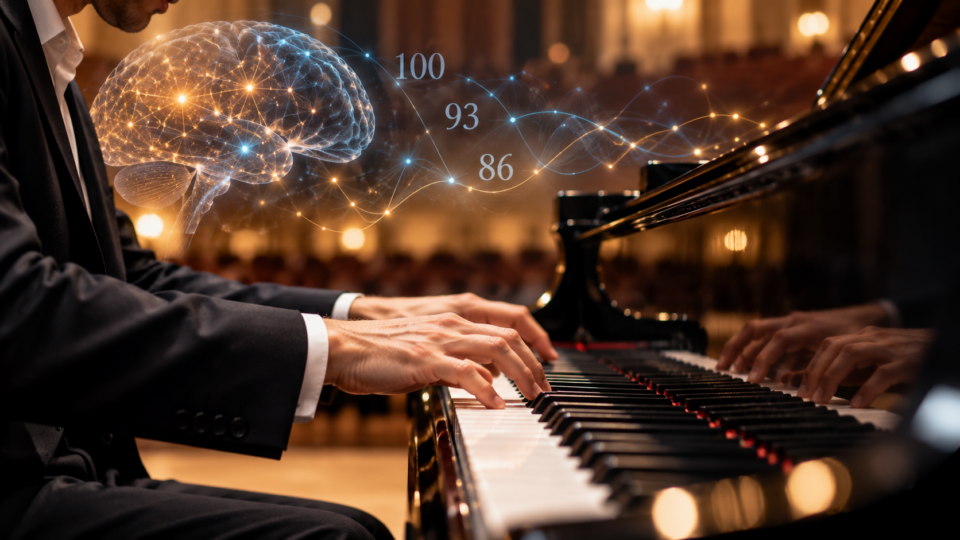
Why playing while thinking is a difficult test
A pianist can make rapid movements look effortless, but performing a familiar skill while doing mental arithmetic is a different challenge.
Researchers have long observed that performing two demanding tasks at once can reduce performance in one or both.
This interference is often explained by the idea that well-practised movements become automatic and therefore require less conscious attention.
A new study suggests that explanation is incomplete. Expertise gained over years of musical training and automaticity developed through short-term practice appear to make partly independent contributions.
Published in Scientific Reports on 16 October 2026, the experiment tested 38 conservatory-level pianists as they learned unfamiliar piano passages and performed arithmetic at the same time.
The findings matter beyond music because they help distinguish knowing a skill deeply from simply repeating one action until it feels familiar.
The study involved experienced musicians, not beginners
The research team included Florian Worschech, Hannah Losch, Markus Raab and André Lee.
Forty-one pianists initially participated, but three were excluded because of substantially lower experience and performance, leaving 38 for analysis.
The analysed group included 17 men and 21 women, with an average age of 27.1 years.
Participants reported an average of 21,403 hours of cumulative piano practice, although individual totals varied considerably.
They had started learning piano at an average age of 5.8 years.
Twenty-one participants were enrolled in or had completed a piano performance course, while 17 were studying or had completed piano pedagogy.
These details are important because the study compared degrees of expertise within an experienced group. It did not compare professional pianists against a matched sample of complete novices.
Two unfamiliar piano sequences created a controlled test
Each pianist learned two newly composed sequences rather than performing familiar repertoire.
Each sequence contained eight chords, with three notes for each hand in every chord.
The sequences were designed to have comparable complexity and motor demands.
Participants practised each sequence for 20 trials lasting 20 seconds, with 30-second breaks between trials.
Giving everyone the same number of practice trials allowed researchers to examine how quickly individual musicians improved.
The team estimated learning rates from each pianist’s performance across the practice period.
Those rates served as indicators of how far each musician had progressed towards more automatic execution by the final trial.
This is not identical to directly measuring unconscious processing, but it provided a way to examine practice-related learning separately from years of musical experience.
The second task was counting backwards in sevens
After learning the passages, participants performed the piano tasks under single-task and dual-task conditions.
In the dual-task conditions, they played while completing mental arithmetic by counting in steps of seven.
One piano condition required performance at maximum speed, described as the Prestissimo condition.
The other required playing at a fixed metronome tempo.
These two settings placed different demands on movement execution and timing.
The researchers measured how piano performance changed when arithmetic was added.
They also examined how arithmetic performance itself declined during simultaneous playing.
That distinction prevents a misleading conclusion in which musicians appear to protect piano accuracy only because they stop paying attention to the arithmetic.
Both tasks suffered when combined
The experiment confirmed that performing the piano and arithmetic tasks together imposed measurable costs.
In the maximum-speed condition, the model estimated a decline in piano performance relative to playing alone.
Arithmetic performance declined by an average of 41.70 percent in that condition.
In the metronome condition, arithmetic performance declined by an average of 55.37 percent.
These percentages refer to the cognitive arithmetic task, not to an equivalent percentage reduction in piano accuracy.
The piano outcomes were modelled on different scales for the two conditions, so their numerical coefficients should not be compared as though they were the same measure.
The important finding is that even highly trained musicians experienced interference.
Expertise reduced the size of the disruption; it did not make the cognitive cost disappear.
Musical expertise offered protection beyond practice
The researchers created an expertise measure using information such as the age participants began lessons, formal training and concert experience.
Interestingly, cumulative practice time did not improve the fit of that particular expertise measurement model and was excluded from the final factor.
This does not mean practice hours are irrelevant to musical ability. It means the variable did not contribute usefully to the study’s selected statistical measure.
Higher measured expertise predicted smaller dual-task costs in both the maximum-speed and metronome conditions.
That association remained relevant after accounting for differences in how quickly the pianists learned the new passages.
The result suggests that extensive musical development may support performance under divided attention in ways that are not captured by the automaticity of a newly learned sequence.
Such advantages might involve richer representations of music or more efficient coordination, but the study did not isolate one definitive neural mechanism.
Learning a passage also mattered independently
Participants who learned the unfamiliar sequences more quickly tended to be more resistant to dual-task interference.
The researchers interpreted faster learning as an indication of reaching a more advanced learning stage after the same amount of practice.
This effect was distinct from the overall expertise measure.
In other words, two pianists with similar backgrounds could still differ in how efficiently they learned a particular sequence.
Conversely, two pianists who reached similar learning stages might differ in their broader musical expertise.
Both dimensions helped explain performance when the arithmetic task was added.
The finding challenges the common assumption that expertise and automaticity are simply two names for the same process.
Practice can make a specific movement more efficient, while long-term expertise may provide additional resources for managing simultaneous demands.
Cognitive abilities contributed too
The researchers also assessed abilities related to processing speed and switching between tasks.
Better performance on relevant cognitive measures was associated with lower dual-task costs in parts of the analysis.
The pattern depended on the type of piano task rather than appearing identically in every condition.
This suggests that managing two tasks involves more than motor skill alone.
For example, the ability to redirect attention may become more important when a task requires a particular kind of timing or monitoring.
However, the study cannot establish that training general cognitive abilities would necessarily improve piano performance.
The results are associations within one experimental design, not evidence that a commercial brain-training programme would reproduce the effect.
The findings instead encourage researchers to consider motor expertise, task-specific learning and broader cognitive abilities as related but distinct factors.
Why the researchers used Bayesian modelling
The research team used Bayesian hierarchical models to estimate learning curves and the effect of the second task.
This approach allowed them to account for differences among participants while modelling performance across repeated trials.
The analysis also controlled statistically for cognitive dual-task costs when evaluating the piano outcomes.
The researchers then used mediation analyses to examine whether the apparent effect of expertise could be explained mainly by faster learning or other measured abilities.
Those analyses indicated that the expertise effect was largely independent of task automaticity and the cognitive factors considered.
Statistical independence in this context should not be mistaken for proof of completely separate brain circuits.
The experiment measured behaviour and performance; it did not directly image the neural pathways supporting each effect.
The conclusions therefore concern distinct statistical contributions rather than a definitive biological division.
What the findings mean for musicians
Musicians routinely divide attention between movement, sound, notation, ensemble partners and performance goals.
A player who can execute a passage reliably in isolation may still struggle when required to listen closely or make another decision at the same time.
The experiment suggests that repeating a passage and developing wider expertise can each support more resilient performance.
However, it does not provide a specific training prescription or establish an ideal balance between technical drills and broader musical education.
The authors note that unlimited rehearsal is not practical for professional musicians who must learn large repertoires.
The study therefore raises an important question about which forms of practice produce skills that remain robust under real performance demands.
A useful next step would be to test training strategies prospectively and assess whether improvements transfer to realistic concerts or ensemble playing.
Could the results apply outside music?
Many activities combine complex movement with mental decisions.
Examples include driving, surgery, competitive sport and some industrial tasks.
The distinction between long-term expertise and short-term automaticity may be relevant to these settings, but direct generalisation would be premature.
The participants were experienced pianists performing specially constructed sequences in a laboratory.
The experiment did not test drivers, surgeons or athletes.
Nor did it show that expertise eliminates distraction in safety-critical environments.
What it offers is a conceptual framework: a person can be highly practised at one routine without possessing the broader expertise needed to cope with changing demands.
Future studies would need to examine that possibility in other fields using their own task-specific measures.
Limitations are important
The final sample contained only 38 people, all of whom had substantial musical training.
A larger and more diverse sample could reveal different patterns among beginners, older musicians or performers from other traditions.
The experiment took place in one session using two artificial sequences, rather than following skill acquisition over months or years.
Learning rate was used as a proxy for the stage of automaticity, which is not a direct measure of the amount of conscious attention used.
The expertise score was based on several indicators rather than a universally accepted objective ranking of piano skill.
The study also used observational comparisons of expertise within an experiment, so it cannot establish that acquiring a particular amount of training causes a specified reduction in interference.
The authors reported no financial or non-financial competing interests.
These qualifications limit how confidently the results can be extended beyond the study conditions.
The central lesson is that expertise is more than repetition
The experiment offers a nuanced answer to why experienced performers often handle competing demands better.
Both advanced learning of a specific passage and broader musical expertise were associated with smaller performance losses when mental arithmetic was added.
The contributions were largely independent in the researchers’ models.
Processing speed and task-switching abilities provided additional explanatory information in some conditions.
That combination argues against treating all skilled performance as the product of automatic movements alone.
It also shows that even highly experienced musicians have limited capacity when two tasks compete for attention.
The broader research question is how people develop flexible skills that remain reliable when the environment becomes more demanding.
For now, the evidence comes from a carefully controlled experiment with 38 pianists, not a universal rule about multitasking.
Source Information
Original study: Distinct contributions of expertise and automatization to higher dual-task performance: A cognitive–motor dual-task study in pianists.
Authors: Florian Worschech, Hannah Losch, Markus Raab and André Lee.
Journal: Scientific Reports, volume 16, article 32671.
Publication date: 16 October 2026.
Methods: Laboratory cognitive–motor dual-task experiment involving 38 conservatory-level pianists learning two novel sequences and performing mental arithmetic, analysed using Bayesian hierarchical and mediation models.