





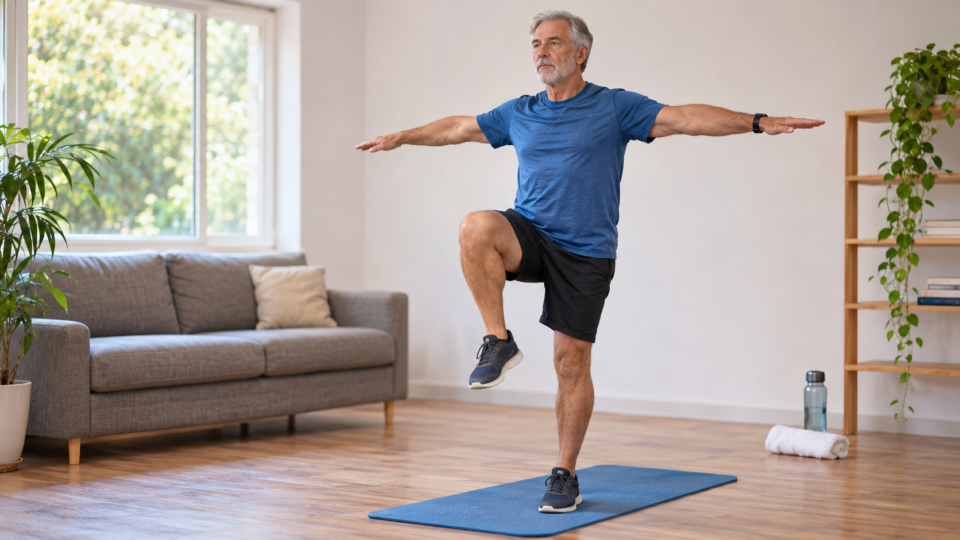
A simple standing test, a complicated question
Standing with the feet side by side for ten seconds sounds straightforward.
For some adults, however, the ability to maintain that position may provide information about physical function and a history of falling.
A newly published analysis of a large Indian ageing survey examined how several common balance tasks relate to self-reported falls.
Its main message is more selective than the claim that any balance test reliably predicts who will fall.
After adjustment for other health and functional characteristics, the side-by-side test and the longer full-tandem test showed the most consistent statistical associations.
That is useful evidence for screening discussions, but it does not establish a test of future fall risk.
The scale of the Indian dataset
Jozo Grgic analysed wave-one data from the Longitudinal Ageing Study in India, a nationally representative survey.
The analysis included up to 57,720 adults aged 45 years or older.
That large base is a strength: it permits examination of patterns across a broad population rather than relying on a small clinical convenience sample.
But the phrase up to matters.
Not every participant contributed to every balance-test comparison, and different tasks were administered according to age and eligibility.
Readers should avoid imagining a single group of 57,720 people completing every test under identical conditions.
Three standing positions
The study considered the side-by-side position, in which the feet stand next to each other, the semi-tandem position, and a full-tandem stance, in which one foot is placed directly ahead of the other.
Participants were assessed on whether they maintained the prescribed position for the full test duration.
Side-by-side and semi-tandem tasks used ten-second thresholds.
The full-tandem task used a 60-second threshold for adults aged 70 or younger and a 30-second threshold for those older than 70.
Those differences make the tests useful for particular groups, but complicate simple comparisons between age bands.
What a completed test measures
The outcome was a binary distinction: whether a participant completed the relevant stance for its required duration.
This captures one aspect of static balance performance, not the entire range of mobility, coordination, vision, medication effects or environmental hazards that influence falls.
Someone can pass a brief standing task and still face risks while walking on uneven ground.
Conversely, someone may struggle with a stance because of pain or another temporary limitation.
The meaning of a test therefore depends on the broader assessment and on why an individual did or did not complete it.
Falls were reported rather than observed
The other side of the comparison was a history of falls reported by participants in the survey.
That is an important methodological distinction.
The researcher did not follow the participants forward to see who subsequently fell, nor did the study randomly assign people to balance training.
Self-report can be informative in a large population study, but recall, interpretation and reporting can vary.
A cross-sectional association between a test result and a past event cannot establish whether impaired balance preceded the fall, followed an injury, or reflected another underlying health condition.
Why the researchers adjusted the analysis
The paper used gender-stratified weighted logistic regression to compare completion of each test with self-reported falls.
The unadjusted models first assessed the basic relationship.
The multivariate models then accounted for age, grip strength, body mass index, activities of daily living, a dementia diagnosis and physical activity.
These factors are plausible influences on both standing ability and fall history.
Adjustment matters because a simple association could partly reflect differences in age or functional health rather than a unique contribution from the balance task.
Yet adjustment for measured characteristics cannot remove every unmeasured confounder.
The initial associations were broad
In the crude analyses, several balance measures were significantly associated with reported falls.
The reported odds ratios for significant crude comparisons ranged from approximately 0.418 to 0.771.
Values below one indicated lower odds of reporting falls among participants who could complete the specified balance task, relative to those who could not, within the relevant model.
An odds ratio is not a probability and should not be read as a direct percentage-point change in risk.
These initial associations also became more selective when the researcher incorporated additional characteristics into the models.
Which tests remained associated
After multivariable adjustment, completion of the ten-second side-by-side task remained significantly associated with falls for both men and women, with reported odds ratios ranging from 0.527 to 0.622.
The 60-second full-tandem task also remained associated in both groups, with odds ratios ranging from 0.784 to 0.856.
For women, the 30-second full-tandem task had a significant association, with an odds ratio of 0.833.
The paper’s conclusion therefore highlighted the side-by-side and 60-second full-tandem tests as the most consistent measures in the subgroups where they were administered.
Why the semi-tandem result matters
The semi-tandem test did not show the same consistent adjusted association.
That should not be converted into a universal verdict that the task has no clinical value.
A relatively easy test may have a ceiling effect when most people can complete it, limiting its ability to distinguish groups in a particular sample.
Different populations, test procedures and clinical questions could produce other patterns.
The paper addresses associations with self-reported falls in a large Indian survey, not every use of a balance task in rehabilitation or geriatric assessment.
A large sample does not guarantee prediction
The distinction between association and prediction is central.
Even a highly statistically significant relationship may not classify future fallers accurately.
To establish prospective predictive value, researchers would need to measure balance at baseline and observe subsequent falls over a defined period, ideally reporting discrimination, calibration and clinically meaningful thresholds.
This study instead linked present test completion with recalled falls in the same survey wave.
It can identify potentially useful screening signals but cannot tell a clinician the probability that a specific patient will fall next month.
Age-specific protocols need careful reading
The 60-second full-tandem analysis concerns adults aged 70 or younger, whereas the 30-second version concerns older adults.
Their odds ratios should not be compared as if the test duration and underlying populations were identical.
A shorter threshold in an older group may change how many people pass and how informative the result appears.
The gender-stratified analysis adds another layer: patterns can differ between men and women, but such differences do not necessarily prove biological causes.
Differences in health, activity and other contextual factors could also influence test performance.
What the findings mean for everyday care
A brief standing assessment can be inexpensive and easy to administer in suitable clinical settings.
The findings support continued interest in simple balance tasks as one component of broader functional evaluation.
They do not justify using a single pass-or-fail result as a diagnosis or a guarantee of safety.
A comprehensive falls assessment may consider medications, vision, mobility, muscle strength, prior falls, environmental hazards and medical history.
People who feel unsteady should not attempt challenging balance positions without appropriate support merely because a study discusses them.
A broader view of ageing research
The paper sits alongside other evidence that ageing-related outcomes have multiple determinants.
Research Today has reported on cognitive scores and later stroke risk in a Swedish study, and on inequalities in pain after age 80.
Those reports examine different populations and outcomes, and neither independently validates a balance test.
Their relevance is methodological: health in later life rarely reduces to a single indicator.
It is more useful to ask which measure adds information beyond other factors than to treat one convenient measurement as a complete explanation.
Strengths and limits in balance
The nationally representative survey and large number of adults strengthen the descriptive evidence.
Gender-stratified, weighted analyses and adjustment for multiple covariates also improve interpretation compared with a simple raw comparison.
Important limitations remain.
The design is cross-sectional, falls were self-reported, and reasons for failing or not completing a test were not fully observable.
Test protocols differed by age.
Unmeasured illness, medications, injury consequences or fear of falling could influence both the reported history and the balance outcome.
The estimates should therefore be read as associations rather than causal effects.
What the next study should test
A prospective study could assess participants using standardised balance protocols and then record falls over time, including injuries and repeated events.
Researchers could evaluate whether the side-by-side and tandem tests improve prediction beyond age, mobility, prior falls and other standard clinical information.
They could also examine whether results vary by rural or urban setting, disability, gender and access to healthcare.
Such a design would clarify whether the strongest cross-sectional signals translate into practical risk identification.
A separate intervention trial would be needed to test whether acting on those results actually prevents falls.
The practical conclusion
In a large Indian ageing dataset, completing the side-by-side and longer full-tandem balance tasks was associated with lower odds of reporting a fall after adjustment for several measured characteristics.
The study does not prove that better test performance prevents falls, nor that passing a test rules out future injury.
Its contribution is to distinguish among common standing tasks rather than treating all balance measures as equivalent.
For clinicians and researchers, that is a reason to investigate the most informative tests further while retaining a broad view of fall prevention and older adults’ health.
Source Information
Study title: Common balance tests and their association with falls
Authors: Jozo Grgic
Journal: Scientific Reports
Publication date: 10 November 2026
Study design: Cross-sectional secondary analysis of nationally representative ageing survey data using gender-stratified weighted logistic regression
Sample or scope: Up to 57,720 adults aged 45 years or older in wave 1 of the Longitudinal Ageing Study in India
Key finding: Completion of the 10-second side-by-side and 60-second full-tandem tests showed the most consistent adjusted associations with self-reported falls within the groups tested