









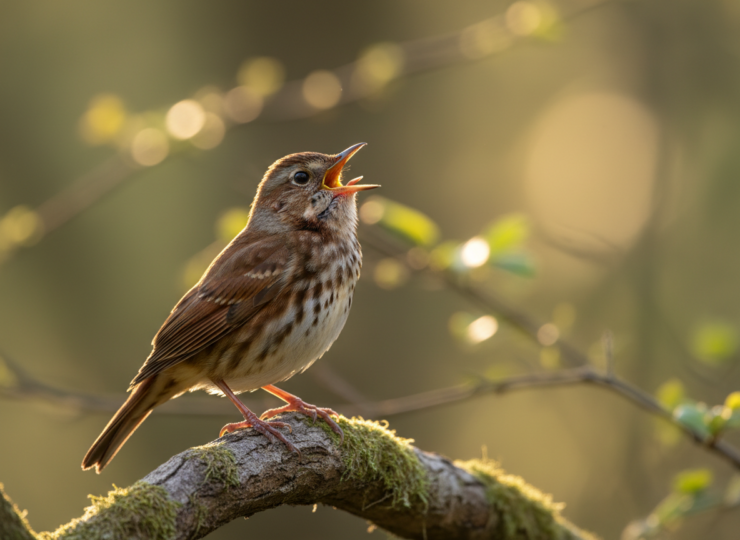
Birdsong is often treated as a single ingredient in the restorative sound of nature. New research suggests that this is too simple: the acoustic structure of a bird’s call or song can strongly shape how pleasant people find it.
In a controlled laboratory study, 84 adults in Germany rated 15-second vocalisations from 123 European bird species. When researchers analysed the recordings alongside those ratings, three broad acoustic components explained 46.8% of the variation in average pleasantness between species.
Higher low and peak frequencies were associated with greater pleasantness, while higher amplitude and a combination of wider bandwidth and higher upper frequencies were associated with lower ratings. Vocalisations containing more different types of sound elements were also rated more positively.
The findings, published in Frontiers in Bird Science, suggest that the quality of a natural soundscape may depend on more than how many bird species are present. Which species are heard, and what their vocalisations actually sound like, may matter too.
The blackbird and barn owl sat at opposite ends of the ratings
The researchers recruited participants through a university mailing list and wider personal networks. Thirty-seven people completed the laboratory study between November 2022 and January 2023, with another 47 participating in May 2025.
The final sample included 84 adults aged 19 to 81, with a mean age of 33.88 years. There were 61 women, 22 men and one participant identifying as diverse.
Participants listened through headphones in a controlled seminar-room environment. The 123 recordings were presented in random order without identifying the bird species, and listeners rated each vocalisation from one, meaning not very pleasant, to five, meaning very pleasant.
Across all species, the mean pleasantness score was 3.13 out of five. The common blackbird received the highest average rating at 4.52, while the barn owl received the lowest at 1.32.
That wide spread gave the researchers an opportunity to ask what separated sounds people tended to enjoy from those they did not.
Researchers measured the sounds rather than relying only on impressions
Each 15-second recording was analysed in Raven Pro acoustic software. The team manually marked individual sound elements in spectrograms and measured their low frequency, high frequency, peak frequency and the bandwidth containing 90% of the sound energy.
They also measured minimum, maximum and peak amplitude. To capture one aspect of complexity, the researchers counted how many different element types appeared in each recording, distinguishing this from the total number of elements produced.
Because several of these acoustic measurements are closely related, the team used principal component analysis to reduce them to three broader dimensions. The first represented amplitude, the second combined low and peak frequency, and the third combined bandwidth with high frequency.
The main species-level analysis then compared these components with the average pleasantness rating for each of the 123 species. Averaging across listeners avoided treating repeated ratings from the same people as if they were independent observations.
Frequency was the strongest acoustic predictor
All three acoustic components significantly predicted pleasantness. The frequency component, representing higher low and peak frequencies, showed the strongest positive association, with a standardised coefficient of β = 0.519 and p < .001.
The bandwidth and high-frequency component moved in the opposite direction. Wider bandwidth and higher upper frequencies were associated with lower pleasantness, β = -0.375, p < .001.
Amplitude was also negatively associated with ratings, β = -0.241, p < .001. In practical terms, the pattern favoured sounds with higher lower and peak frequencies, but more moderate amplitude and a narrower frequency range.
Together, the three acoustic components explained 46.8% of the variation in species-level pleasantness ratings. The adjusted R² was 0.455, and the overall model was highly significant, F(3,119) = 34.912, p < .001.
That is a substantial proportion for a subjective judgement such as pleasantness. It indicates that measurable properties of the sound itself were closely associated with how listeners evaluated different species.
Variety mattered more than simply producing more notes
The study also separated sound complexity from sheer vocal activity. A bird could produce many repeated elements without producing many different types of elements.
The number of different element types significantly predicted pleasantness, β = 0.315, p < .001. Each additional unit in the study’s complexity measure was associated with a 0.059-point increase in pleasantness in that model.
By contrast, the total number of elements was not significant, β = -0.099, p = .301. The complexity model explained 8.4% of the variance overall.
When the researchers entered complexity, total element count and all three acoustic components into the same model, complexity remained significant while total element count did not. This suggests that variation in the types of sounds contributed information beyond the frequency, bandwidth and amplitude measures.
The result is important because it distinguishes a varied vocalisation from a merely busy one. More sound was not automatically more pleasant.
Liking birds mattered, but birding expertise did not
Acoustics were not the whole story. Participants also answered questions about how much they liked and valued birds, as well as how many species they could recognise visually and acoustically and how they rated their own birding expertise.
People with more positive attitudes toward birds tended to give higher pleasantness ratings. The correlation between perception of birds and average pleasantness was rs = 0.42, p < .001.
Birding specialisation itself was not a significant predictor, nor were age, gender or the year in which the participant completed the study. This suggests that enjoying these vocalisations was not simply a product of expert identification skills.
The distinction is useful. Familiarity with birds and positive associations with them may shape perception, but the measurable structure of the sounds still showed strong species-level relationships with pleasantness.
Pleasantness also tracked earlier measures of restorative potential
For 21 species that overlapped with an earlier study, the researchers compared their pleasantness ratings with previously published scores of perceived restorative potential. The two measures were positively correlated, with Spearman’s rho = 0.542 and p = .011.
This does not prove that a pleasant bird sound improves mental health or restores attention. It does, however, suggest that pleasantness and perceived restoration may capture related aspects of how people experience natural sound.
That connection gives the findings relevance beyond laboratory aesthetics. Parks, urban green spaces and conservation areas are experienced acoustically as well as visually, and bird communities contribute to those soundscapes in different ways.
Soundscape management may need to look beyond species counts
Biodiversity assessments often emphasise richness and abundance. For human experience, however, two sites with similar numbers of bird species could sound very different.
The researchers argue that acoustic composition could therefore add another layer to the way recreational environments are assessed. Supporting bird communities whose vocalisations are experienced positively could potentially strengthen the perceived quality of natural spaces.
There is also a conservation communication angle. Charismatic wildlife is usually discussed in visual terms, but an appealing sound may be another form of charisma that influences how people connect with a species.
That does not mean conservation should prioritise species according to human musical taste. Ecological function and biodiversity remain distinct goals. Rather, acoustic pleasantness may help explain an additional pathway through which biodiversity becomes meaningful to people.
The amplitude result needs particular caution
The study has several limitations. The recordings came from a commercial collection assembled from field recordings made over many years, and they were unlikely to have been captured using one standardised recording protocol.
That matters most for amplitude. Differences in recorded loudness can reflect microphone distance, equipment and recording conditions as well as the vocal behaviour of the bird itself. The authors therefore caution against treating the amplitude association as a clean measure of natural loudness.
The participant sample was also modest and predominantly female, with women making up 67.6% of the 84 listeners. The study may therefore have lacked power to detect smaller individual differences in age, gender or expertise.
All participants were German adults and the stimuli were birds native to Germany. Cultural associations with species and sound can differ, so the rankings should not automatically be generalised to other countries or ecological settings.
Finally, the analysis averaged repeated ratings at species and participant level rather than modelling the full repeated-measures structure. Future work using mixed-effects models could better separate differences between listeners from differences between bird vocalisations.
A natural soundscape is more than the presence of birds
The central finding is not that there is one universally ideal birdsong. Human perception reflects both acoustic properties and personal associations.
But the study shows that subjective pleasantness is not acoustically arbitrary. Frequency, bandwidth, amplitude and vocal complexity together captured meaningful differences in how 123 species were rated.
For research on urban nature and restorative environments, that shifts attention from whether birds can be heard to what the living soundscape actually contains. A richer understanding of nature may require listening to biodiversity, not simply counting it.
Source Information
Study: Analyzing the acoustic parameters of bird vocalizations and their perceived pleasantness by humans
Authors: Nadine Kalb, Gesa von Lücken, Judith Lukanowski, Florian Dechant and Christoph Randler
Journal: Frontiers in Bird Science, Volume 5
Published: 2 September 2026
Study design: Controlled laboratory listening study involving 84 German adults rating 15-second vocalisations from 123 European bird species, combined with spectrographic acoustic analysis and species-level regression modelling.
DOI: 10.3389/fbirs.2026.1794594