








High blood pressure is often associated with middle age.
Yet the early changes that accompany hypertension can begin much sooner, including in people who appear healthy, have no diagnosed chronic illness and may not realise that their blood pressure behaves differently outside a clinic.
New South African research suggests that one measure of arterial stiffness may identify these patterns more effectively than a more complicated score combining several cardiovascular tests.
Researchers from North-West University analysed 1,019 South African adults between the ages of 20 and 30. They found that carotid-femoral pulse wave velocity, or PWV, performed better than a composite vascular-status score in identifying different hypertension patterns.
The result does not mean PWV should replace ordinary blood-pressure testing.
It does, however, challenge a familiar assumption in medicine and data analysis: combining more measurements does not always produce a better result.
Blood pressure does not always behave consistently
A single blood-pressure reading offers only a brief picture.
Some people record a high reading inside a clinic but have lower blood pressure during ordinary daily life. This is commonly described as white-coat hypertension.
Others experience the opposite pattern.
Their blood pressure may appear normal during a clinic visit but rise during work, travel, stress, activity or other parts of the day. This is known as masked hypertension.
A third group experiences sustained hypertension, with elevated readings both inside and outside the clinic.
These differences matter because relying only on an office reading can miss important patterns.
The researchers therefore used both clinic measurements and 24-hour ambulatory blood-pressure monitoring, in which a portable device records blood pressure repeatedly while the participant continues with normal daily activities.
They then compared these blood-pressure patterns with several measurements of vascular health.
What pulse wave velocity measures
Every heartbeat sends a pressure wave through the arteries.
In flexible arteries, that wave travels more slowly because the vessel walls expand and absorb some of the pressure.
As arteries become stiffer, the wave moves more quickly.
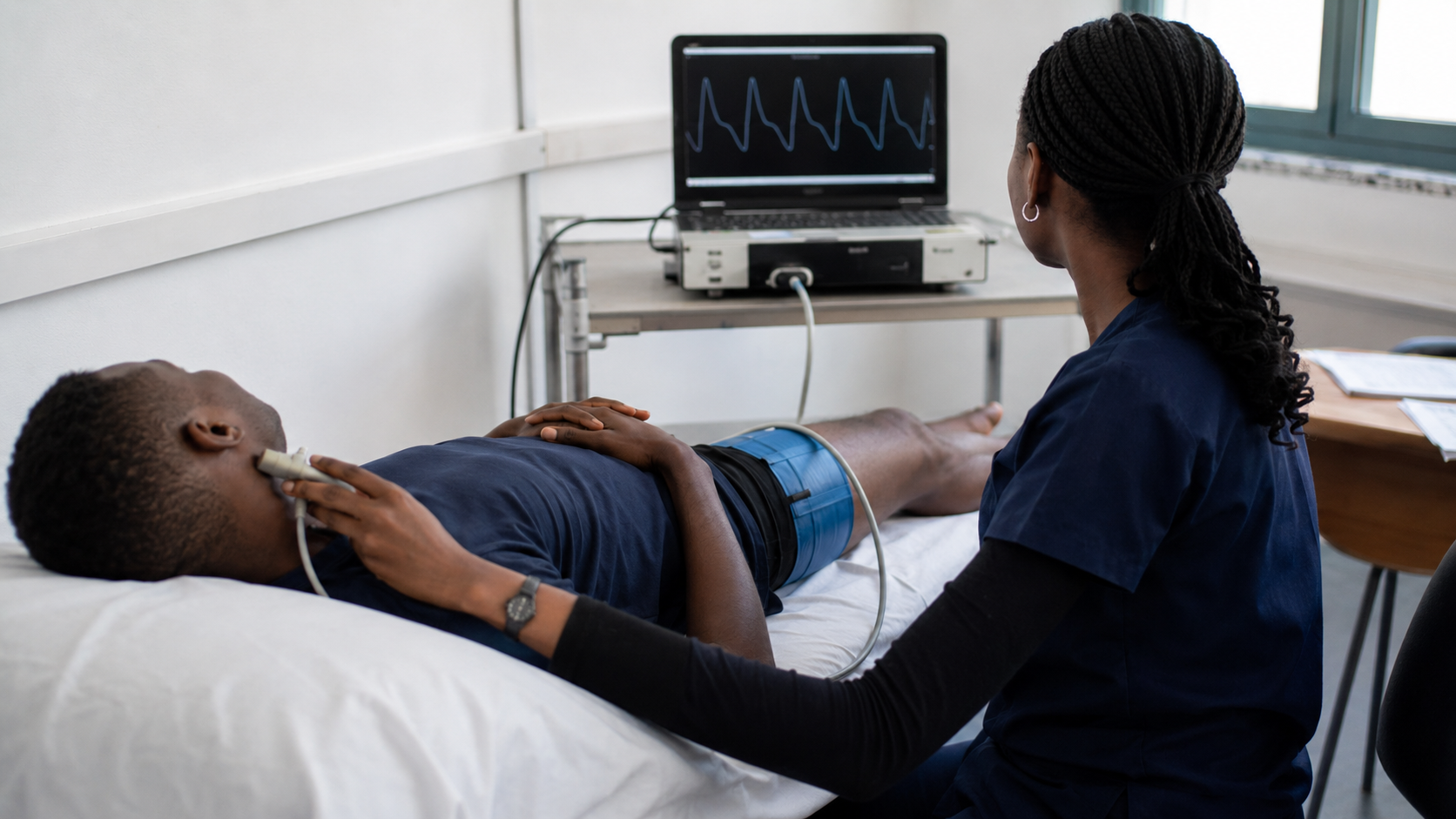
PWV estimates that speed by measuring how long the pressure wave takes to travel between two points — in this study, along the major arteries between the neck and upper thigh.
A faster wave can indicate reduced arterial flexibility.
The researchers also measured the augmentation index, which reflects how pressure waves are returned through the vascular system, and the thickness of the inner layers of the carotid artery wall.
These three measures were combined into a vascular status score, or VSS, intended to provide a broader picture of cardiovascular health.
In theory, combining several useful indicators could produce a stronger screening measure than relying on any one of them.
That was not what happened.
The individual measurement performed better
A vascular status score above the researchers’ selected threshold was associated with greater odds of masked, sustained and white-coat hypertension.
But its ability to distinguish participants with and without hypertension was only modest.
PWV performed more consistently.
Participants above the study’s PWV thresholds had approximately 2.25 to 2.70 times the odds of masked, sustained or overall hypertension, depending on the blood-pressure pattern being examined.
The researchers concluded that PWV outperformed the full vascular status score, as well as the other individual components, in identifying hypertension among the young adults studied.
This does not mean the additional measurements contain no useful information.
It means that combining them may have reduced the influence of the measurement most closely connected to the earliest vascular change occurring in this particular group.
Early hypertension may be functional before it becomes structural
The result may partly reflect the participants’ age.
PWV measures how the arteries function, specifically, how easily they expand as pressure moves through them.
Changes in arterial function can occur before lasting physical thickening becomes clearly visible in the vessel walls.
Carotid intima-media thickness, by comparison, measures a structural change that may become more apparent only after longer exposure to elevated pressure, inflammation or other cardiovascular strain.
In young adults, early vascular changes may therefore be detectable through stiffness before substantial structural damage develops.
The researchers suggest that combining an early functional measure with indicators that change later could dilute the value of the most sensitive component.
The study’s title captures the broader lesson: sometimes the sum is not better than the individual parts.
The participants appeared healthy
The study used baseline information from the African-PREDICT project, a long-term South African investigation into the early detection of cardiovascular disease and hypertension.
Participants were recruited in and around Potchefstroom in North West.
They were between 20 and 30 years old and had no previously diagnosed chronic disease. People living with HIV, those who were pregnant or breastfeeding, and individuals meeting certain high blood-pressure criteria during initial screening were excluded from the underlying cohort.
This makes the findings especially interesting.
The study was not limited to older patients already receiving treatment for cardiovascular disease. It investigated young adults who were considered apparently healthy when they entered the research programme.
The results therefore support the idea that less visible vascular differences can already be present early in adulthood.
They do not show how many young South Africans nationally have undiagnosed hypertension.
A promising test with practical obstacles
PWV is non-invasive. But that does not mean it is automatically suitable for routine use in every clinic.
Accurate carotid-femoral measurements require specialised equipment, trained staff and consistent procedures. The researchers acknowledge that cost and availability could limit broader adoption in resource-constrained healthcare settings.
South Africa also lacks comprehensive age-specific reference ranges for PWV among young adults.
A measurement becomes more useful clinically when healthcare professionals know what should be considered typical or concerning across different ages and populations.
The thresholds calculated in this study may help guide future research, but the authors caution that they should not yet be treated as clinical recommendations.
What the study cannot prove
The research was cross-sectional.
It examined blood pressure and vascular measurements at one stage rather than following participants to determine who later developed cardiovascular disease.
That means the study can identify associations and compare the performance of different measures, but it cannot prove that arterial stiffness caused hypertension.
It also cannot show whether screening young adults with PWV would reduce future heart attacks, strokes or deaths.
The participants came from a specific part of North West, so the findings may not represent every South African population or healthcare setting.
Longer-term studies would be needed to determine whether the young adults identified through PWV are more likely to develop sustained hypertension or cardiovascular disease later in life.
More information is not automatically better information
Healthcare increasingly relies on composite scores.
Combining several measurements can simplify a complicated clinical picture and help professionals consider multiple risk factors at once.
But every additional variable does not necessarily improve accuracy.
In this South African group, a direct measurement of arterial stiffness provided more useful information about hypertension than a score incorporating stiffness, pressure-wave reflection and artery-wall thickness.
The strategic implication is not that medicine should rely on only one measurement.
It is that new screening systems need to prove that their complexity adds value.
For young adults, the earliest warning may not yet be visible as permanent structural damage.
It may be present in the speed of a pressure wave moving quietly through the arteries.
Source Information
Study Title: When the sum isn’t the whole — The vascular status score and its components in hypertension identification: The African PREDICT study
Authors: Marizelle Vermeulen, Wayne Smith, Yolandi Breet and Annemarie Wentzel
Journal: Journal of Human Hypertension
Published: 9 May 2026
DOI: 10.1038/s41371-026-01156-3