





A short resistance-band conditioning exercise was followed by faster punches in elite male karate athletes, with the strongest improvement appearing several minutes after the exercise rather than immediately afterwards.
Researchers studying 15 elite male Shotokan karate athletes found that mean Gyaku-Zuki punch velocity increased by 14.4% eight minutes after a sport-specific resistance-band conditioning activity. Mean punch velocity was still 12.3% above baseline after 12 minutes.
Why the timing of a warm-up matters
Athletes often use explosive exercises before competition in an attempt to temporarily improve subsequent performance. This phenomenon is known as post-activation performance enhancement, or PAPE. The effect is not necessarily immediate because the conditioning activity can produce both performance-enhancing responses and short-term fatigue.
For karate athletes, that timing question is particularly relevant. A warm-up that makes a punch faster several minutes later could be useful, while the same activity performed too close to competition could provide little benefit or even coincide with fatigue.
Researchers tested 15 elite karate athletes
The study used a randomised, counterbalanced crossover design involving 15 elite male Shotokan karate athletes. Their mean age was 21.1 years, with a standard deviation of 3.9 years.
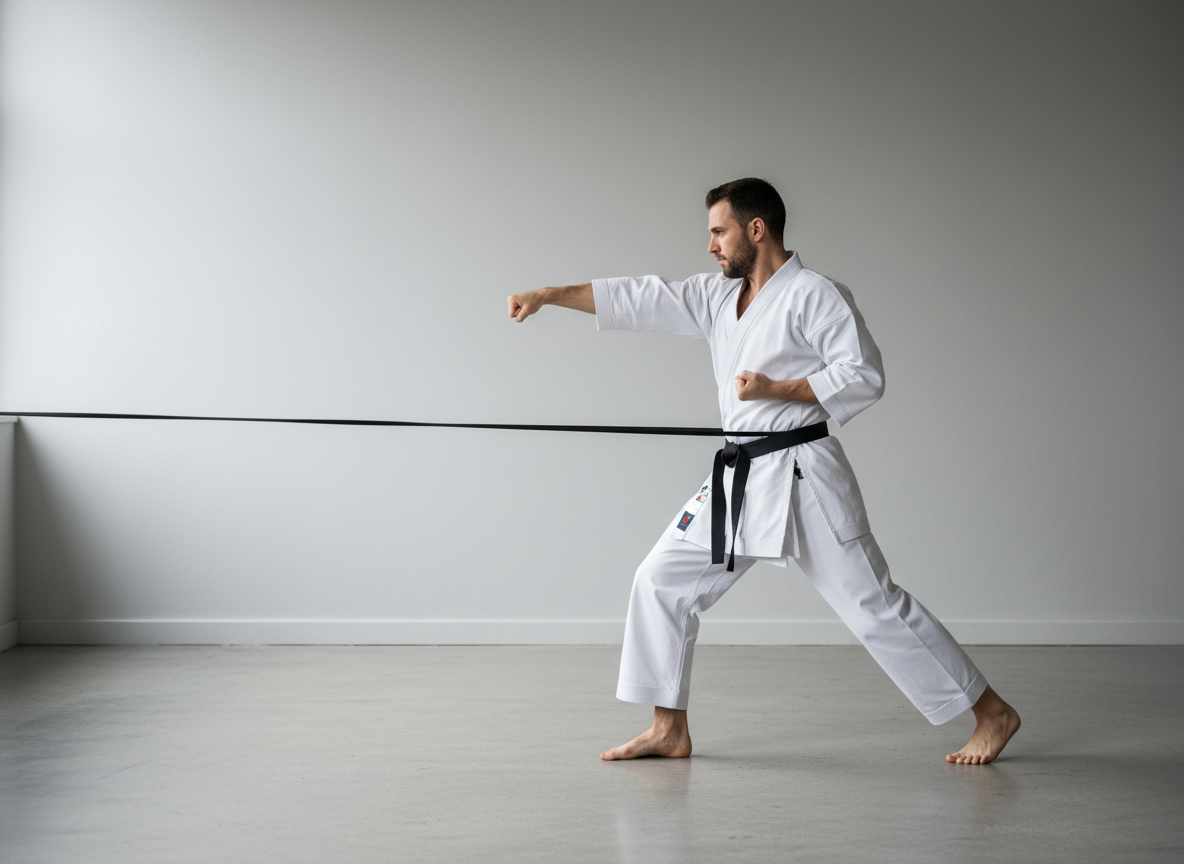
The conditioning activity consisted of two sets of five maximal Gyaku-Zuki punches performed against an elastic resistance band. The band was standardised to an initial resistance of 30 ± 2 newtons at the starting position. Importantly, this was an initial tension rather than a constant force because elastic resistance changes as a band stretches.
The researchers measured the punches with a three-dimensional motion-capture system operating at 340 Hz. They examined mean punch velocity, peak punch velocity and punch execution time at different points following the conditioning activity. The data were analysed using repeated-measures analysis of variance and Bonferroni-adjusted post hoc comparisons.
Punch velocity improved most after eight minutes
The clearest change occurred eight minutes after the resistance-band exercise. Mean punch velocity was 14.4% higher than baseline at this point, a statistically significant difference with p = 0.001.
At 12 minutes, mean punch velocity remained 12.3% higher than baseline, with p = 0.002. The overall effect of time on mean punch velocity was large, with a partial eta squared value of 0.804.
Peak punch velocity followed a more complicated pattern. It initially decreased at 15 seconds after conditioning but increased at eight minutes. The overall time effect for peak velocity was also large, with partial eta squared of 0.642.
Punch execution time became shorter from 15 seconds through 12 minutes, with the largest reduction occurring at eight minutes. Its overall time effect had a partial eta squared of 0.773.
The results point to an eight-to-12-minute window
Taken together, the measurements suggest that the most favourable period followed several minutes after the conditioning exercise. The researchers identified eight to 12 minutes after resistance-band punching as the period with the clearest kinematic improvements.
This distinction is important because the findings do not show that athletes should perform resisted punches immediately before striking. Peak punch velocity actually fell at the earliest 15-second measurement, illustrating the balance between residual fatigue and subsequent performance enhancement.
What the findings could mean for karate training
The study provides evidence that a simple, movement-specific resistance-band exercise could have a place in pre-performance preparation for trained karate athletes. Resistance bands are portable and allow athletes to condition the same basic striking movement that they subsequently perform without resistance.
For coaches, the results also emphasise that the recovery interval may be as important as the exercise itself. If the effect is replicated in larger samples and competition settings, warm-up routines could potentially be timed so that athletes enter their performance window after the immediate fatigue from resisted punching has subsided.
The findings are specifically about punch kinematics. Faster movement does not automatically mean a punch will deliver greater impact force, score more effectively in competition or improve overall match performance.
Important limitations
The sample was small, comprising only 15 athletes, and all participants were elite male Shotokan karate practitioners. The findings therefore cannot automatically be generalised to female athletes, younger competitors, recreational practitioners, other karate styles or other combat sports.
The researchers also standardised the band’s initial tension rather than the resistance experienced throughout the entire punch. Because elastic tension rises as the band elongates, athletes were not exposed to a constant 30-newton load during the movement.
The study focused on three-dimensional kinematics and did not include kinetic measurements such as impact force. It therefore cannot establish whether the observed increases in velocity translated into harder or more effective punches.
Finally, the experiment assessed an acute response under controlled conditions. Further work would be needed to establish whether the same timing and magnitude of improvement occur during real tournaments, after different warm-up routines or when athletes are already fatigued from previous bouts.
A practical effect with a narrow interpretation
The results offer a useful example of why sports warm-ups should be evaluated not only by what athletes do, but also by when subsequent performance is measured. In these elite male karate athletes, resistance-band punching was followed by the clearest improvement after an eight-minute recovery period.
The 14.4% increase in mean punch velocity is substantial within this experiment, but the small and specialised sample means it should be treated as a promising sport-specific finding rather than a universal warm-up prescription.
Source Information
Study: The effects of resistance band-induced post-activation performance enhancement on Gyaku-Zuki punch kinematics in elite male karate athletes
Authors: Sina Najafpoor, Hamed Fadaei and Hakimeh Adigozali
Journal: BMC Sports Science, Medicine and Rehabilitation
Published: 24 September 2026
DOI: 10.1186/s13102-026-02118-5
Study type: Randomised, counterbalanced crossover study
Sample: 15 elite male Shotokan karate athletes