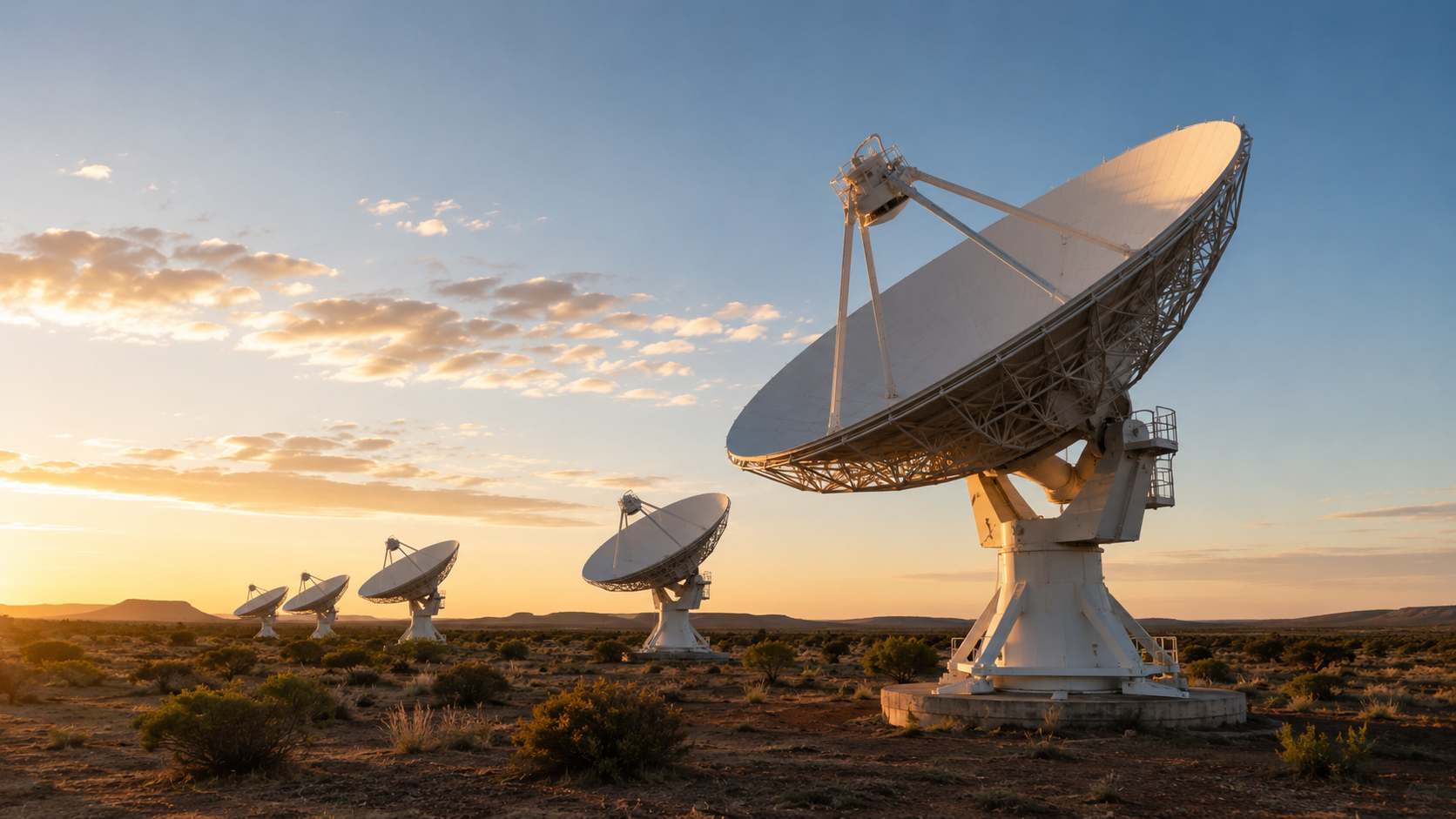








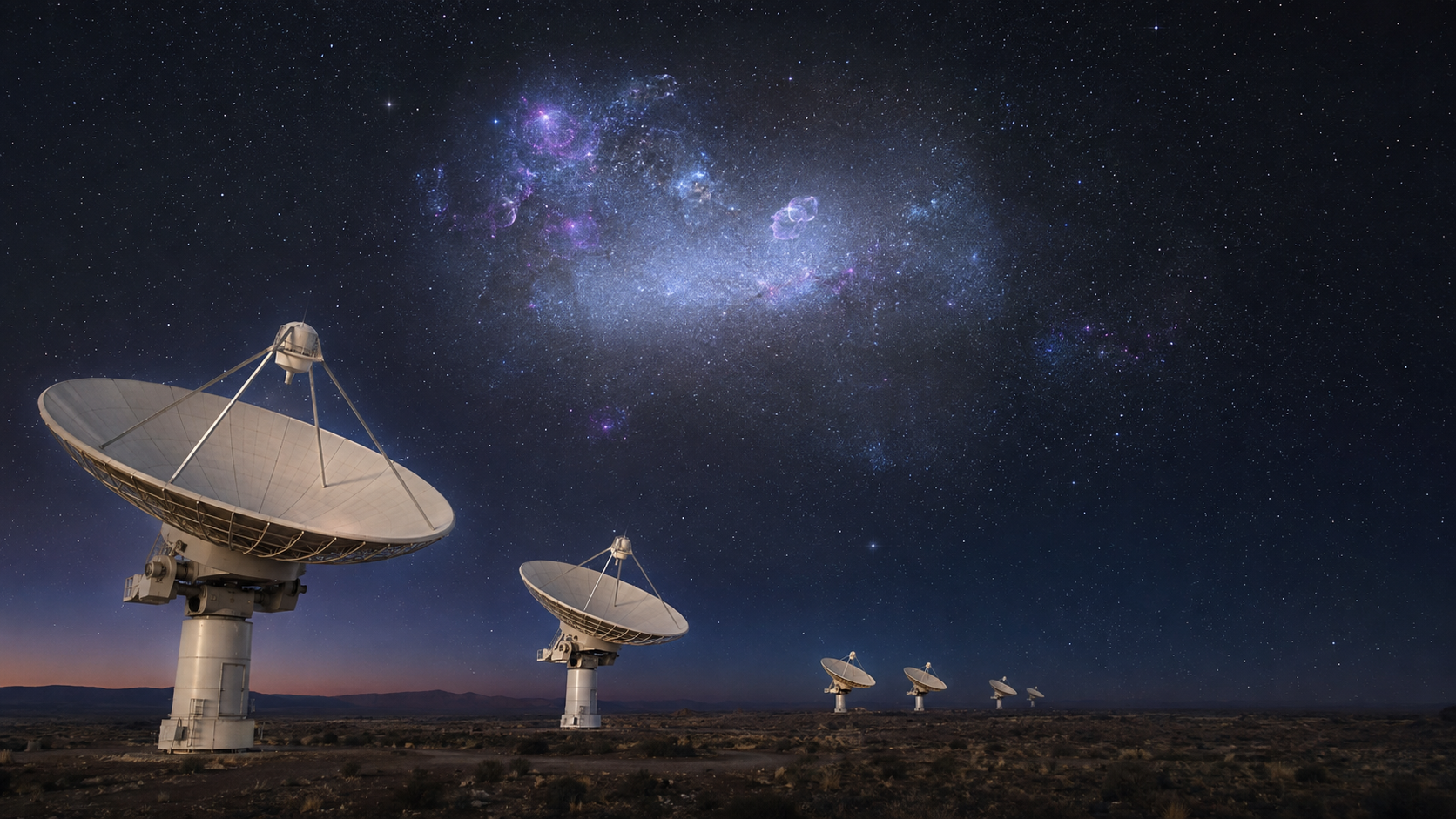
South Africa’s MeerKAT telescope has produced a new radio survey of the Large Magellanic Cloud, revealing a possible previously unknown supernova remnant, stars not detected before at radio wavelengths and several unusual objects far beyond the galaxy itself.
The first data release provides a sharper and more sensitive radio view of the Large Magellanic Cloud than earlier surveys conducted at similar frequencies.
Published in the Monthly Notices of the Royal Astronomical Society, the study used 258.4 hours of MeerKAT observations to build a detailed mosaic from 207 individual telescope pointings. The final images cover six overlapping fields and achieve a resolution of approximately eight arcseconds.
A Nearby Laboratory for Studying Galaxies
The Large Magellanic Cloud is a small neighbouring galaxy interacting with the Milky Way. It lies roughly 50 kiloparsecs—or about 160,000 light-years—from Earth.
Its relative proximity allows astronomers to examine individual stars, nebulae and supernova remnants while still studying how these objects behave as parts of a complete galaxy.
MeerKAT observed the galaxy at radio frequencies centred near 1.3 gigahertz. Radio telescopes detect forms of emission that may be faint, obscured or entirely invisible in ordinary optical images.
The South African telescope’s sensitivity to both compact sources and large, faint structures allowed the researchers to see features that previous observations had not clearly resolved. Compared with an earlier ASKAP survey, the MeerKAT images offered almost twice the angular resolution, improved sensitivity and more precise positioning of detected objects.
A Possible Supernova Remnant
Among the survey’s initial findings is a circular radio structure designated MCSNR J0455−6925.
The object has a shell-like shape measuring approximately 30 parsecs across at the distance of the Large Magellanic Cloud. It appears strongly in radio observations but does not have matching hydrogen-alpha emission in optical data—a pattern that can indicate radiation produced by energetic particles rather than hot ionised gas.
These characteristics make it a possible supernova remnant: the expanding debris left behind when a massive star explodes.
However, the classification remains provisional. The object is faint and located within more complicated surrounding radio emission. The researchers could not obtain a sufficiently reliable radio spectral index to confirm its physical nature from the MeerKAT data alone.
The survey also showed that a previously known supernova remnant, J0450.4−7050, extends farther than astronomers had recognised. MeerKAT detected faint filamentary structures beyond its earlier measured boundaries.
Dying Stars Become Visible in Radio
The new images also revealed radio emission from several planetary nebulae that had previously been identified through optical surveys but not detected at radio wavelengths.
Planetary nebulae form when ageing stars expel their outer layers. Radio observations can help astronomers measure the ionised material surrounding these stars, including gas that may be difficult to study when dust obscures visible light.
Three newly detected examples produced radio signals as faint as 0.06 millijanskys. The researchers expect the full MeerKAT data set could eventually reveal radio emission from more than half of the 431 known planetary nebulae in the Large Magellanic Cloud.
The survey also detected four Wolf–Rayet stars—massive, evolved stars that lose material through powerful stellar winds. One of these had not previously been detected at radio wavelengths. Such observations may help researchers estimate how quickly these stars are losing mass.
The Survey Sees Beyond Its Main Target
Not everything visible in the images belongs to the Large Magellanic Cloud.
The broad survey field also contains foreground stars within the Milky Way and distant galaxies located far behind the Magellanic system.
One diffuse circular source may belong to the unusual class known as odd radio circles: enormous rings of radio emission surrounding distant galaxies. The researchers measured the structure at a possible physical diameter of approximately 270 kiloparsecs, but further evidence is needed before it can be securely classified.
Another distant object, a bent-tail radio galaxy nicknamed “Rhabdomys” because of its mouse-like shape, has a radio tail extending approximately 350 kiloparsecs from its central active galaxy.
A South African Scientific Resource
MeerKAT is operated by the South African Radio Astronomy Observatory, a facility of the National Research Foundation. Several researchers affiliated with SARAO and Rhodes University contributed to the survey and its analysis.
The project demonstrates how South African astronomy infrastructure can produce open scientific data with value far beyond a single discovery.
This paper presents only the first release and a selection of promising objects. It is not a complete analysis of every source in the images. Separate catalogues and more focused studies will be required to confirm candidates and investigate the wider population of stars, remnants and distant galaxies.
MeerKAT has therefore done more than photograph a neighbouring galaxy.
It has created a detailed radio map in which many of the most valuable discoveries may still be waiting to be identified.
Source Information
Study Title: The MeerKAT 1.3 GHz survey of the Large Magellanic Cloud
Authors: W. D. Cotton et al.
Journal: Monthly Notices of the Royal Astronomical Society
Published: 23 May 2026
DOI: 10.1093/mnras/stag963