






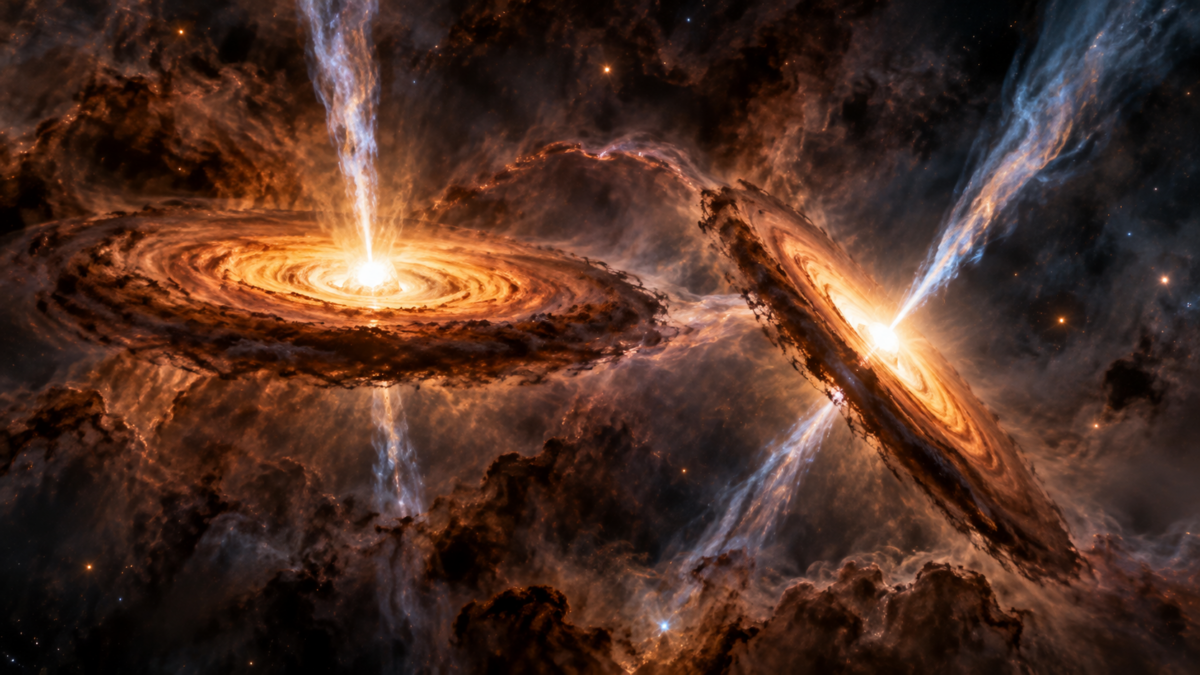
Stars are normally imagined as being born together when they belong to the same binary system.
Two stars form from the same collapsing cloud or disk of gas, grow alongside each other and eventually settle into an orbit that can last millions or even billions of years.
A newly observed pair of massive young stars appears to have taken a considerably more chaotic route.
Astronomers studying a system known as IRAS 07299−1651 have reconstructed the three-dimensional motion of two massive protostars that are still actively growing.
Their results suggest that the stars may not have formed together at all.
Instead, they appear to have started forming independently before experiencing a close gravitational encounter that brought them together into their present configuration.
In representative orbital solutions, their closest encounter occurred only about 60 years before the observations.
That is effectively yesterday on an astronomical timescale.
The study, published on 7 September 2026 in Nature Astronomy, provides some of the strongest observational evidence yet that massive binary stars can form when two independently developing stars encounter one another while they are still young.
And astronomers were able to watch enough of their motion over nearly eight years to reconstruct how the encounter unfolded.
These stars are still being born
The two objects are not mature stars like the Sun.
They are protostars.
Each is still accumulating gas and dust from the dense cloud surrounding the system.
Massive stars develop quickly compared with stars like the Sun and often spend their earliest stages buried inside thick concentrations of material that block ordinary visible light.
This makes their formation especially difficult to observe.
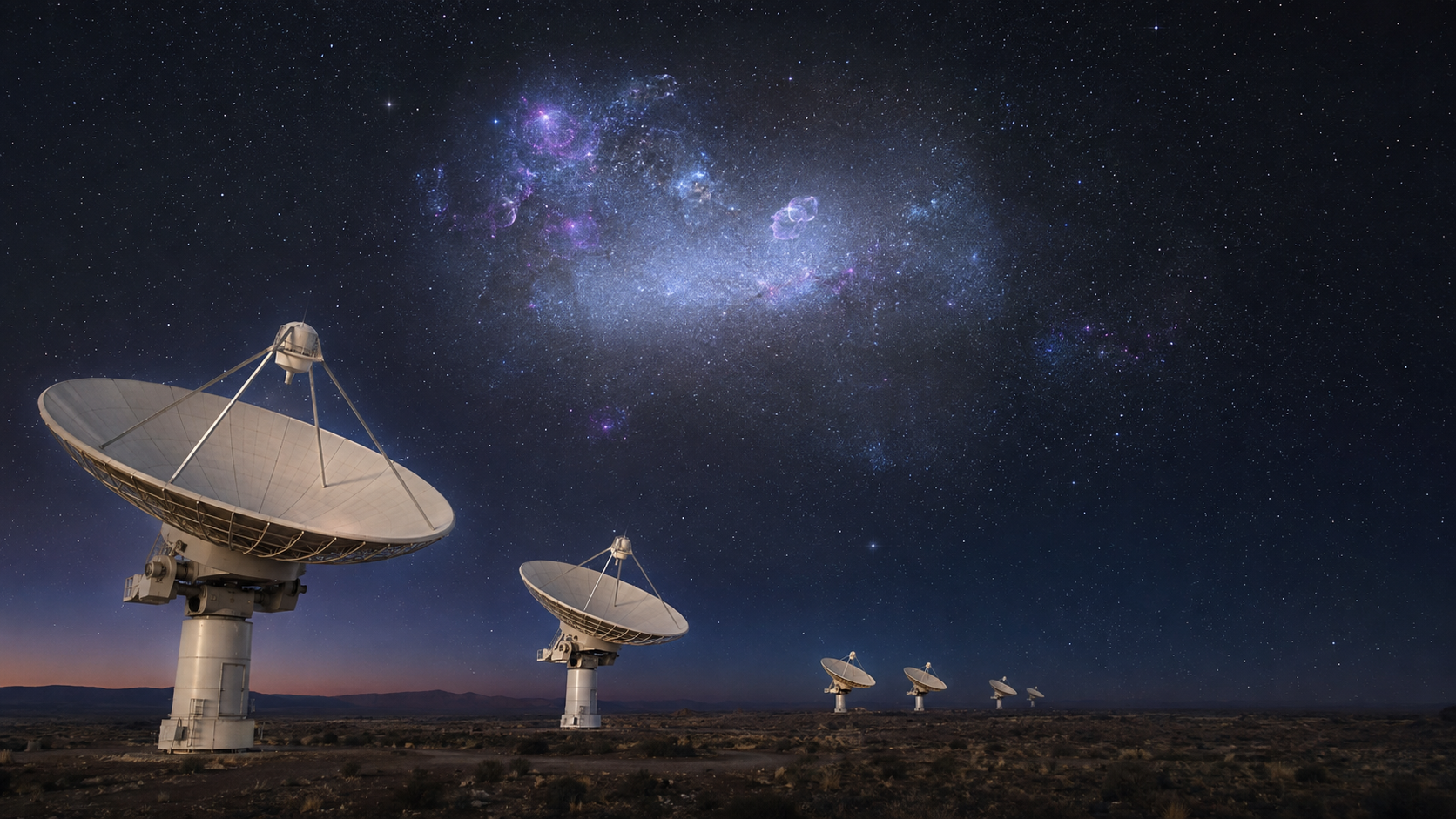
Radio telescopes such as the Atacama Large Millimeter/submillimeter Array, better known as ALMA, can peer through much of this obscuring material and detect radiation emitted by the gas and dust surrounding young stars.
That ability allowed researchers to follow subtle changes in the positions of the two protostars across almost eight years.
The shifts were tiny.
But they were enough to reveal that the stars were moving around one another.
Astronomers effectively watched the orbit develop
Earlier observations of the same system had already suggested that IRAS 07299−1651 contained two massive protostars.
At first, the system appeared broadly compatible with one of the standard explanations for massive binary formation.
A large rotating disk of material could have fragmented into two concentrations, with each eventually developing into a star.
If that had happened, the stars would essentially have grown up together.
But one detail was difficult to explain.
The disks surrounding the two stars were not neatly aligned.
The researchers therefore continued observing the system.
By tracking the stars’ movements with ALMA and combining them with observations from the Very Large Array, the James Webb Space Telescope and the European Southern Observatory’s Very Large Telescope, they were eventually able to reconstruct the system in three dimensions.
What emerged was considerably messier than a pair of stars calmly developing inside one shared disk.
The orbit is extremely stretched
The stars do not appear to follow a neat circular path around one another.
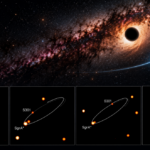
The preferred orbital solutions are highly eccentric and close to parabolic.
An eccentric orbit is strongly elongated rather than circular.
A near-parabolic trajectory is particularly interesting because it sits close to the dividing line between an object being securely gravitationally bound and one being able to escape.
The two stars currently have a separation of approximately 200 astronomical units.
One astronomical unit is the average distance between Earth and the Sun.
So even though astronomers describe this as a relatively close massive binary, the stars are currently separated by roughly 200 times the Earth-Sun distance.
The important evidence comes not simply from their current separation but from the reconstructed trajectory that brought them there.
Their disks point in different directions
The gas disks surrounding the two young stars provide another clue.
Young stars usually grow by drawing material from rotating disks around them.
If two stars formed together through the fragmentation of one larger disk, astronomers would generally expect their smaller disks and their shared orbit to retain at least some common orientation.
That is not what the researchers observed.
The disks around the two stars are strongly tilted relative to each other.
They are also misaligned with the orbital plane of the binary.
Jets of material launched away from the stars, visible in infrared observations, reinforce this picture because their directions provide information about the orientations of the individual systems.
The resulting geometry looks less like two stars that developed together and more like two independent systems that were brought together later.
The stars may have met by chance
The researchers propose what they describe as a core-merger scenario.
In this picture, the two protostars began forming separately in different dense cores of gas.
Those cores were initially not gravitationally bound to one another.
As they moved through the crowded star-forming environment, however, they experienced a close encounter.
Gravity dramatically changed their trajectories.
The stars then emerged in the highly eccentric configuration observed today.
Rather than being siblings born from the same disk, they may be closer to two young stars that encountered one another and became partners afterwards.
The closest encounter may have happened around 60 years ago
One of the most remarkable aspects of the reconstruction is how recently this may have occurred.
In representative orbital solutions, the stars passed closest to one another only about 60 years before the observations.
For comparison, massive stars can live for millions of years.
Sixty years is therefore an extraordinarily short interval.
The encounter is not something that occurred in some remote chapter of the system’s history that astronomers are trying to infer after millions of years of evolution.
The system still carries the architecture of the event.
Its disks remain sharply misaligned.
The stars are still actively forming.
And astronomers can measure their movement directly.
The disks survived the encounter
A close encounter between two massive protostars is not a gentle event.
Each object is surrounded by gas and dust that can be disrupted by the gravity of the other star.
Yet the observations reveal compact, well-defined circumstellar disks around both stars.
This means the disks appear to have survived the interaction sufficiently intact to continue rotating and feeding material onto the young stars.
That provides another glimpse of how dynamic massive star-forming regions can be.
A stellar system does not necessarily need to develop through an orderly sequence in which everything remains aligned from birth.
Close encounters can rearrange an emerging system while star formation itself is still underway.
Massive stars are rarely alone
The result matters because massive stars have an unusually strong tendency to occur with companions.
At least 90% of massive stars are thought to exist in binary or higher-order multiple systems.
Understanding how these systems form is therefore central to understanding the evolution of massive stars more generally.
Binary companionship can change almost everything about a star’s later life.
Stars can exchange mass.
One star can strip material from another.
They can eventually produce supernovae, neutron stars or black holes.
In sufficiently compact systems, the remnants can later collide and produce gravitational waves.
The way a binary is assembled during its earliest stages therefore influences events that may occur millions of years later.
Astronomers have several competing explanations
There is no single accepted mechanism responsible for every massive binary.
One possibility is disk fragmentation, where a large disk around a forming star becomes unstable and produces a second object.
Another is core fragmentation, where a collapsing cloud divides into multiple dense regions that subsequently form stars.
Dynamical interactions and gravitational capture provide another route.
The difficulty has been determining which mechanism produced an individual binary.
By the time most massive binary systems become easy to observe, the evidence from their formation has already been partly erased.
The stars have moved, disks may have disappeared and interactions may have altered their orbits.
IRAS 07299−1651 is valuable precisely because astronomers are observing the system while that history is still visible.
It took four major observatories to reconstruct the story
No single telescope provided the entire answer.
ALMA supplied the exceptionally precise measurements required to detect the motion of the stars and resolve their compact disks.
The Karl G. Jansky Very Large Array provided additional radio observations.
JWST supplied infrared imaging capable of examining the deeply embedded system and its surrounding structures.
The Very Large Telescope contributed further infrared observations, including information about jets associated with the stars.
Combining these datasets allowed the researchers to determine not only where the stars were located but also how their disks rotated and how material was moving around them.
The result was what the researchers describe as a full three-dimensional reconstruction of the system.
This is not literally a video of two stars colliding
The phrase “watching a binary assemble in real time” needs some context.
Astronomers did not record a cinematic collision between two visible stars.
The close encounter itself occurred before the observational campaign.
Instead, they repeatedly measured the system over nearly eight years.
Those measurements captured enough orbital motion to allow the trajectory to be reconstructed backwards.
The evidence therefore comes from precise astrometry, gas kinematics, disk orientations and orbital modelling rather than from a direct visual recording of the encounter.
There is also no indication that the two stars physically collided.
They experienced a close gravitational encounter.
That distinction is important.
They may not remain together forever
There is another twist.
The researchers cannot yet say with certainty that the two stars will remain a permanent binary.
Their reconstructed motion lies close to the boundary between a gravitationally bound orbit and a trajectory from which the stars could eventually separate.
The surrounding gas complicates the situation further.
Interactions between the stars and their environment can remove or add orbital energy, potentially pushing the system towards a more securely bound state or allowing the stars to drift apart.
Future observations will reveal which outcome becomes more likely.
This uncertainty is not a weakness of the study.
It is one of the reasons the system is scientifically valuable.
Astronomers may be observing a stellar partnership before its final fate has been decided.
The result could change how some massive binaries are explained
One unusual system does not mean most massive binaries form through chance encounters.
The study examines a single protobinary, and astronomers will need to reconstruct the motions of many more young systems before determining how common this pathway is.
Dense star-forming regions nevertheless provide exactly the environment in which interactions between young stars and gas cores can occur.
If other systems show similarly eccentric orbits and strongly misaligned disks, the core-merger mechanism could become an important part of the explanation for why massive binaries are so common.
The observational technique may be as important as the individual discovery.
ALMA has now demonstrated that astronomers can track the tiny movement of deeply embedded massive protostars over several years and reconstruct their three-dimensional orbits.
Applying the same method elsewhere could turn stellar formation from something largely inferred after the fact into a process astronomers can increasingly watch unfold.
The birth of stars may be considerably messier than it looks
Images of star-forming regions can create the impression of a slow and almost orderly process.
Gas collapses.
A disk forms.
A star grows at its centre.
Reality can be far more chaotic.
Young stars form inside crowded clouds where gravity, turbulence, gas flows and neighbouring objects constantly interact.
IRAS 07299−1651 appears to preserve an unusually clear example of that chaos.
Two massive stars may have begun their lives separately.
They encountered each other while they were still growing.
Their disks survived but ended up pointing in very different directions.
And only decades after their closest encounter, astronomers began measuring the gravitational dance that followed.
For events involving stars that will live for millions of years, catching one within decades of a potentially system-defining encounter is about as close to real time as astronomy gets.
Source Information
Study Title: An eccentric massive protobinary assembled via a core-merger parabolic encounter
Authors: Yao Wang, Yichen Zhang, Rubén Fedriani, Kei E. I. Tanaka, Viviana Rosero, Kai Yang et al.
Journal: Nature Astronomy
Published: 7 September 2026
Object: IRAS 07299−1651
Current stellar separation: Approximately 200 astronomical units
Observational baseline: Nearly eight years
Observatories: ALMA, Karl G. Jansky Very Large Array, James Webb Space Telescope and Very Large Telescope
Proposed formation mechanism: Close encounter and core merger between independently forming protostars
DOI: 10.1038/s41550-026-02953-z