







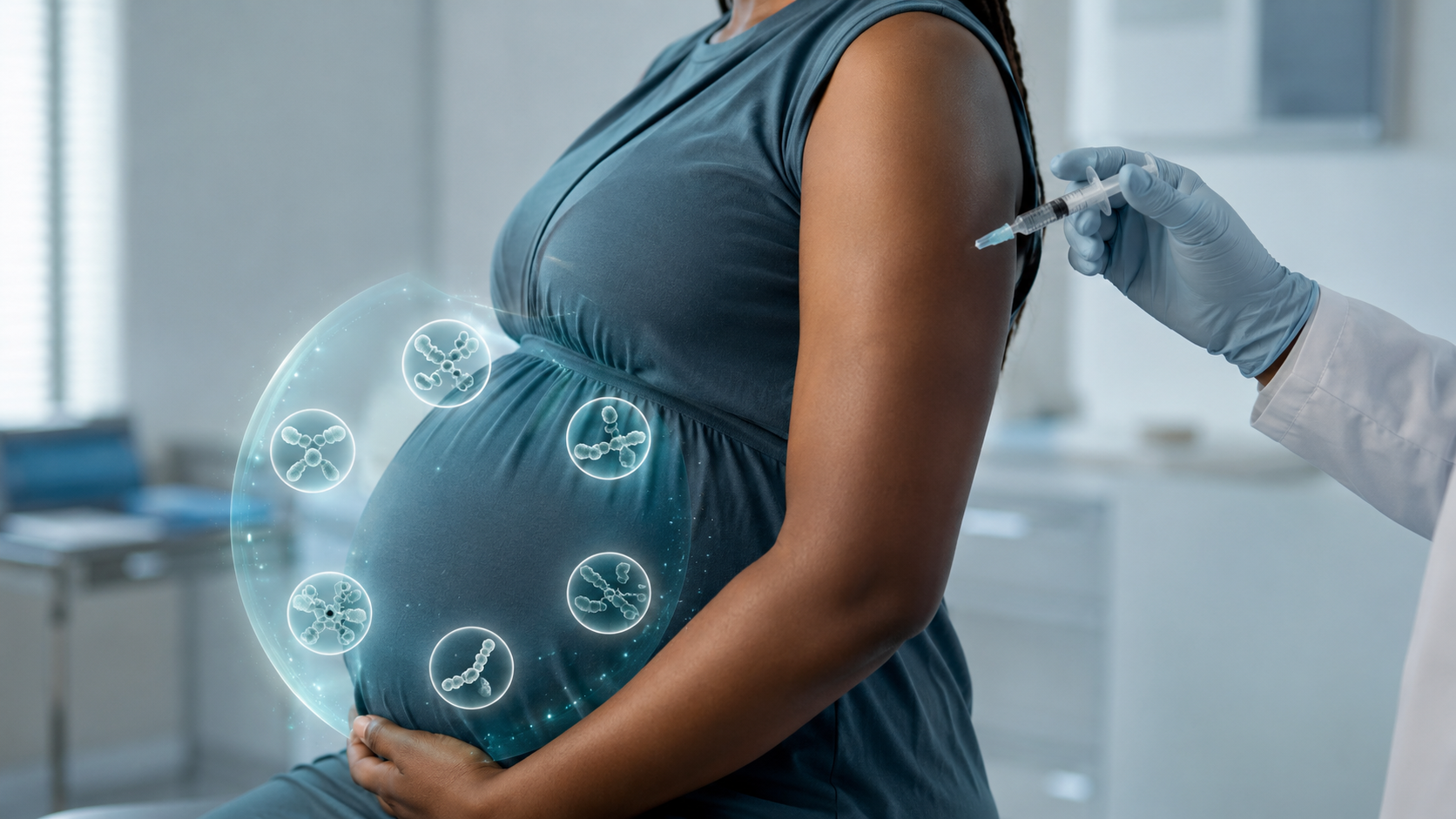
A vaccine given during pregnancy produced strong antibody responses that were passed from mothers to their babies in a new clinical trial, moving researchers another step closer to preventing Group B Streptococcus infections during the earliest and most vulnerable months of life.
For most healthy adults, Group B Streptococcus causes little reason for concern.
The bacterium commonly lives in the gastrointestinal or genital tract without causing illness. During pregnancy and childbirth, however, the situation can change.
A mother carrying the bacterium can pass it to her baby, and in a small number of cases the result can be severe.
Newborns who develop invasive Group B Streptococcus, or GBS, can experience sepsis, pneumonia or meningitis. The infection can develop within days of birth or appear later during the first months of life.
There is still no licensed vaccine specifically designed to prevent GBS disease.
A new trial published in Nature Medicine suggests researchers may be moving closer to one.
The vaccine targets six forms of the bacterium
Researchers tested an experimental vaccine known as GBS6.
Unlike vaccines aimed at a single form of a pathogen, GBS6 contains components targeting six different GBS serotypes: Ia, Ib, II, III, IV and V.
These represent important forms of the bacterium associated with invasive disease.
The idea behind maternal vaccination is relatively straightforward.
Rather than waiting until a newborn is old enough to generate its own immune response, the vaccine is given during pregnancy. The mother’s immune system produces antibodies, some of which cross the placenta before birth.
The baby therefore enters the world carrying part of the mother’s immune protection.
This strategy is already used with other maternal vaccines. The challenge for GBS has been developing a vaccine capable of producing sufficiently broad and durable antibody responses while maintaining an acceptable safety profile during pregnancy.
The trial included mothers and babies in South Africa
The phase 1/2 trial was conducted in several stages.
Earlier stages included participants in South Africa, while the later maternal portion enrolled pregnant women in South Africa, the United States and the United Kingdom.
In that stage, 216 pregnant participants were randomly assigned to receive either GBS6 or a placebo between 24 and 36 weeks of pregnancy.
Half received the vaccine and half received placebo.
A total of 209 infants were born to participants in this part of the study.
The researchers were primarily examining safety and tolerability rather than testing whether the vaccine could already prevent large numbers of GBS infections.
On that measure, the results were encouraging.
Rates of adverse events and serious adverse events were broadly similar between the vaccine and placebo groups, both among mothers and their infants.
Most babies were born full-term.
Babies received antibodies before birth
The immune-response results provide the more important clue about what the vaccine may eventually achieve.
Pregnant participants who received GBS6 developed strong antibody responses against the six targeted serotypes.
Those antibodies were also detected in their babies at birth.
Researchers measured both the quantity of antibodies and whether those antibodies could perform useful immune functions against the bacteria.
The infants showed serotype-specific antibody responses corresponding to the vaccine their mothers had received.
That does not yet prove that vaccinated mothers’ babies will be protected from GBS disease in everyday healthcare.
It does demonstrate one of the mechanisms a successful maternal vaccine would need.
The mother’s immune response was reaching the child.
Current prevention has an important gap
GBS is already preventable to some extent.
Pregnant women can be screened for the bacterium, and antibiotics given during labour can substantially reduce the risk of early-onset infection in newborns.
But antibiotics have limits.
They primarily target transmission around the time of delivery. They do not offer the same solution for GBS infections that occur later in infancy, nor do they address every pregnancy-related consequence associated with the bacterium.
Globally, the scale is substantial.
The World Health Organization estimates that GBS contributes to more than 500,000 premature births and roughly 150,000 stillbirths and infant deaths each year.
That is why researchers have pursued a maternal vaccine for decades.
A successful vaccine would potentially protect infants before they are old enough to receive vaccinations themselves, while reducing dependence on identifying maternal carriage and administering antibiotics during labour.
South Africa is central to this research
South Africa is not simply a convenient comparison point for this study.
A substantial part of the clinical programme was conducted locally, and the paper’s first author, Professor Shabir Madhi, is based at the University of the Witwatersrand and the South African Medical Research Council’s Vaccines and Infectious Diseases Analytics Research Unit.
South Africa has also played an important role in maternal and childhood vaccine research more broadly.
That makes the study unusually relevant locally.
Many major medical discoveries are reported from clinical populations that differ considerably from those found in South Africa. Here, South African participants were included directly in the development programme.
The later phase of the trial still included participants from multiple countries, which allows researchers to examine the vaccine across different populations while retaining meaningful African representation.
This is not yet a vaccine available to mothers
The study remains an early-stage clinical trial.
That distinction matters.
GBS6 is investigational and is not currently a licensed maternal GBS vaccine.
The trial was designed largely to describe safety and immune responses. It was not large enough to determine definitively whether vaccination reduces serious GBS disease, hospitalisation or death among babies.
In fact, no cases of confirmed early- or late-onset GBS disease occurred among infants during the study period, making it impossible to compare actual disease prevention between the vaccine and placebo groups.
Researchers will therefore need larger studies capable of evaluating clinical protection.
The study was also sponsored by Pfizer, the company developing the vaccine. The authors disclosed that involvement in the published paper.
The next question is whether antibodies become protection
Vaccine development often advances through several questions.
Can the vaccine be given safely?
Does it trigger the intended immune response?
Does that response reach the people who need protection?
And finally, does it prevent disease in the real world?
The new research provides encouraging answers to some of the earlier questions.
The most important one remains. Researchers now need to establish how reliably the antibodies generated by GBS6 translate into protection against severe infection during infancy.
If that evidence follows, maternal vaccination could eventually add another layer of protection during a period when newborns have few defences of their own.
The promise of the vaccine is therefore not that babies would need another injection soon after birth.
It is that some protection could already be waiting for them when they arrive.
Source Information
Study Title: Maternal 6-valent group B Streptococcus vaccine in non-pregnant and pregnant females: a randomized phase 1/2 trial
Authors: Shabir A. Madhi, Hasra Snaggs, Zahra Skogeby, Ye Feng, Shaun Barnabas, Jeffrey Baker, Lee Fairlie and colleagues
Journal: Nature Medicine
Published: 28 July 2026
DOI: 10.1038/s41591-026-04558-5