






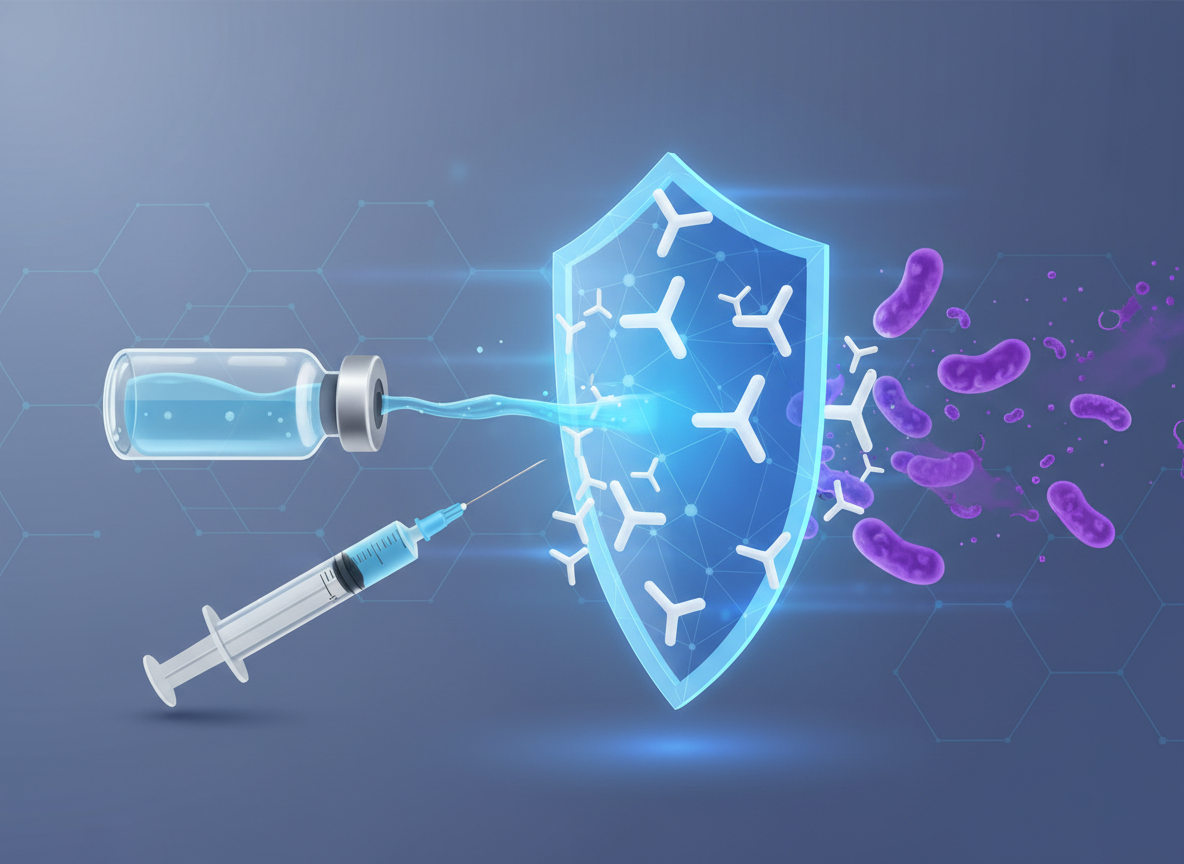
A vaccine already used against meningococcal disease may also stimulate immune responses against the bacterium that causes gonorrhoea.
That does not yet mean the vaccine has been proven to prevent gonorrhoea infections.
But new randomized trial evidence provides a clearer biological explanation for why researchers have been investigating that possibility.
A phase 2 study published in Nature Communications on 23 September 2026 found that two doses of the four-component meningococcal serogroup B vaccine, known as 4CMenB, induced antibodies that recognised outer-membrane-vesicle antigens from Neisseria gonorrhoeae.
The trial included 52 healthy adults aged 18 to 49 years who had no history of gonorrhoea and were considered at low risk of infection. Forty-one participants received the vaccine and 11 received placebo.
The strongest responses were seen in blood, where vaccine-induced IgG antibodies rose sharply after vaccination and remained elevated months later. Smaller mucosal responses were also detected in vaginal, rectal and salivary samples.
The findings support the idea that a vaccine designed for one Neisseria species may generate immune responses that also recognise another closely related species.
Gonorrhoea remains difficult to prevent with vaccination
Gonorrhoea is caused by the bacterium Neisseria gonorrhoeae.
Unlike several other major bacterial infections, there is currently no widely licensed vaccine specifically designed to prevent gonorrhoea.
Developing one has been difficult because the bacterium can vary the proteins displayed on its surface and can repeatedly infect people without reliably generating long-lasting protective immunity.
This makes it harder to identify immune targets that remain stable enough for a vaccine to provide broad protection.
Researchers have therefore been interested in an unusual clue: vaccines developed against meningococcal serogroup B may produce some immune responses that also recognise gonococcal bacteria.
The two bacteria are close relatives
Neisseria meningitidis, which can cause meningitis and bloodstream infection, and Neisseria gonorrhoeae belong to the same bacterial genus.
They are not the same organism and cause very different diseases.
However, they share enough biological features that some immune responses generated against meningococcal components may also recognise related gonococcal structures.
One component of the 4CMenB vaccine is derived from outer membrane vesicles.
Outer membrane vesicles are small packages released from the outer surface of certain bacteria. They contain proteins and other molecules that can be recognised by the immune system.
The new study specifically tested whether antibodies generated after 4CMenB vaccination could bind to outer membrane vesicles from two gonococcal strains.
The trial randomly assigned participants to vaccine or placebo
The study used a phase 2, double-blind, randomized, placebo-controlled design.
Participants were randomly assigned in a four-to-one ratio to receive either 4CMenB or placebo.
The first dose was given on day 1 and the second on day 29.
Participants were then followed through day 181, allowing the researchers to examine not only whether antibody responses appeared, but also how long they persisted.
The primary outcome focused on IgG antibodies in rectal mucosal secretions.
Serum antibody responses were a secondary outcome, while vaginal secretions and saliva were assessed as exploratory mucosal outcomes.
The strongest response appeared in the blood
At the start of the study, all participants already had detectable serum IgG against the gonococcal outer membrane vesicles being tested.
This baseline immunity likely reflects previous exposure to related bacterial antigens rather than previous gonorrhoea infection, because participants had no known history of the disease.
After 4CMenB vaccination, serum antibody levels increased substantially.
The responses peaked on day 43, approximately two weeks after the second vaccine dose.
Importantly, antibody levels remained elevated at day 181.
That persistence suggests that the cross-reactive immune response was not limited to a brief spike immediately after vaccination.
Mucosal immunity matters because gonorrhoea infects mucosal surfaces
Blood antibodies are useful to measure, but gonorrhoea is primarily transmitted and established at mucosal surfaces.
These include the genital tract, rectum and throat.
A vaccine that produces a strong blood response but little immunity at those sites may not necessarily provide effective protection where infection first occurs.
This is why the researchers placed particular emphasis on mucosal antibody responses.
At baseline, mucosal IgG against the gonococcal vesicles was already detectable in many participants.
After vaccination, additional responses were observed, although they were generally smaller than the serum responses.
The response differed depending on the body site
The mucosal response did not follow one identical pattern across the body.
The largest response was observed in vaginal secretions, where antibody levels peaked on day 43.
Rectal secretions and saliva showed smaller responses that peaked later, around day 57.
The researchers found little evidence of comparable vaccine-induced responses among placebo recipients.
This site-specific pattern is important because it suggests that systemic vaccination can influence immunity at mucosal surfaces, but not equally at every site.
The study measured immune responses, not infections prevented
This is the most important limitation when interpreting the result.
The trial was designed to test immunogenicity.
It asked whether vaccination produced antibodies that recognised gonococcal antigens.
It did not recruit a population at high risk of gonorrhoea and then measure whether vaccinated participants developed fewer infections than those receiving placebo.
The participants were specifically selected as healthy adults with no history of gonorrhoea and a low expected risk of infection.
The study therefore cannot provide a vaccine-effectiveness percentage against gonorrhoea.
Antibodies that bind to a pathogen are encouraging, but binding alone does not guarantee that those antibodies will prevent infection in real-world exposure.
A biological signal is still an important step
The absence of an infection endpoint does not make the study unimportant.
Vaccine development often proceeds in stages.
Researchers first need evidence that a vaccine generates the type of immune response that could plausibly contribute to protection.
If that signal is absent, a large efficacy trial becomes much harder to justify.
The new findings show that 4CMenB can produce both systemic and mucosal antibodies that recognise gonococcal outer membrane vesicles.
That strengthens the biological case for directly testing whether vaccination lowers infection risk.
The trial was small
Another limitation is the sample size.
Only 52 participants were enrolled, with 41 receiving vaccine and 11 receiving placebo.
That is reasonable for an early immunogenicity study, but it is far too small to determine how well the vaccine might prevent a relatively infrequent clinical outcome.
Larger trials would also allow researchers to examine whether responses differ by sex, age, prior bacterial exposure, anatomical site and other characteristics.
They would also be needed to determine whether the antibody responses measured in this study correlate with meaningful protection.
The result does not change current vaccine indications on its own
4CMenB is a meningococcal vaccine.
This study does not by itself establish a new licensed indication for preventing gonorrhoea.
That distinction matters because a promising immune response can sometimes fail to translate into meaningful protection in later clinical trials.
The appropriate interpretation is therefore that the vaccine generated cross-reactive antibodies and may have potential in gonorrhoea prevention, not that gonorrhoea vaccination has already been solved.
Why repurposing an existing vaccine would be attractive
If later studies confirm meaningful protection, using or adapting an existing vaccine platform could offer practical advantages.
Researchers would be starting from a vaccine technology that has already undergone extensive development for meningococcal disease.
That does not eliminate the need for gonorrhoea-specific efficacy, safety and policy evidence.
But it could shorten part of the path compared with building an entirely new vaccine concept from the beginning.
The study may also help researchers identify which shared antigens are most important, potentially informing future vaccines designed more directly around gonococcal protection.
The next question is whether these antibodies actually protect people
The phase 2 trial answers a mechanistic question.
Vaccination with 4CMenB can induce antibodies in blood and at several mucosal sites that recognise N. gonorrhoeae antigens.
The next step is a clinical one.
Researchers need to determine whether people who receive the vaccine are actually less likely to acquire gonorrhoea, whether protection differs between anatomical sites and how long any protection lasts.
Those questions require substantially larger studies in populations with enough gonorrhoea exposure to measure infection outcomes reliably.
The broader lesson is about cross-protection
Vaccines are usually named for the disease they are designed to prevent.
But immune systems respond to biological structures rather than product labels.
When two pathogens share related components, immunity directed against one organism can sometimes recognise the other.
The new trial shows that this principle is biologically plausible for 4CMenB and Neisseria gonorrhoeae.
Whether that immune cross-recognition becomes meaningful protection against gonorrhoea is now the more important question.
Source Information
Study Title: Systemic and Mucosal Antibody Responses Against Neisseria gonorrhoeae (Ng) Outer Membrane Vesicle Antigens following Four-Component Meningococcal Serogroup B (4CMenB) Immunization in Healthy Adults: A Randomized Phase II Trial
Authors: Varun K. Phadke, Soma Sannigrahi, Erin M. Scherer, Stacey A. Smith, Colleen F. Kelley, Maranda Leary, Sergio Cruz, Lori M. Newman, Christine Orndahl, E. Ross Colgate, Nadine Rouphael, Yih-Ling Tzeng and colleagues
Journal: Nature Communications
Published: 23 September 2026
Sample: 52 healthy adults aged 18–49 years with no history of gonorrhoea and low expected infection risk; 41 received 4CMenB and 11 received placebo.
Method: Phase 2, double-blind, randomized, placebo-controlled trial. Participants received two doses on days 1 and 29 and were followed through day 181. IgG responses against outer membrane vesicles from two N. gonorrhoeae strains were measured in rectal secretions, serum, vaginal secretions and saliva.
Main finding: Two-dose 4CMenB vaccination induced robust serum IgG responses against gonococcal outer membrane vesicles that remained elevated through day 181, as well as smaller site-specific mucosal responses. The study demonstrated cross-reactive immunity but did not test whether vaccination reduced gonorrhoea infections.
DOI: 10.1038/s41467-026-77936-9