








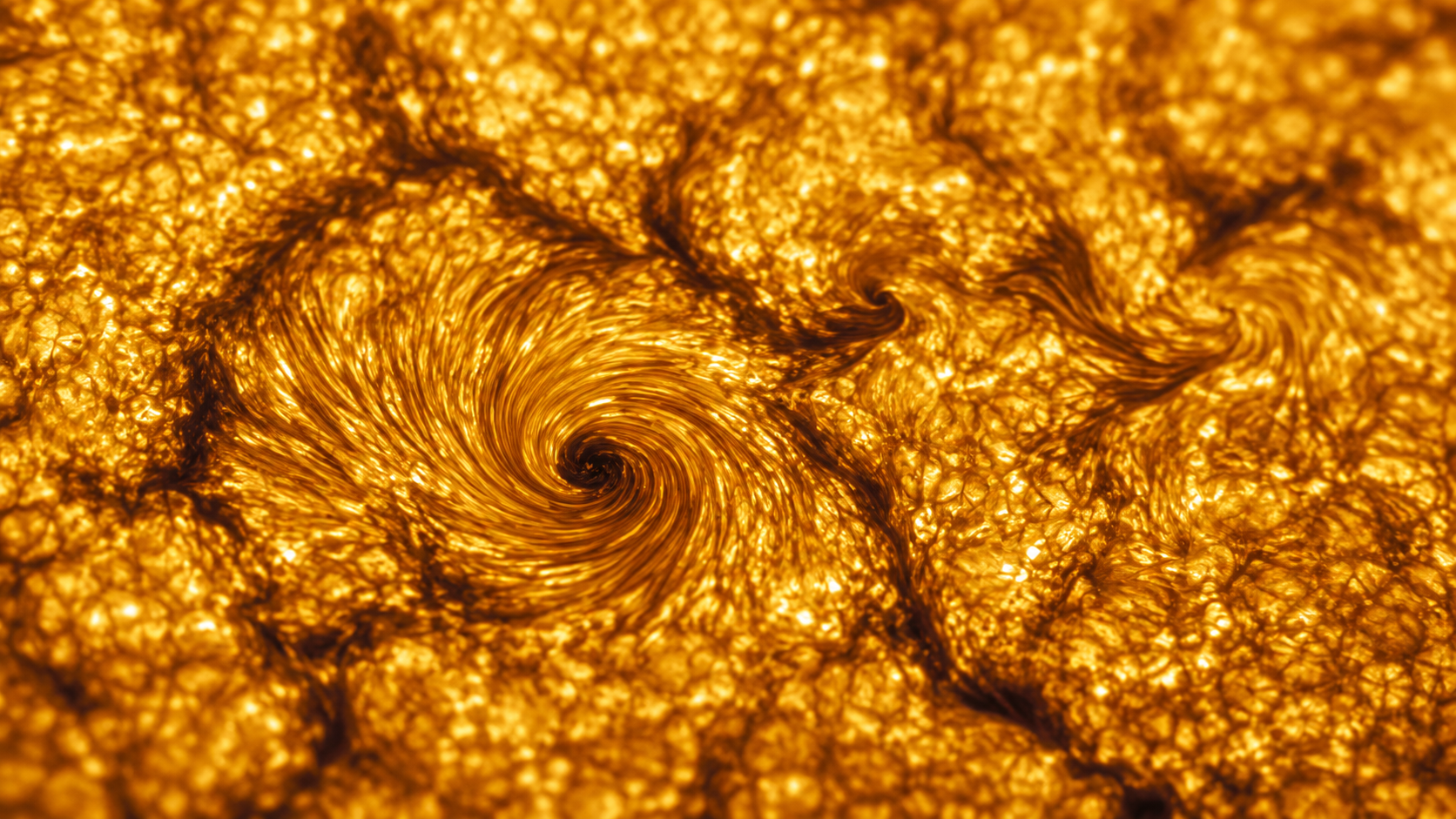
The sharpest observations yet of the Sun’s visible surface have revealed tiny swirling structures in its plasma that scientists had long predicted but never directly observed there before.
From Earth, the Sun looks remarkably simple.
A bright disc crosses the sky each day, apparently smooth enough that the enormous physical processes taking place across its surface remain invisible to the naked eye.
Move closer or build a powerful enough telescope and that simplicity disappears.
New observations from the Daniel K. Inouye Solar Telescope in Hawaii have revealed a surface filled with curling, vortex-like structures formed as streams of superheated plasma move past one another at different speeds.
Some measure only about 19 kilometres across.
That is extremely small by solar standards, and seeing structures at this scale has allowed scientists to confirm a physical process on the Sun’s visible surface that had previously existed mainly in theory and computer models.
The Sun’s surface is more turbulent than it looks
The part of the Sun that we normally see is called the photosphere.
It is not a solid surface like the ground beneath our feet. Instead, it is a relatively thin layer of hot plasma from which most of the visible sunlight reaching Earth escapes.
Plasma behaves somewhat like a fluid, but with an important difference: its particles carry electrical charge and interact strongly with magnetic fields.
That makes the photosphere a complicated environment.
Hot material rises from deeper inside the Sun, cooler material sinks, magnetic fields concentrate in particular regions and neighbouring flows can move at different speeds.
Researchers using the four-metre Inouye Solar Telescope were able to examine those interactions in unprecedented detail.
What emerged were repeated curled and feather-like structures forming along the boundaries of magnetised plasma.
Scientists recognised a familiar instability
The pattern has a name: Kelvin–Helmholtz instability.
The underlying physics is not unique to the Sun.
Imagine wind blowing across the surface of water. The air above and water below move at different speeds, allowing small disturbances at their boundary to grow into waves.
Something similar can happen when two layers of fluid or gas move past one another.
Under the right conditions, their boundary becomes unstable and begins curling into rolling vortices.
Kelvin–Helmholtz structures have been observed in Earth’s atmosphere and around planets such as Jupiter and Saturn.
Scientists have also studied them elsewhere in the solar environment.
What had been missing was direct confirmation at these tiny scales in the Sun’s photosphere.
The new observations provide that confirmation.
Some of the structures are only 19 kilometres wide
The Inouye Solar Telescope is currently the world’s most powerful solar telescope.
Its four-metre primary mirror gives researchers enough resolving power to separate features on the Sun that previous observations could blend together.
In the new images, scientists identified vortices ranging from roughly 19 kilometres to around 170 kilometres across.
That may sound enormous on Earth.
On a star approximately 1.4 million kilometres in diameter, they are minute.
The smallest are comparable in scale to the distance across a large city.
Researchers combined the observations with high-resolution computer simulations and found that the same Kelvin–Helmholtz structures could be reproduced numerically.
That agreement gives them greater confidence that the swirling patterns are not simply visual curiosities created by the telescope.
They represent a real physical process occurring across magnetically active regions of the Sun.
Tiny vortices could move enormous amounts of energy
The discovery matters because Kelvin–Helmholtz instability does more than produce attractive patterns.
It mixes material.
In magnetised plasma, that means it can also move energy, momentum and magnetic fields between neighbouring regions.
The Sun’s magnetic field is constantly stretched, twisted and rearranged by moving plasma. Energy can accumulate within those magnetic structures before eventually being released.
That release can sometimes become violent.
Solar flares can send enormous bursts of radiation into space, while coronal mass ejections can launch vast clouds of magnetised plasma away from the Sun.
If directed towards Earth, these events contribute to space weather capable of disturbing satellite operations, radio communications, GPS navigation and electrical infrastructure.
The newly observed vortices are not themselves giant solar eruptions.
Instead, researchers think they may form part of the much smaller-scale machinery that continually twists and mixes the magnetic field from which larger events eventually emerge.
They may also help explain a long-standing solar mystery
Another puzzle sits above the photosphere. The Sun’s visible surface is about 5,500°C.
Its outer atmosphere, the corona, can reach temperatures exceeding one million degrees.
That sounds backwards.
Normally, moving away from a heat source means temperatures fall. Yet the Sun’s tenuous outer atmosphere becomes dramatically hotter than the surface beneath it.
Scientists have proposed several mechanisms capable of carrying and releasing enough energy to heat the corona.
The new vortices add another piece to that problem.
Because Kelvin–Helmholtz instability can efficiently transport energy through plasma and twist magnetic fields into more complicated arrangements, widespread small vortices could contribute to moving energy upwards through the solar atmosphere.
That possibility is important. It is not yet a complete explanation.
The discovery began with telescope testing
There is also an unusual detail behind the finding.
The observations were originally taken partly to test and fine-tune what the Inouye Solar Telescope could achieve.
Only after researchers examined the exceptionally detailed data did the structures become apparent.
That is one of the advantages of improving scientific instruments.
A better telescope does not merely produce prettier versions of things researchers already know exist.
Sometimes it reveals phenomena that earlier instruments did not have the resolution to separate from the background.
The Inouye telescope can now examine the photosphere at scales that begin to approach the dimensions of some of the physical processes predicted by solar simulations.
Theory and observation are therefore meeting at a level that was previously inaccessible.
Scientists still need to connect the small and the enormous
The new study does not show that Kelvin–Helmholtz vortices directly cause individual solar flares or coronal mass ejections.
Nor does it solve the coronal-heating problem.
The observations were concentrated on a magnetically active region, and researchers still need to understand how common these instabilities are across different parts of the Sun and how much energy they transport in practice.
Their importance will ultimately depend on scale.
A 20-kilometre vortex is tiny compared with the Sun. But if similar structures occur continuously across large regions, their combined effect could become substantial.
That is now something astronomers can begin measuring rather than merely modelling.
For centuries, increasing magnification has repeatedly changed our picture of the universe.
The latest view of our own star has done something similar.
The Sun did not suddenly become more turbulent.
We have simply become able to see how turbulent it was all along.
Source Information
Study Title: Ubiquitous Kelvin–Helmholtz instabilities driving plasma mixing on the Sun
Authors: Friedrich Wöger, David Kuridze and colleagues
Journal: Nature
Published: 5 August 2026
DOI: 10.1038/s41586-026-10871-3