





Southeast Asia faces an unusually difficult electricity transition. Demand is rising quickly, coal and natural gas still dominate generation, and governments are simultaneously trying to cut emissions without weakening energy security. A new modelling study suggests that the region may face a choice more complicated than simply replacing fossil generation with ever larger amounts of renewable capacity.
Researchers modelling the Association of Southeast Asian Nations, or ASEAN, found that allowing carbon capture on existing and new fossil-fuel power plants substantially changed the least-cost shape of a deeply decarbonised 2050 electricity system. In their model, carbon capture did not crowd out solar power. Instead, dispatchable captured-carbon generation reduced the amount of solar capacity that had to be overbuilt, sharply cutting wasted renewable electricity and the battery storage needed to balance the grid.
The results are striking in several of the region’s largest power systems. By 2050, annual renewable curtailment in Vietnam fell from 240.47 TWh in the renewable-only scenario to 25.16 TWh when carbon capture was available. Indonesia fell from 86.50 TWh to 12 TWh, while the Philippines fell from 41.77 TWh to 8.36 TWh. Battery energy capacity was also more than 90% lower in Vietnam and roughly 70% to 75% lower in Indonesia and the Philippines.
But the study is a model of possible futures, not a forecast that these investments will occur. Its conclusions depend on assumptions about technology costs, carbon storage, future demand and policy. That distinction matters because the pathway it identifies would require carbon capture infrastructure on a scale that ASEAN has not yet built.
A power system growing faster than its carbon budget
The study, published in Scientific Reports on 27 September 2026, starts from the scale of ASEAN’s energy challenge. The region’s GDP increased from about US$0.94 trillion in 2005 to US$3.66 trillion in 2022. Installed power capacity almost tripled over the same period, from 109.7 GW to 315.3 GW.
Electricity generation exceeded 1,210 TWh, with coal and natural gas providing more than 70% in 2022. Renewable sources including hydropower, biomass, solar, wind and geothermal supplied 25.4%. The researchers’ demand model projects that ASEAN electricity demand could approximately triple again over the period examined.
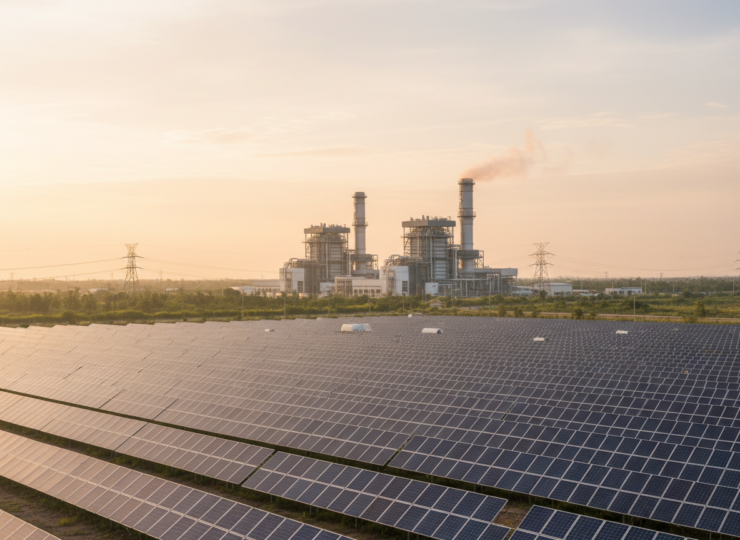
This creates a systems problem. Solar power can provide very cheap electricity when the sun is available, but a grid with extremely high solar penetration must still supply electricity at night and during weak generation periods. One response is to install enough solar and batteries to cover those periods. Yet doing so can create large surpluses during sunny hours, forcing the system to curtail electricity that could otherwise have been generated.
How the researchers modelled ASEAN to 2050
The researchers built an ASEAN-wide power-system model using the open-source urbs linear optimisation framework. The model searches for the lowest-cost combination of generation, storage and transmission that can satisfy electricity demand while remaining within progressively tighter carbon constraints.
The model represented every ASEAN country and six model years from 2025 to 2050 in five-year intervals, using hourly time steps within each model year. It used a myopic structure in which the capacity built in one model year becomes part of the system inherited by the next.
Carbon constraints became progressively tighter, moving from a 10% reduction in 2025 to a 90% reduction by 2050 for ASEAN as a whole. Renewable potentials and hourly generation profiles were estimated using pyGRETA, while a multivariate linear regression model supplied future electricity-demand profiles. The resource assessment estimated more than 25 TW of open-field and rooftop solar PV potential across ASEAN and 622 GW of combined onshore and offshore wind potential.
A key methodological addition was the explicit treatment of retrofits. Existing coal and gas plants could transfer capacity into a carbon-capture version of the same plant at a retrofit investment cost, while the model could also build new carbon-capture plants from 2030 onward. Cross-border transmission expansion was included, and battery storage was modelled at country level.
The researchers then compared two central pathways. In the renewable-only scenario, the system could expand renewable generation but could not deploy carbon capture. In the carbon-capture scenario, both new captured-carbon generation and retrofits of existing fossil plants were available alongside renewables.
Solar remained central, but the system needed less overbuilding
The modelling did not produce a future in which carbon capture replaced solar. Solar PV expanded rapidly in both scenarios. The difference emerged in what happened when solar was unavailable or produced more electricity than the system could use.
In the carbon-capture scenario, captured-carbon plants supplied firm generation as solar output declined in the afternoon, at night or during unfavourable weather. That dispatchable capacity meant the model did not need to build as much surplus solar capacity simply to ensure enough electricity was available during low-solar periods.
The effect was especially visible in Vietnam. Under the renewable-only pathway, 240.47 TWh was curtailed in 2050, equal to roughly 18% of total generation. With carbon capture available, curtailment fell to 25.16 TWh, a reduction of almost 90%.
Indonesia showed a similar pattern. Curtailment declined from 86.50 TWh, around 8% of total generation, to 12 TWh. In the Philippines it fell from 41.77 TWh, around 12% of total generation, to 8.36 TWh. Relative to solar output, more than one fifth of PV generation was curtailed in Indonesia and the Philippines in the renewable-only scenario, and nearly one quarter was curtailed in Vietnam. With carbon capture, curtailment generally fell below 10% of PV output.
This is an important distinction for interpreting the study. Carbon capture appears valuable in the model partly because it changes the amount of renewable overcapacity needed to meet the same emissions constraint. The result is therefore about whole-system optimisation, not simply a comparison of the cost of one carbon-capture plant with one solar farm.
Battery requirements fell sharply
The same system logic affected energy storage. Without carbon capture, batteries had to expand dramatically to move surplus renewable electricity into periods of lower renewable output. Once dispatchable captured-carbon generation was allowed, that requirement dropped.
By 2050, modelled battery energy capacity was more than 90% lower in Vietnam under the carbon-capture scenario. Indonesia and the Philippines required roughly 70% to 75% less battery energy capacity than in the renewable-only pathway.
The model also favoured modifying existing infrastructure rather than replacing all of it. In most ASEAN countries, more than 90% of existing gas plants were retrofitted with carbon capture in the carbon-capture pathway. In Indonesia, conventional existing gas capacity fell to zero by 2050, while new and retrofitted gas capacity equipped with capture together exceeded 40 GW.
That finding is economically intuitive within the model because retrofitting preserves part of the value of relatively young generating assets. It is also politically consequential. A transition built around retrofits looks very different from one based on rapid fossil-plant retirement, both for utilities and for governments concerned about stranded assets.
The infrastructure challenge moves from batteries to carbon
Lower battery deployment does not mean the carbon-capture pathway is infrastructure-light. The researchers estimate that roughly 600 million tonnes of carbon dioxide would be captured annually across the region by 2050. That carbon would need to be transported and stored safely.
The study cites an estimated regional geological storage potential of about 170 billion tonnes of carbon dioxide, but stresses that only part of that theoretical resource is likely to be technically and economically usable. Storage sites remain insufficiently characterised in several countries. Large-scale deployment would therefore require geological mapping, appraisal, transport corridors, regulation and long-term liability arrangements, potentially across national borders.
This turns the modelling result into a governance question. A mathematically attractive power-system configuration is not automatically an implementable one. Carbon capture becomes useful at the scale modelled only if governments can create a functioning regional system for moving and storing carbon, while investors believe the rules and incentives will remain stable for decades.
Important assumptions limit what the results can prove
The researchers explicitly caution that long-term electricity forecasts are uncertain. Future demand, fuel prices, technology costs and policy can all deviate substantially from assumptions made today.
The carbon-capture calculations assume a 90% capture rate and carbon transport and storage costs of US$10 per tonne. Changing those assumptions could alter the technology’s competitiveness. Site-specific constraints may also make some existing plants unsuitable for retrofitting.
The model excludes nuclear power even though several ASEAN countries are considering it. Nuclear could compete with captured-carbon generation as a source of firm low-carbon electricity. The model also excludes carbon-removal options such as direct air capture and bioenergy with carbon capture and storage, which could change the least-cost mix under strict emissions limits.
Battery storage is the only country-level storage technology represented because comparable pumped-hydro potential data were not available across the region. Better representation of long-duration storage could therefore change the balance between renewables, storage and dispatchable generation.
Finally, the emissions constraint is applied to ASEAN as a whole rather than requiring every member state to achieve the same 90% reduction. That choice allows countries with different resources to specialise and trade electricity, but real national policies do not necessarily operate as a single regional carbon budget.
What the study changes about the renewables debate
The study’s most useful contribution is not an argument that ASEAN should choose carbon capture instead of renewables. Its modelling suggests almost the opposite. Very large amounts of solar remain central, but the marginal value of adding still more solar declines once the system begins discarding substantial midday output and building storage primarily to cover periods when solar is absent.
Under those conditions, a more expensive but dispatchable low-carbon technology can become valuable because of what it allows the rest of the system not to build. In the scenarios examined here, carbon capture reduced renewable curtailment, storage requirements and total capacity overbuild while helping the region meet the same emissions constraint.
Whether that theoretical advantage survives real-world costs, storage constraints, public acceptance and policy uncertainty remains unresolved. The model identifies a pathway worth testing more rigorously, not a settled blueprint for ASEAN’s energy future.
Source Information
Study: Balancing renewables and carbon capture in emerging economies: a decarbonization pathway for ASEAN
Authors: Shwe Sin Han, Thushara Addanki, Anurag Chidire, Shiddalingeshwar C. Devihosur, Tobias Massier and Thomas Hamacher
Journal: Scientific Reports, volume 16, article 29922
Published: 27 September 2026
DOI: 10.1038/s41598-026-72869-1
Study type: ASEAN-wide linear power-system optimisation and scenario modelling from 2025 to 2050