



A bottle that visibly warns you when its cap is loose would normally need a sensor, a battery and some form of electronic display.
Researchers at the Massachusetts Institute of Technology have demonstrated another option: make the bottle itself change appearance.
Their new fabrication system, called ShiftLens, creates 3D-printed objects whose surfaces can switch between different images or patterns when they are pressed, rotated or slid. The visual change is entirely mechanical, requiring no electronics or external power source.
The researchers demonstrated the approach across six objects, ranging from a chemical bottle and click pen to an interactive game and colour-changing lipstick tube. Depending on the mechanism used, the current system can produce two fixed states, several selectable states or as many as 10 visual states.
The display is built into the surface
Most objects that provide changing visual information rely on electronic components.
A warning light on a machine, for example, needs electricity. A digital label requires a display. Even relatively simple products often need sensors to determine whether something has been opened, moved or positioned correctly.
ShiftLens takes a different approach.
Its surface consists of two specially designed layers. The upper layer contains an array of small lenticular lenses, while the layer underneath contains narrow strips taken from the different images the object needs to display.
Moving one layer by a small amount changes which strips are visible through the lenses.
The same basic principle is familiar from lenticular pictures that show different images depending on the angle from which they are viewed. ShiftLens differs because the change is controlled by the object itself rather than by where the viewer is standing.
Turning a knob, sliding a component or tightening a lid physically shifts the optical layers and changes the image that becomes visible.
This means the mechanical action being performed can also become the object’s display mechanism.
A bottle can show whether it is closed
One of the researchers’ demonstrations involved a chemical storage bottle.
The bottle was designed so that tightening its cap moves the ShiftLens surface. When the cap is properly secured, the bottle displays a check mark. If the cap is loose, a warning symbol appears instead.
No electronic sensor needs to detect the cap position because the cap itself mechanically controls what appears on the bottle.
A click pen was built around the same idea. Extending and retracting the pen tip changes the pattern visible on its barrel.
Other demonstrations were more interactive.
The researchers produced a tic-tac-toe board in which each square can display a cross, circle or blank state by rotating a knob. They also created a door sign that switches between two messages using a mechanical control.
A lipstick tube demonstrated continuous visual change. Rotating its barrel moves the optical layers while simultaneously changing the colour pattern visible on the outside of the tube.
In each case, the appearance is directly connected to a physical movement.
One print produces the complete object
Building these surfaces manually would require designers to coordinate the object’s geometry, the optical lenses, the underlying images and the mechanical movement between them.
The researchers therefore developed a computational design tool that handles much of this process automatically.
A designer provides the shape of the object, the appearances it needs to display and the type of physical interaction required. The software then generates the optical layers, image patterns and mechanical structures needed to produce the object.
The completed design can then be manufactured in a single pass using a multimaterial 3D printer.
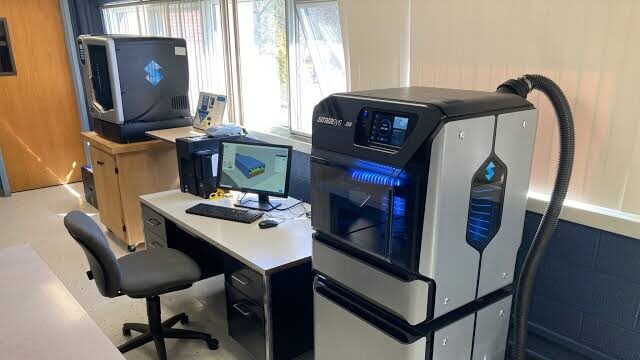
For the prototypes, the researchers used a Stratasys J55 printer with transparent and coloured printing materials. The optical components, patterned surface and mechanical mechanisms were therefore produced as parts of the same fabrication process rather than assembled around a separate electronic system afterwards.
More states come with a trade-off
ShiftLens is not an electronic screen replacement.
Its optical design imposes limitations on how many different appearances an object can display and from which angles those appearances remain clearly visible.
The researchers tested lens designs containing between two and 10 display states. All produced recognisable patterns when viewed directly, but increasing the number of states reduced the range of viewing angles from which the intended image remained clearly visible.
There is also a physical manufacturing limit.
Each additional visual state requires narrower image strips beneath the lenses. In the researchers’ fabrication process, features smaller than around 200 micrometres could not be printed reliably.
Object shape matters as well.
The two optical layers need to move relative to one another without losing alignment, meaning ShiftLens cannot simply be applied to any arbitrary 3D surface. The researchers identified specific families of shapes that are compatible with the required sliding and rotational movements.
These constraints make the technology considerably less flexible than a conventional digital display.
But flexibility is not necessarily the point.
Some products may not need another screen
Electronic displays are useful because they can show almost anything. That capability also brings additional components, power requirements and potential failure points.
For products that only need to communicate a small number of physical states, a simpler mechanical system may be sufficient.
A shipping container could indicate whether a fastener has moved. Outdoor signage could change without requiring electrical wiring. Equipment exposed to water or chemicals could provide visual feedback without relying on fragile embedded electronics. The researchers also suggest that the concept could eventually be applied to infrastructure such as pipes, where a mechanical change could help indicate a faulty connection.
The current research remains a fabrication platform rather than a commercial product, and the team plans to improve the software while expanding the range of mechanical interactions that can control the surfaces.
Still, ShiftLens demonstrates an interesting alternative to the assumption that making an object interactive necessarily means putting electronics inside it.
Sometimes the smarter object may simply be the one that needs no electricity at all.
Source Information
Research: ShiftLens: Mechanically Actuated Optical Surfaces for Switchable Appearances on 3D Objects
Authors: Yunyi Zhu, Dingning Cao, Jeremy Mrzyglocki, Stefanie Mueller and Narjes Pourjafarian
Publication: Proceedings of the ACM Symposium on User Interface Software and Technology (UIST ’26)
DOI: 10.1145/3830398.3830555
Institution: Massachusetts Institute of Technology