






Wildfires do not respond only to temperature.
Heat and drought can make landscapes easier to burn, but vegetation, fuel availability and the legacy of previous fires can continue shaping fire regimes even after the climate begins to change again.
New research from the geological record suggests that this kind of delayed fire response has happened before.
A study published in Scientific Reports on 24 September 2026 analysed fossil charcoal preserved in lake sediments from the Boltysh impact crater in Ukraine.
Using Raman spectroscopy, the researchers reconstructed changes in wildfire intensity across an Early Palaeocene warming episode known as a negative carbon excursion.
They found evidence for more than one phase of wildfire intensification.
The first coincided with progressive drying and an expansion of flowering plants. A later phase appeared during climatic recovery, when warming itself was easing but the characteristics of the available vegetation and fuel continued to support more intense fire.
The result suggests that once warming, drying and vegetation change push a landscape toward a more fire-prone state, the fire regime may not immediately return to its previous condition when temperatures begin to moderate.
Fossil charcoal can preserve a record of ancient fires
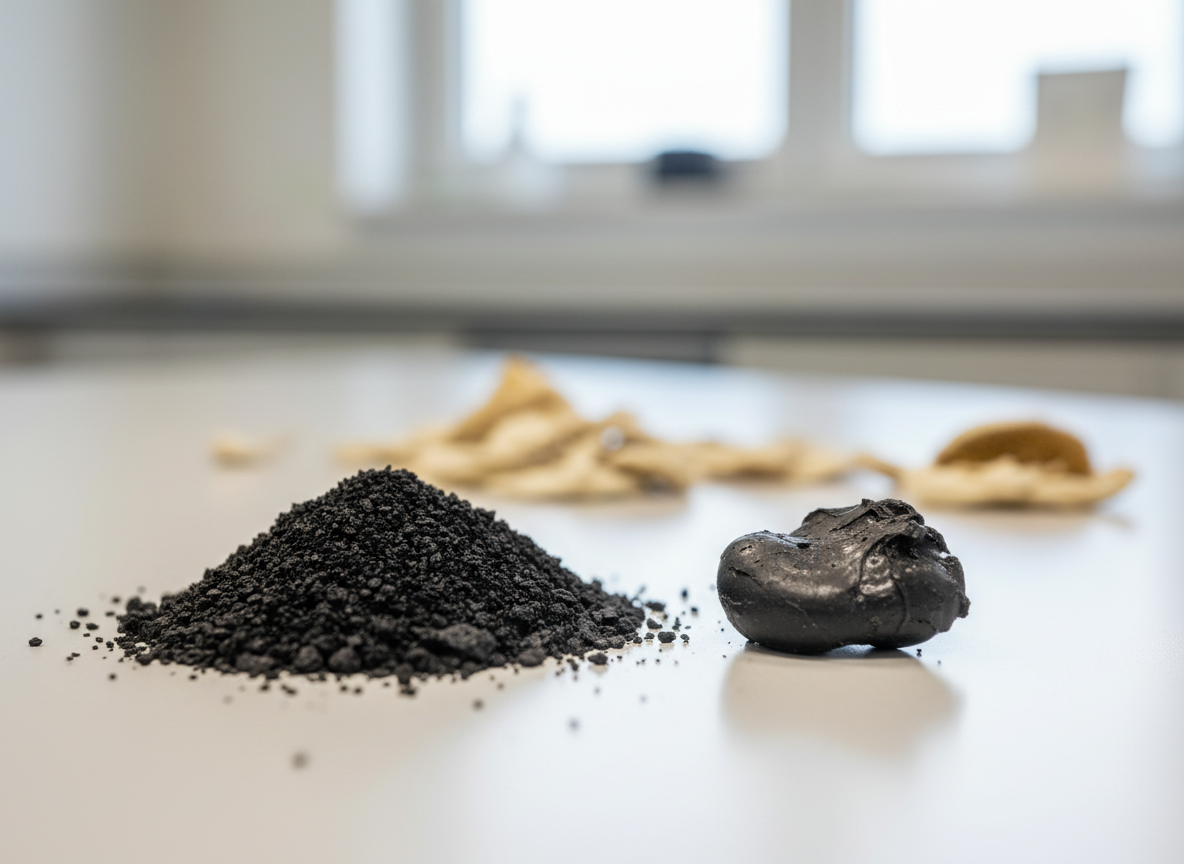
Charcoal is one of the most useful traces of prehistoric wildfire.
When vegetation burns, some of the organic material is transformed into carbon-rich charcoal rather than being completely consumed.
Fragments can then be transported into lakes and buried within sediment.
If those sediments accumulate over long periods, they can preserve a chronological record of past fire activity alongside pollen, organic matter and other environmental indicators.
The new study focused on charcoal from the Boltysh 42/11 sediment core.
Boltysh is an impact crater that later became a lake basin, creating conditions in which ancient sediments could accumulate and preserve evidence of environmental change.
The researchers used those fossil fragments not simply to ask whether fire occurred, but to investigate how fire intensity changed through time.
Raman spectroscopy can reveal how strongly charcoal was heated
Raman spectroscopy measures how light interacts with the molecular structure of a material.
In charcoal, the structure of carbon changes as burning temperature changes.
This means the Raman spectrum of a charcoal fragment can preserve information about the thermal conditions under which it formed.
The technique therefore gives researchers a way to move beyond simply counting charcoal particles.
Two sediment layers may contain similar amounts of charcoal while representing fires that burned under different conditions.
By examining the structure of the charcoal itself, the researchers could reconstruct changes in the character and intensity of the fire regime across the climatic event.
The warming event was recorded as a negative carbon excursion
The sediments span part of the Danian, the earliest stage of the Palaeocene Epoch.
Within the record, the researchers focused on a negative carbon excursion.
A negative carbon-isotope excursion occurs when the balance of carbon isotopes in the environment shifts toward lighter carbon.
Such excursions can accompany major changes in the carbon cycle and are often associated with climatic disruption.
In the Boltysh record, the excursion coincided with environmental warming and changing moisture conditions.
This provided the researchers with a natural sequence in which to examine how wildfire responded as climate conditions intensified and then recovered.
The first increase in fire intensity tracked drying and vegetation change
The early phase of wildfire intensification coincided with cyclical but progressively stronger aridification.
Drier conditions can increase fire risk by reducing moisture in leaves, litter and dead wood.
But climate was not the only change occurring in the landscape.
The researchers also link the early fire intensification with increasing dominance of angiosperms, or flowering plants.
Vegetation determines the amount, continuity and combustibility of fuel available to a wildfire.
A shift in plant communities can therefore alter fire behaviour even if the climatic conditions remain similar.
In this phase of the record, warming, drying and vegetation change appear to have acted together rather than independently.
The most interesting result appeared during climate recovery
If temperature were the only important control, fire intensity should decline as the climate begins recovering from a warming event.
That is not what the Boltysh charcoal record showed.
The researchers identified a later re-intensification of wildfire during the recovery phase.
By this stage, the relationship between warming and fire had become partly decoupled.
The authors argue that fuel characteristics had become more important.
In other words, the vegetation produced under the earlier climatic conditions helped create a landscape capable of sustaining more intense fire even as the original warming pressure weakened.
This is the part of the study with the clearest relevance to modern discussions of wildfire feedbacks.
Fire can reshape the fuel that controls future fire
Wildfire is not merely an outcome of climate.
It also changes the ecosystem on which the next fire will depend.
Fire can kill established trees, open the canopy, stimulate some species and suppress others.
The replacement vegetation may differ in height, density, moisture content and flammability.
Those changes can then make future fires either more or less likely.
This creates the possibility of a feedback in which climate initiates a shift toward more fire, but the resulting vegetation structure helps maintain that fire regime afterward.
The Palaeocene record studied here is consistent with that kind of persistence.
A return to cooler conditions does not necessarily restore the old ecosystem
Ecological systems can contain historical memory.
If climate warming changes the vegetation enough, simply returning temperature toward an earlier level may not immediately recreate the original landscape.
The new plant community may produce different fuels.
Repeated fires may also prevent slower-growing or less fire-tolerant species from becoming dominant again.
As a result, fire can remain elevated because the ecosystem has shifted into a different state.
The Boltysh record provides evidence that this type of delayed response may have operated in deep time, long before modern land management or industrial greenhouse-gas emissions existed.
That makes the ancient record useful, but not a direct model of the present
The comparison with modern wildfire has limits.
Early Palaeocene ecosystems differed from modern ecosystems in vegetation, atmospheric conditions and global geography.
Modern fire regimes are also shaped by human settlement, land clearing, ignition, invasive species, grazing and active fire suppression.
The ancient record therefore cannot tell us exactly how many fires will occur in a modern forest or how severe they will become under a particular emissions scenario.
Its value lies in showing that a natural climate perturbation can trigger ecological changes that continue influencing fire after peak warming has passed.
The findings do not mean reducing emissions would be pointless
The study’s discussion of persistent wildfire could easily be interpreted too strongly.
The fact that fire can remain elevated after climatic recovery does not mean future warming is irrelevant.
Temperature, drought and atmospheric moisture continue to influence how easily fuels ignite and how rapidly fires spread.
Reducing additional warming can still reduce the degree of climatic stress imposed on ecosystems.
The more cautious implication is that climate mitigation may not immediately reverse every ecological consequence that previous warming has already set in motion.
Fire management and ecosystem restoration may therefore remain necessary even as the climate drivers are addressed.
Fire suppression can also alter the amount of fuel available
Modern wildfire management introduces another complication that did not exist in the ancient system.
Suppressing frequent smaller fires can allow vegetation and dead organic matter to accumulate.
When burning eventually occurs under extreme weather, a larger fuel load can contribute to more severe fire behaviour.
The authors point to this interaction when discussing why modern fire intensification may persist even if the climatic pressure eventually moderates.
This does not mean suppression is always harmful.
Protecting lives and infrastructure often requires immediate fire control.
It does mean that long-term fire management also has to consider the vegetation and fuel conditions being created between major events.
The method provides a different view from charcoal abundance alone
Another important contribution of the study is methodological.
Many palaeofire reconstructions rely heavily on the abundance of charcoal preserved in sediments.
That can reveal when fire activity increased, but the quantity of preserved charcoal is influenced by many factors, including production, transport and sedimentation.
Raman spectroscopy adds information about the thermal alteration of the charcoal itself.
This can help distinguish changes in fire character that might not be obvious from abundance alone.
Applying the technique to a continuous lake-sediment sequence therefore gives researchers a higher-resolution view of how fire intensity changed through the climatic event.
Fossil charcoal is still an indirect proxy
No method can reconstruct an ancient wildfire as completely as modern instruments can observe a fire today.
Charcoal records are proxies.
The material that survives combustion, reaches the lake and becomes preserved represents only part of the original fire system.
Raman-derived thermal information also reflects the conditions experienced by individual charcoal fragments rather than a direct measurement of landscape-wide flame intensity.
The reconstruction therefore depends on combining the charcoal evidence with the surrounding geological and vegetation record.
The study is strongest as evidence for changing fire regimes through time, not as a precise replay of each individual wildfire.
One ancient lake cannot represent every ecosystem
The analysis is based on the Boltysh lacustrine record.
That gives the study valuable temporal detail, but it also means the results describe one regional ecosystem responding to one ancient climatic event.
Other landscapes with different vegetation, rainfall or soil conditions could have responded differently.
Additional high-resolution charcoal records from other regions would be needed to determine how widely the same multi-phase pattern occurred.
The broader principle is ecologically plausible: fuel characteristics can become partly independent of the warming that originally altered them. However, the exact timing and strength of the effect are likely to vary between ecosystems.
The bigger lesson is that wildfire has memory
Wildfire risk is often described as a response to current weather.
The geological record shows why that picture is incomplete.
Today’s fire depends partly on yesterday’s climate because earlier conditions shape the vegetation and fuel now available to burn.
Warming and drying can begin the transition, but the resulting ecological changes may continue to influence fire after the original climatic peak has passed.
That makes fire a product not only of present conditions, but of environmental history.
The fossil charcoal at Boltysh records precisely that kind of history: an initial fire intensification associated with warming, drying and vegetation change, followed by renewed fire during climatic recovery when fuel characteristics had taken on a larger role.
For modern wildfire management, the implication is not that climate action has failed before it begins. It is that preventing further warming and managing the landscapes already transformed by past warming may need to happen at the same time.
Source Information
Study Title: Palaeocene climate warming as a catalyst for wildfire intensification
Authors: Thomas Theurer, David Jolley, David K. Muirhead and Dmitri Mauquoy
Journal: Scientific Reports
Published: 24 September 2026
Dataset: Fossil charcoal preserved in the Boltysh 42/11 lacustrine sediment record from the Boltysh impact crater in Ukraine, spanning a Danian (Early Palaeocene) negative carbon excursion and subsequent climatic recovery.
Method: The researchers used Raman spectroscopy of fossil charcoal as a geothermometric proxy to reconstruct changes in wildfire intensity through the sediment sequence and interpreted those changes alongside the associated climatic and vegetation record.
Main finding: Wildfire intensified in multiple phases. Early intensification coincided with progressive aridification and angiosperm proliferation, while fire intensified again during climatic recovery, when fuel characteristics rather than continued warming appeared to become the dominant control. The findings suggest that vegetation and fuel feedbacks can allow elevated fire regimes to persist beyond the climatic conditions that initially triggered them.
DOI: 10.1038/s41598-026-72676-8