






Sunflower husks are usually treated as a low-value agricultural by-product, but new research suggests that carefully carbonising this waste could turn it into a functional reinforcing material for rubber.
A peer-reviewed study published in Scientific Reports on 24 September 2026 tested carbon-rich materials produced from sunflower husks at different temperatures and in different processing environments. The researchers then added these materials to a model rubber based on special-purpose butadiene-nitrile rubber and measured how they changed processing behaviour, cross-linking, strength, elongation and hardness.
The clearest result was that the carbonisation conditions mattered. Sunflower husk carbonizates produced in an inert argon atmosphere at 700 °C and 800 °C delivered the strongest overall physical and mechanical performance among the plant-derived fillers tested. Increasing filler dosage generally raised Mooney viscosity, cross-link density and rigidity, which was accompanied by higher strength and Shore A hardness compared with the unfilled model rubber.
The findings do not mean sunflower waste can simply replace conventional carbon black in commercial rubber products. The work used a controlled laboratory formulation, and the plant-derived fillers also altered vulcanisation behaviour in ways that could complicate industrial processing. Instead, the study provides evidence that agricultural waste can be engineered into a technically active rubber ingredient whose properties can be tuned through processing.
The researchers turned sunflower husks into several different carbon materials
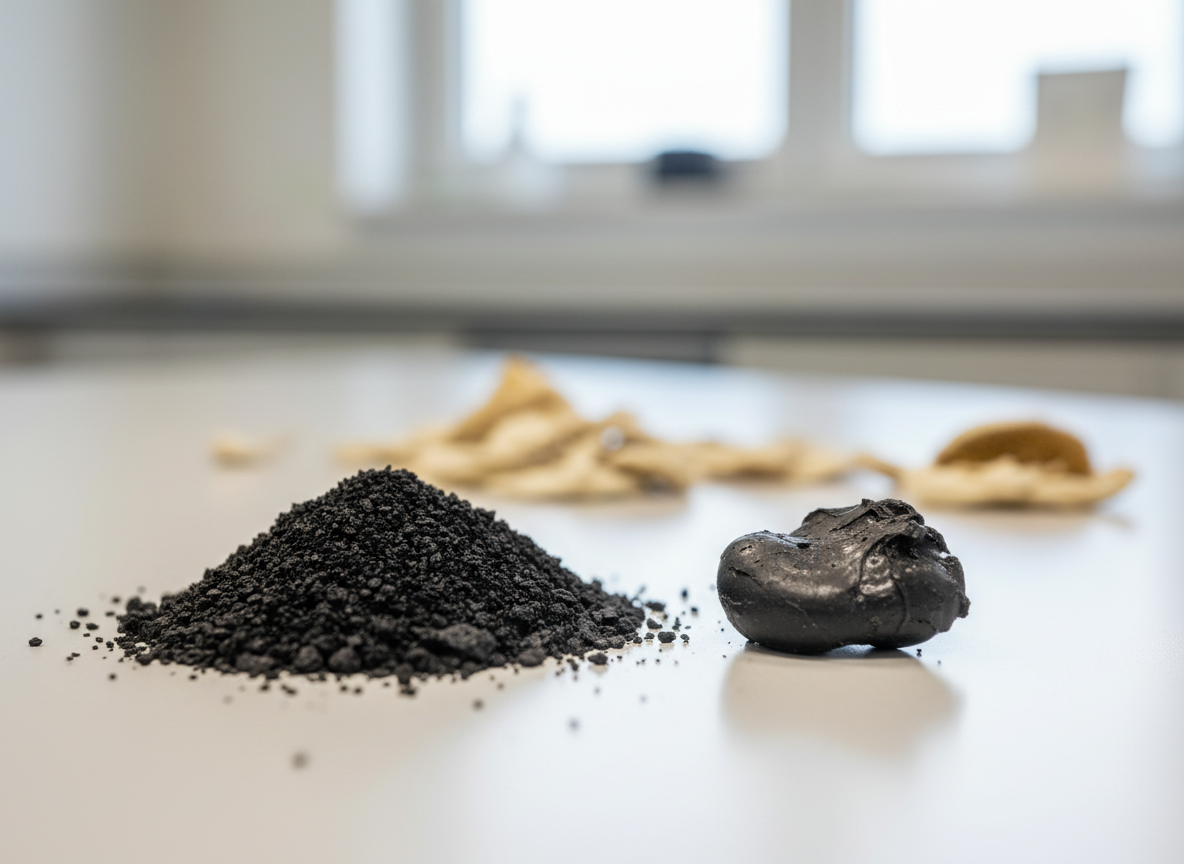
The team used sunflower husks from East Kazakhstan as the starting material. The husks were carbonised in a rotating tubular furnace under an inert argon atmosphere at temperatures ranging from 300 °C to 800 °C in 100 °C increments. Each inert-atmosphere treatment lasted 50 minutes.
The resulting materials were labelled according to their processing temperature, from SHC300 through SHC800. The researchers also produced a sunflower husk ash in an oxidising environment at 650 °C for 45 minutes, labelled SHA650.
This design allowed the researchers to separate two important processing variables. One was temperature, which changes how extensively the original plant material is carbonised. The other was atmosphere, because heating biomass in inert gas preserves a carbon-rich structure while oxidative treatment burns away much of the organic carbon and leaves a more mineral-rich ash.
Higher carbonisation temperatures created more porous materials
The physical surface of the filler changed substantially as carbonisation temperature increased. The specific surface area of the inert-atmosphere material rose from 13 square metres per gram at 300 °C to 24 at 400 °C, 32 at 500 °C, 61 at 600 °C, 94 at 700 °C and 103 square metres per gram at 800 °C.
Sorption volume followed the same general pattern, increasing from 0.004 cubic centimetres per gram for SHC300 to 0.040 cubic centimetres per gram for SHC800. The researchers attributed this to the progressive removal of volatile compounds and the development of a more porous carbon structure as processing temperature increased.
The chemistry changed as well. The pH of the aqueous suspension increased from 7.3 for SHC300 to 10.2 for SHC800. The oxidatively produced SHA650 material had the highest pH at 11.1 and a specific surface area of 41 square metres per gram.
Elemental analysis showed that higher-temperature inert processing increased carbon content while reducing oxygen content. Oxidative processing produced a different material in which much of the carbon skeleton had been removed and mineral components, including potassium and calcium compounds, became relatively more prominent.
The fillers were tested at three concentrations in nitrile rubber
The researchers incorporated the sunflower-derived materials into a model formulation based on BNKS-18AMN, a synthetic butadiene-nitrile rubber containing approximately 17% to 20% acrylonitrile. The base formulation also contained stearic acid, zinc oxide, sulfur and a vulcanisation accelerator.
Each sunflower-derived filler was tested at 5, 10 and 15 parts per hundred rubber, commonly abbreviated as phr. For comparison, the researchers also prepared mixtures containing conventional N772 carbon black at the same dosages, as well as an unfilled model mixture.
The rubber compounds were mixed on laboratory rollers at approximately 45 °C and a roll speed of 25 revolutions per minute. After mixing and a 24-hour resting period, the compounds were vulcanised at 160 °C. The researchers determined the appropriate vulcanisation time from rheological measurements rather than applying one fixed curing time to every formulation.
The study measured processing behaviour as well as final mechanical performance
A reinforcing filler has to do more than make a finished rubber sample stronger. It can also change how easily the uncured compound flows, how quickly vulcanisation begins and how the polymer network develops during curing.
The team therefore measured Mooney viscosity, a standard indicator of the processing resistance of uncured rubber. Vulcanisation kinetics were examined using rheometer curves, including minimum and maximum torque, scorch time, optimal vulcanisation time and vulcanisation rate.
Cross-link density was estimated by equilibrium swelling in toluene. Samples were immersed for 144 hours, weighed, dried and analysed using established polymer-network equations. Mechanical testing included conditional tensile strength and elongation at break at an extension rate of 500 millimetres per minute. Ten specimens were tested for each treatment temperature and filler dosage in the tensile measurements.
Shore A hardness was measured on three disc-shaped specimens for each compound, with measurements taken at five points on each specimen. The researchers also exposed vulcanised samples to elevated temperature and air oxygen to examine how the materials behaved under conditions intended to simulate ageing.
More sunflower-derived filler generally made the rubber more rigid
Across the experimental formulations, increasing the amount of sunflower-derived material generally increased Mooney viscosity. In practical terms, this means the uncured rubber became more resistant to flow as filler loading increased.
Cross-link density also increased with filler dosage. A denser network of links between polymer chains usually restricts molecular movement, which helps explain why the filled vulcanizates became more rigid and why hardness increased.
The study found that the strongest overall physical and mechanical indicators occurred in rubber containing the inert-atmosphere sunflower husk carbonizates produced at 700 °C and 800 °C. These were also the two inert materials with the largest measured specific surface areas, at 94 and 103 square metres per gram respectively.
That relationship is important because filler performance depends partly on the interface between the filler particles and the surrounding polymer. A more developed surface can provide more opportunity for physical interaction with rubber chains. The results therefore suggest that the thermal treatment did not merely convert the husk into carbon. It progressively changed the structure of the filler in ways that affected its behaviour inside the rubber matrix.
The plant-based fillers also changed vulcanisation kinetics
The same chemical characteristics that made the sunflower materials active inside the rubber also created processing trade-offs.
The researchers observed reduced resistance to premature sub-vulcanisation, particularly when the oxidatively produced material was used. They linked this effect to the relatively high concentration of metal-containing mineral components, which can act as additional activators during vulcanisation.
At the same time, the presence of the biomass-derived filler could increase the time needed to reach the optimal vulcanisation state. The authors attribute this to adsorption of components of the vulcanising system onto the surface of the plant-derived materials.
These two effects illustrate why a sustainable filler cannot be evaluated only by tensile strength or hardness. A material that reinforces the final product but narrows the safe processing window could require changes to mixing, accelerator chemistry or curing conditions before it is useful at industrial scale.
Why sunflower husks are an attractive feedstock
Sunflower oil production generates large quantities of husk. The material can be used for animal feed or bedding, but it is also frequently burned or disposed of. Converting some of this residue into a useful industrial filler could create a higher-value outlet for an agricultural by-product.
The rubber industry is an especially relevant target because reinforcing fillers are used across tyres, seals, footwear, conveyor belts and many other elastomer products. Carbon black remains one of the dominant fillers because it can strongly improve stiffness, strength, wear resistance and other properties.
However, conventional carbon black is generally produced from fossil-derived feedstocks through high-temperature processes. Researchers are therefore investigating biochar and other biomass-derived carbon materials as potential partial alternatives in applications where their performance is suitable.
The findings do not yet establish an environmental advantage
Using agricultural waste as a feedstock sounds inherently sustainable, but the environmental balance depends on the complete production process.
Producing the best-performing carbonizates in this study required heating sunflower husks to 700 °C or 800 °C under an argon atmosphere. That requires energy and an inert gas supply. Whether the resulting filler has a lower life-cycle environmental impact than conventional carbon black would depend on the energy source, furnace efficiency, transport distances, process yield and the fate of gases and other products released during carbonisation.
The study was designed primarily to establish material behaviour, not to conduct a full life-cycle assessment. It therefore supports the technical possibility of using sunflower husk carbonizates in rubber, but it does not demonstrate that the process is already environmentally or economically superior at commercial scale.
The experiment used a deliberately simplified rubber system
Another important limitation is that the researchers used model elastomeric compositions. This is useful scientifically because it reduces interference from the many additives found in commercial formulations and makes it easier to isolate the effect of the experimental filler.
But real industrial rubber compounds can contain complex combinations of reinforcing agents, processing aids, antioxidants, accelerators, pigments and other ingredients. Interactions among those components could change how sunflower-derived fillers behave.
The work also focused on one special-purpose nitrile rubber system. The results should therefore not automatically be transferred to natural rubber, styrene-butadiene rubber, silicone elastomers or other polymers without further testing.
Long-term durability and scale-up remain open questions
The researchers did examine changes after exposure to elevated temperature and air oxygen, providing an initial view of ageing behaviour. However, commercial qualification would require a broader set of durability tests tailored to the intended product.
Depending on the application, these could include repeated mechanical fatigue, abrasion, oil and solvent resistance, ozone exposure, weathering, compression set and long-duration thermal ageing. Particle consistency would also matter because agricultural residues can vary with cultivar, growing conditions, soil chemistry and processing history.
Scaling the carbonisation process would introduce additional questions about energy use, emissions control, feedstock preparation and the ability to produce filler with consistent surface area, mineral content and particle structure from batch to batch.
The broader opportunity is to engineer waste rather than simply add it
One of the most useful lessons from the study is that biomass filler is not a single material.
The same sunflower husk feedstock produced markedly different surface areas, pH values, structures and rubber-processing effects depending on how it was heated. The inert SHC800 material reached a specific surface area of 103 square metres per gram, almost eight times the 13 square metres per gram measured for SHC300.
This means the industrial question is not simply whether sunflower husks can be put into rubber. It is whether the waste can be processed into a reproducible material with the particular surface chemistry and structure needed for a given elastomer formulation.
In that sense, the study fits into a wider shift in materials science. Agricultural residues are increasingly being treated not merely as cheap bulk fillers, but as feedstocks whose properties can be engineered through carbonisation, activation and other forms of processing.
What happens next
Future research will need to determine whether the strongest laboratory formulations can retain their advantages in more realistic commercial compounds and manufacturing conditions.
Direct comparisons with conventional reinforcing fillers will be particularly important, as will optimisation of particle size and surface chemistry. Researchers will also need to determine whether lower-temperature or less energy-intensive processing can achieve similar reinforcement, because the strongest formulations in this experiment were associated with the highest inert carbonisation temperatures.
A life-cycle assessment would help establish whether diverting sunflower husks into rubber fillers can meaningfully reduce fossil-resource use or greenhouse-gas emissions after the energy demands of carbonisation are included.
For now, the study provides a technically promising proof of concept. Sunflower husk waste can be transformed into a carbon-rich material that does more than occupy space inside rubber. Under the right processing conditions, it changes the polymer network and improves key mechanical properties. The challenge is now to determine whether that laboratory performance can be translated into a consistent, economical and genuinely lower-impact industrial filler.
Source Information
Study Title: Enhancing filler for elastomeric compositions based on sunflower husk carbonizates
Authors: Aigerim Kaiaidarova, Valeryia Bobrova, Andrei Kasperovich, Sergey Lezhnev, Evgeniy Panin, Sergey Nechipurenko, Sergey Efremov and Mukhambetkali Burkitbayev
Journal: Scientific Reports
Published: 24 September 2026
Materials: Sunflower husk carbonizates produced under argon from 300 °C to 800 °C and sunflower husk ash produced in an oxidising environment at 650 °C, tested in model BNKS-18AMN nitrile rubber at 5, 10 and 15 parts per hundred rubber.
Method: The researchers characterised filler surface properties and incorporated the materials into model rubber compounds. They measured Mooney viscosity, vulcanisation kinetics, equilibrium-swelling cross-link density, tensile strength, elongation at break, Shore A hardness and changes after thermal-oxidative ageing.
Main finding: Sunflower-derived fillers increased viscosity, cross-link density, rigidity, strength and hardness relative to the unfilled model composition, with the strongest overall physical and mechanical performance observed for inert-atmosphere carbonizates produced at 700 °C and 800 °C. The fillers also altered vulcanisation behaviour, creating processing trade-offs that require further optimisation.
DOI: 10.1038/s41598-026-73038-0