





Rainfed agriculture depends on a resource farmers cannot schedule: water. In nutrient-poor, coarse-textured soils, the challenge is not only how much rain falls, but how much of that water the soil can retain long enough for roots to use it. A new two-year experiment suggests that combining rice-husk biochar with a small dose of an anionic polymer can materially change that equation.
Published in Scientific Reports on 27 September 2026, the study tested ten soil-management treatments in maize grown in nutrient-deficient sandy loam under rainfed conditions. The strongest treatment combined rice-husk biochar at 10 tonnes per hectare with polymer at 10 kilograms per hectare. Compared with an untreated control, this combination reduced soil penetration resistance by 37%, increased soil moisture by 64%, doubled root length, increased root volume 1.8-fold and raised maize grain yield 2.23-fold.
The results are striking, but they need to be read in the context of the experiment. This was a controlled two-year pot study, not a multi-location farm trial. It therefore offers strong evidence that the amendment combination can alter soil physical conditions and plant performance under the tested conditions, while leaving open important questions about cost, long-term effects and field-scale performance.
Why sandy rainfed soils create a difficult growing environment
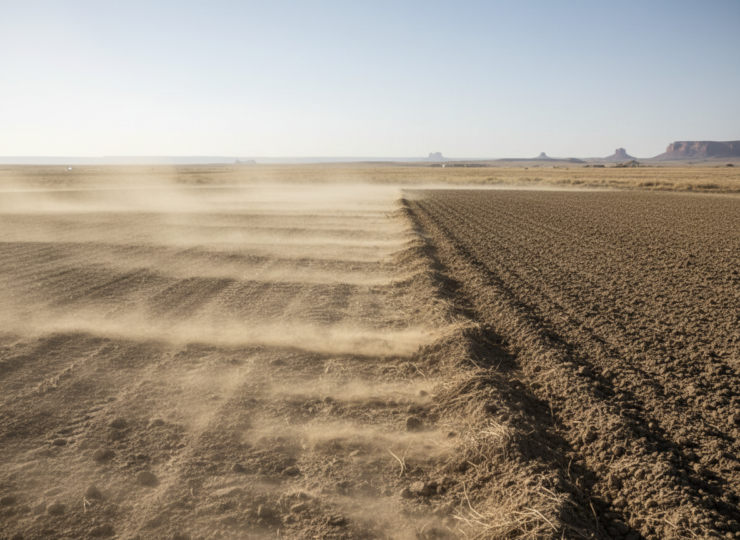
Sandy loam can present a difficult combination for crop production when fertility is low and rainfall is unreliable. Larger pores allow water to drain relatively quickly, while limited organic matter can restrict nutrient retention. Roots may therefore encounter a soil that is simultaneously short of available nutrients and unable to buffer plants effectively between rainfall events.
Biochar has attracted attention because its porous carbon-rich structure can modify water retention, nutrient availability and soil physical properties. Its effects, however, depend heavily on feedstock, production conditions, soil type, application rate and climate. Polymers are another soil-management option. Water-retaining or structure-modifying polymers can influence soil moisture and aggregation, but their performance is likewise context dependent.
The question addressed by Vikas Abrol and colleagues was therefore more specific than whether either material can help crops. They wanted to know whether rice-husk biochar and an anionic polymer could work together, and whether that combination would outperform the individual amendments in a nutrient-poor rainfed soil.
A two-year experiment compared ten soil treatments
The researchers conducted a two-year pot experiment using maize and nutrient-deficient sandy loam. Ten treatments were evaluated. These included rice-husk biochar at 5 and 10 tonnes per hectare, polymer at 10 and 20 kilograms per hectare, combinations of the two amendments, a recommended fertilizer treatment and an untreated control that received neither fertilizer nor the experimental amendments.
This design allowed the researchers to look beyond grain yield. They measured changes in the soil environment, nutrient availability and uptake, root development and crop performance. That matters because a yield difference alone cannot reveal why a treatment worked. Measuring the chain from soil condition to root architecture and then to crop output gives a more informative picture of the proposed mechanism.
The treatment that emerged most consistently was the combination of 10 tonnes per hectare of rice-husk biochar and 10 kilograms per hectare of polymer, referred to in the study as RHB10 + P10. Importantly, the best-performing combination did not use the highest polymer rate. That suggests the relationship is not simply a matter of adding more material, and it makes optimisation of dose an important part of any future field work.
The soil became easier for roots to penetrate and held more moisture
Relative to the untreated control, RHB10 + P10 reduced soil penetration resistance by 37%. Penetration resistance is a measure of how strongly soil resists a penetrating object and is commonly used as an indicator of the mechanical resistance roots may face. Lower resistance can make it easier for roots to explore a larger volume of soil, although root growth also depends on water, nutrients, temperature and plant physiology.
The same treatment increased soil moisture content by 64% compared with the control. Under rainfed conditions, this is potentially important because soil water stored after rainfall can help plants bridge dry intervals. The finding does not mean that the amendment creates water. Rather, under the experimental conditions, more moisture remained available in the amended soil when the researchers measured it.
The study also reported improved nutrient availability and plant nutrient uptake under the combined treatment relative to other treatments. Together, lower mechanical resistance, greater retained moisture and improved nutrient conditions offer a plausible explanation for the changes seen below ground.
Root length doubled and root volume rose 1.8-fold
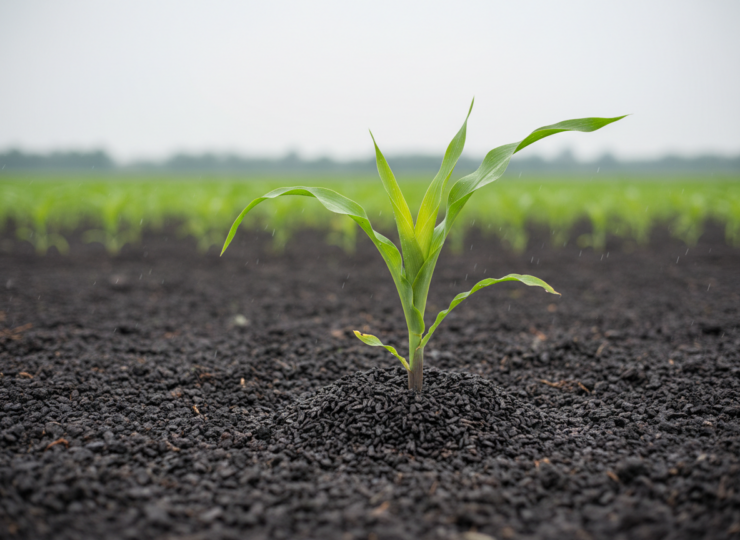
The root response was substantial. With RHB10 + P10, maize root length was 2.0 times that of the untreated control, while root volume was 1.8 times higher.
That result connects the soil measurements to crop performance. A larger root system can potentially explore more soil for water and nutrients. In a rainfed setting, deeper or more extensive root exploration can be particularly valuable when moisture is unevenly distributed. The experiment therefore points to a connected sequence: the amendment mixture changed the soil environment, roots developed more extensively, and crop output increased.
It is important not to turn that sequence into a stronger causal claim than the design supports for real farms. Within the experiment, treatments were deliberately imposed and plant responses measured, which supports causal interpretation under those controlled conditions. Whether the same chain operates at the same magnitude across different field soils, rainfall regimes and farming systems remains a separate empirical question.
Maize grain yield reached 2.23 times the untreated control
The most commercially relevant outcome was grain production. Maize yield under RHB10 + P10 was 2.23 times the yield of the untreated control. Put another way, the experimental combination produced a little more than twice as much grain as soil receiving neither the amendments nor fertilizer.
That comparison is informative but also sets an important boundary around interpretation. The reference group was an unfertilized control in nutrient-deficient soil. A 2.23-fold advantage over that baseline should not automatically be interpreted as the gain a well-managed commercial farm would achieve. The study included a prescribed fertilizer treatment precisely because practical decisions require comparison against existing management, not only against untreated soil.
The broader value of the findings lies in the simultaneous improvement across soil, roots and yield. A treatment that increases yield while leaving the underlying soil constraint unchanged may offer a different kind of benefit from one that alters water retention, penetration resistance and nutrient availability together.
Why the combination may outperform either amendment alone
Biochar and polymer act through different but potentially complementary physical and chemical pathways. Rice-husk biochar contributes a porous carbonaceous material that can alter soil structure, water storage and nutrient retention. An anionic polymer can influence interactions among soil particles and water. When used together, those effects may create a soil environment that is more favourable to root expansion than either amendment produces on its own.
The experiment is therefore best understood as a test of synergy rather than simply another biochar trial. The strongest result came from a particular pairing of amendment rates. This matters for agricultural management because combinations can sometimes reduce the quantity of a costly input needed to obtain a useful response.
At the same time, the study does not establish that the selected rates are universally optimal. Biochar made from another feedstock may have different porosity, ash content, pH and nutrient characteristics. A clay soil may respond differently from sandy loam. Polymer behaviour may also change with soil chemistry and repeated wetting and drying.
The practical question is now field-scale durability
For rainfed farming, the prospect of retaining more water while improving root development is attractive. Yet the next stage of evidence needs to move beyond pots. Field soils are spatially variable, roots can explore much larger volumes, rainfall is uneven, machinery changes compaction, and amendments may be redistributed or diluted through cultivation.
Economics also matters. Applying biochar at 10 tonnes per hectare represents a substantial material requirement. Its feasibility will depend on local feedstock supply, pyrolysis costs, transport distance, application equipment and the persistence of benefits over multiple seasons. The polymer dose is far smaller by mass, but price, environmental persistence and regulatory considerations also need assessment.
Longer studies would help establish whether the 64% moisture advantage persists, whether soil structure continues to improve or stabilises, and whether repeated polymer application is necessary. Researchers will also need to test whether yield gains remain large when the comparison is made against optimally fertilized and otherwise well-managed field plots.
What the study adds
The study provides a useful proof of concept for integrated soil amendment in a setting where water and nutrient limitations occur together. Its most persuasive feature is not any single percentage, but the alignment of several outcomes: lower penetration resistance, higher soil moisture, greater nutrient availability, larger root systems and higher grain yield all pointed in the same direction under the best-performing treatment.
For researchers, that creates a clear field-testing hypothesis. For farmers and policymakers, it is too early to treat the treatment as a ready-made prescription. A two-year pot experiment can identify promising combinations and mechanisms, but adoption decisions require evidence on field variability, environmental safety, cost and durability.
The central finding is therefore both encouraging and appropriately narrow: in nutrient-poor sandy loam under the conditions tested, combining rice-husk biochar at 10 tonnes per hectare with an anionic polymer at 10 kilograms per hectare produced a markedly better soil and crop response than the untreated control. Whether that advantage can be reproduced economically across real rainfed farms is the question that now matters most.
Source Information
Study: Biochar-polymer synergy enhances soil health, root growth, and maize yield under rainfed conditions
Authors: Vikas Abrol, Stanzin Khenrab, Peeyush Sharma, Ajmer Brar, Vidushi Kumari, A. P. Singh, R. K. Gupta, Gurdev Chand, Sahil Singh, Subhash Chandra and colleagues
Journal: Scientific Reports
Published: 27 September 2026
DOI: 10.1038/s41598-026-71169-y