





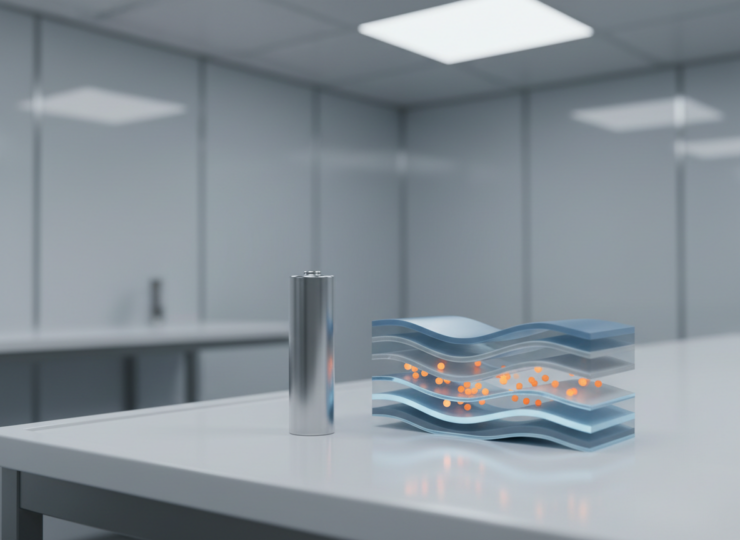


Sodium-ion batteries are often presented as a promising complement to lithium-ion technology because sodium is abundant and layered oxide cathodes can be built from comparatively accessible materials. Yet the chemistry faces a stubborn engineering problem: repeated charging and discharging can force cathode crystals through structural and volume changes that accumulate mechanical stress, damage interfaces and gradually erode capacity.
A new peer-reviewed study published in Nature Communications on 28 September 2026 reports a layered oxide cathode designed to respond differently. Instead of merely resisting deformation, the material changes its interlayer spacing during charge in a way that the researchers describe as self-adaptive. In long-term testing, the cathode retained 82% of its capacity after 1,000 cycles at a 2C rate.
The result matters because it reframes a familiar battery-design problem. Mechanical stability does not necessarily require a crystal structure that stays rigid. A structure that adjusts its dimensions as its electronic state changes may be able to manage stress before that stress becomes destructive.
Why sodium-ion cathodes struggle with repeated cycling
Layered transition-metal oxides are attractive positive-electrode materials for sodium-ion batteries. Their structures can reversibly host sodium ions, and their composition can be tuned across multiple transition metals. That flexibility also creates complexity. Removing and reinserting sodium during cycling changes electrostatic interactions within and between the oxide layers. Those changes can alter lattice dimensions, trigger structural transitions and concentrate stress.
Over many cycles, even small dimensional changes can matter. Repeated expansion and contraction can contribute to cracking, loss of contact and progressive electrochemical degradation. This is one reason why a cathode can perform strongly in early cycles but fail to preserve that performance over the much longer cycle life required for practical energy storage.
Jia-Yang Li and colleagues therefore investigated whether the internal charge distribution of a layered oxide could be engineered so that its structural response to charging becomes more mechanically accommodating.
A high-entropy layered oxide built to adjust
The researchers developed a multi-element doped, high-entropy layered oxide cathode. High-entropy materials distribute several elements through a common structural framework rather than relying on one dominant metal species. In this study, that compositional design was used to influence both charge compensation and the forces acting between adjacent oxide layers.
The team combined electrochemical cycling with structural and spectroscopic measurements. Four-dimensional scanning transmission electron microscopy, or 4D-STEM, was used to map local electric-field behaviour and examine how Coulombic interactions were distributed through the material. In situ X-ray absorption spectroscopy tracked changes in the electronic states of constituent elements as the cathode was charged and discharged.
These methods are important because battery capacity alone cannot explain why a material survives. Cycling tests show whether performance is retained, while microscopy and spectroscopy help identify the physical and electronic processes associated with that retention.
The crystal did not simply expand throughout charging
The central observation was a non-monotonic change in interlayer spacing. At the beginning of charging, the spacing between layers expanded. At the highest voltage, it compressed. The researchers interpret this adjustable response as a self-adaptive volume mechanism that reduces the acceleration of mechanical stress.
That behaviour was linked to charge reconfiguration involving oxygen and transition-metal ions within the oxide layers. According to the study, redistribution of charge reduces repulsive forces between oxygen atoms in neighbouring layers. The result is a structure whose dimensions can respond dynamically as its state of charge changes.
The 4D-STEM measurements further indicated a relatively uniform electric-field distribution. The authors argue that this reflects more even Coulombic interactions between oxide layers and contributes to mechanical integrity. In situ X-ray absorption measurements also identified charge-compensation behaviour that the researchers associate with the material’s high-rate performance.
This is more than a description of expansion and contraction. The proposed mechanism connects electronic charge, interlayer forces and macroscopic cycling stability. In other words, the material’s mechanical response emerges from what electrons and ions are doing inside the lattice.
82% capacity retention after 1,000 cycles
The clearest long-duration result was obtained at a 2C cycling rate. After 1,000 cycles, the cathode retained 82% of its capacity. A 2C rate corresponds to a nominal full charge or discharge in roughly half an hour, although actual test protocols and usable capacity depend on the cell configuration and voltage limits.
Capacity retention is particularly informative here because the study’s proposed advantage is durability. An electrode that maintains a large share of its starting capacity through 1,000 relatively rapid cycles provides evidence that the structural strategy is doing more than improving an isolated first-cycle metric.
Still, 82% retention should not be interpreted as proof that a commercial sodium-ion battery using this material would retain exactly the same performance. Laboratory cathode testing isolates material behaviour under defined conditions. Real batteries add constraints involving electrode loading, electrolyte quantity, cell packaging, temperature, manufacturing consistency, safety, cost and the behaviour of the negative electrode.
Why the mechanism may be more important than the headline number
Battery research often produces impressive cycle counts, but the most transferable findings are frequently the mechanisms that explain them. Here, the researchers propose that charge reconfiguration can be used as a design lever for controlling mechanical strain.
That principle could be useful beyond one exact cathode composition. If researchers can deliberately tune how charge is distributed across oxygen and transition-metal states, they may be able to design other layered materials whose lattice changes are less damaging during cycling. This shifts attention from simply suppressing structural change to shaping the trajectory of that change.
The study also illustrates why advanced characterisation is becoming central to battery development. A conventional before-and-after structural measurement can miss transient behaviour that occurs only at particular states of charge. In situ spectroscopy and spatially resolved electron microscopy can reveal those intermediate states and connect them to long-term electrochemical outcomes.
What this could mean for sodium-ion technology
Sodium-ion batteries are being investigated for applications where cost, material availability and supply-chain diversification may matter as much as maximum energy density. Long-lived cathodes are therefore important not only for consumer devices but also for stationary storage and other applications where repeated cycling determines lifetime economics.
A cathode that combines rapid cycling with long-term structural stability could strengthen that case. The present study provides a materials-level route toward that goal, but it does not establish commercial readiness. Scaling a complex multi-element oxide while maintaining compositional uniformity, processing quality and economic viability remains a separate challenge.
Important limitations remain
The study should be interpreted as advanced materials research rather than a demonstration of a market-ready battery. The reported durability comes from controlled electrochemical testing, and performance in commercial-format full cells can differ once electrode thickness, areal loading, electrolyte constraints and paired-electrode degradation are introduced.
The high-entropy strategy also introduces compositional complexity. A material can be electrochemically compelling while still facing challenges in precursor supply, synthesis control, batch consistency and manufacturing cost. Long-term safety behaviour and performance across broad temperature ranges will also matter for practical deployment.
Finally, the mechanistic interpretation links charge reconfiguration to reduced interlayer repulsion and self-adaptive volume change. That evidence is strengthened by the study’s microscopy and in situ spectroscopy, but further work across related compositions will be needed to establish how general the mechanism is and which aspects are most important for scale-up.
A different way to think about battery durability
The study’s broader contribution is conceptual. Repeated volume change is usually framed as something battery materials should minimise. This cathode suggests another possibility: some change can be useful if it is coordinated, reversible and electronically controlled.
By allowing the layered structure to expand and then compress as charge is redistributed, the researchers created a material that appears to manage its own mechanical state during operation. The 82% capacity retention after 1,000 cycles provides the long-term electrochemical result, while 4D-STEM and in situ X-ray measurements offer a mechanism for why that durability emerged.
For sodium-ion batteries, that combination of durability and mechanistic insight is significant. It suggests that the next generation of cathodes may not need to be structurally static. They may instead need to be structurally intelligent enough to adapt.
Source Information
Study: Li, J.-Y., Guo, Y., Wang, X. et al. “Self-adaptive layered oxide cathodes driven by charge reconfiguration for sodium-ion batteries.” Nature Communications (2026).
Published: 28 September 2026.
DOI: 10.1038/s41467-026-78040-8.
Study type: Experimental materials science and electrochemical characterisation of a layered oxide sodium-ion battery cathode.
Journal: Nature Communications.