


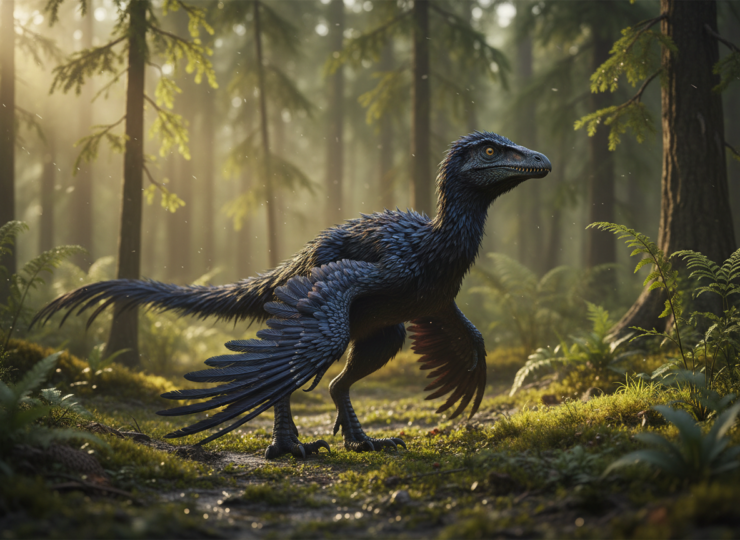
A remarkably complete feathered dinosaur from northeastern China is giving palaeontologists a new way to test one of the most persistent questions surrounding the origin of flight: did bird-like dinosaurs inherit a common flight apparatus, or did similar aerial adaptations emerge more than once?
The newly described species, Norellraptor barsboldi, belongs to Microraptorinae, a group of small predatory dinosaurs closely related to birds. Its skeleton is only 57 centimetres long, but it preserves an unusually rich combination of skeletal anatomy, traces of plumage and microscopic evidence from its bones. By placing these features into an evolutionary framework, researchers found that microraptorines and birds acquired many similar flight-related traits in different sequences.
The finding matters because similarity does not necessarily mean common inheritance. Wings and other flight-related structures could reflect traits passed down from a shared ancestor, similar developmental constraints that repeatedly channel evolution in the same direction, or convergent evolution under separate selective pressures. The new fossil gives researchers unusually detailed evidence with which to distinguish among those possibilities.
A small dinosaur with unusually complete evidence
The specimen, catalogued as 130108-MHGU-F4281, was recovered from the Lower Cretaceous Jiufotang Formation near Lamadong Town in western Liaoning, China. The formation belongs to the fossil-rich Jehol Biota, which has produced some of the most informative feathered dinosaurs known.
The skeleton is complete and only moderately disarticulated around the limb girdles. The researchers identified a distinctive combination of skull, pelvis, wrist, hand and foot features that justified naming a new genus and species. They named it Norellraptor barsboldi in honour of palaeontologists Mark Norell and Rinchen Barsbold, both influential figures in research on bird-like dinosaurs.
The animal’s anatomy also places it among relatively late-diverging microraptorines. Its forelimbs, wrists, sternum and other structures preserve features relevant to aerial locomotion, while patches of plumage survive around several parts of the skeleton. The researchers report probable asymmetrical pennaceous feathers near the forelimb, although preservation is not sufficient to reconstruct the complete feather arrangement or establish exactly how the animal moved through the air.
Bone fusion and microscopic tissue structure indicate that the individual was beyond the juvenile stage when it died. Histological sections through the radius revealed two lines of arrested growth, dividing the outer bone into three growth zones. That evidence indicates an animal at least around three years into its development rather than a very young individual whose proportions might still have changed substantially.
Testing whether flight anatomy followed the same evolutionary route
The central analysis went beyond describing a new dinosaur. The researchers mapped anatomical changes across an evolutionary tree and compared the sequence in which flight-related features appeared in microraptorines with the sequence reconstructed for Avialae, the lineage that includes birds.
This comparison is important because two lineages can end up looking similar while arriving there through very different evolutionary histories. If microraptorines and birds inherited a common developmental programme for building a flight apparatus, researchers would expect the relevant anatomical innovations to accumulate in broadly comparable sequences. If similar features instead arose independently, the ordering of those changes could differ.
The analysis found substantial convergence. About 30% of the anatomical characteristics identified as evolutionary novelties within microraptorines were also acquired independently along the bird lineage. That is a sizeable overlap and helps explain why these dinosaurs can look strikingly bird-like.
Yet the order of acquisition was consistently different. The same broad functional destination was therefore reached through distinct sequences of anatomical change. Combined with the fossil’s bone histology, the result argues against a single shared developmental pattern automatically producing the flight-related anatomy of both groups.
What the fossil says about the origins of flight
The results strengthen the case that aerial adaptations among paravian dinosaurs were evolutionarily more complicated than a single package inherited intact from one flying ancestor. Microraptorines may have assembled their own combination of flight-related traits step by step, while birds followed a different route.
That does not by itself prove exactly how well Norellraptor flew, or even whether its aerial behaviour resembled powered bird flight. Flight capability cannot be inferred from one feature alone. Feather geometry, body mass, limb proportions, musculature and aerodynamic performance all matter. The fossil instead addresses a different question: how the underlying anatomical toolkit accumulated through evolutionary time.
The distinction is significant. If superficially similar wings and flight-associated skeletons arose under independent selective regimes, then the early history of flight among dinosaurs may have involved multiple evolutionary experiments. Natural selection could repeatedly favour structures useful for aerial behaviour without requiring every winged lineage to inherit the same complete flight system from its common ancestor.
The study also illustrates why exceptionally preserved fossils can alter evolutionary interpretation even when researchers already know many related species. A nearly complete skeleton allows traits from different regions of the body to be analysed together. Histology adds developmental information, while phylogenetic analysis places those observations into a broader sequence of evolutionary change.
Important limits remain
The evidence remains constrained by the fossil record. The study is centred on one exceptionally preserved specimen of the new species, and evolutionary reconstructions depend on which taxa and anatomical characters are available for comparison. Future fossils could change relationships within Microraptorinae or reveal intermediate combinations that alter the inferred order of trait acquisition.
The plumage is also incomplete. Although feathers are preserved in several areas, their detailed morphology and full length cannot always be established. This limits direct aerodynamic reconstruction. Similarly, the histological evidence comes from a sampled forelimb bone and should not be treated as a complete record of growth throughout the skeleton.
For those reasons, the study does not close the debate over when powered flight first appeared among paravians. It does, however, make a shared evolutionary pathway less necessary as an explanation for the striking similarities between microraptorines and birds.
A more branching picture of how flight evolved
The broader message is that complex biological abilities need not evolve through a single predictable sequence. Around 30% convergence in anatomical innovations shows that evolution can repeatedly arrive at similar structures, while the different ordering of those innovations shows that the routes can remain distinct.
For the evolution of flight, that produces a more branching picture than a simple progression from ground-dwelling dinosaur to bird. Different paravian lineages may have explored different combinations of feathers, limb structures and growth patterns, with only some of those experiments contributing directly to the lineage that survives as birds today.
Source Information
Study: Independent assembly of the flight apparatus in a non-avian dinosaur clade
Authors: Xuri Wang, Yannan Ji, Andrea Cau, Martin Kundrát, Yichuan Liu, Yang Wang and colleagues
Journal: Nature Communications
Published: 29 September 2026
DOI: 10.1038/s41467-026-77804-6