



A genetic warning for an iconic rainforest bird
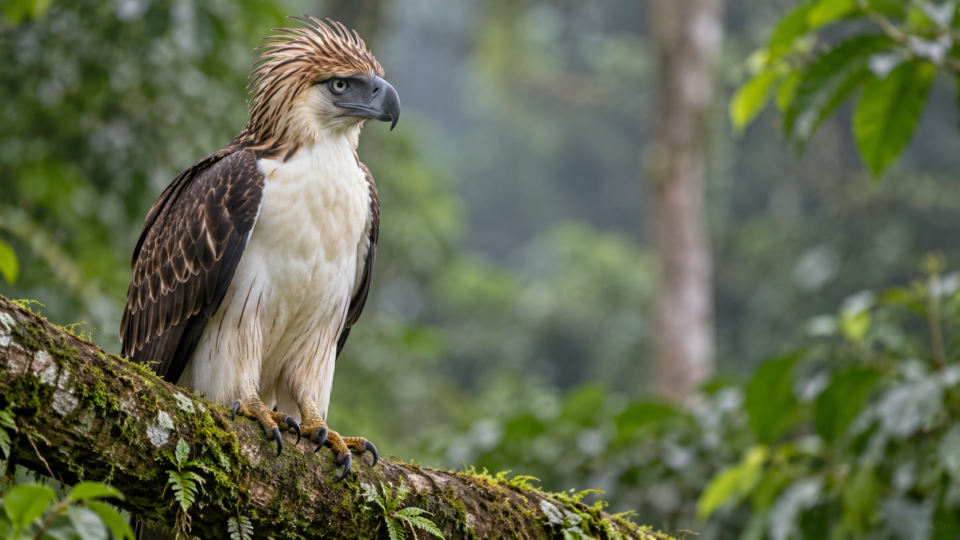
The Philippine eagle is one of the world’s most recognisable birds of prey, yet its survival depends on more than protecting the forest it calls home.
A new genetic investigation suggests that some of the birds brought into conservation care carry signs of greater inbreeding than eagles bred under a managed programme.
The research examined 35 Philippine eagles cared for by the Philippine Eagle Foundation, including 20 birds originally from the wild and 15 born through captive breeding.
Scientists found that inbreeding measures were significantly higher in the wild-captive group than in the captive-bred group.
That difference matters because conservationists must consider not only the number of surviving birds, but also the genetic diversity available to future generations.
The findings were published in Scientific Reports on 17 October 2026, offering new evidence to guide breeding decisions for this critically endangered species.
Why the Philippine eagle is so vulnerable
The Philippine eagle, scientifically known as Pithecophaga jefferyi, is native to the Philippines and depends on rainforest habitat.
Its large size, specialised ecological role and slow reproductive cycle make recovery difficult when numbers decline.
Habitat loss and human encroachment continue to threaten populations and can separate birds from potential mates.
When breeding opportunities are scarce, even an apparently healthy individual may belong to a population with limited genetic options.
This creates an additional challenge for conservation organisations working to maintain a viable population over generations.
Protecting individual birds remains important, but sustaining their long-term future also requires understanding how they are related.
Genetic evidence can reveal connections and vulnerabilities that are difficult to establish from field observations alone.
What the researchers set out to discover
Researchers led by Franchesca Pascual and Dhan Mikhail Perdon investigated the genetic structure of eagles under the Philippine Eagle Foundation’s care.
The team wanted to understand population structure, geographic patterns, inbreeding and relatedness.
These are connected questions, but each addresses a different part of conservation planning.
Population structure describes how genetic differences are distributed among groups of individuals.
Relatedness examines whether two birds share a comparatively recent family connection.
Inbreeding measures can indicate whether an individual’s parents were genetically related.
The researchers also considered isolation by distance, a pattern in which birds originating farther apart tend to be more genetically different.
Together, these analyses can help inform decisions about which birds might be paired in future breeding programmes.
Thirty-five birds and millions of genetic clues
The study analysed genome-wide single-nucleotide polymorphisms, commonly shortened to SNPs.
A SNP is a position in DNA where individuals can carry different genetic variants.
By comparing many such positions across the genome, scientists can investigate patterns of similarity and difference.
The researchers examined samples from 20 wild-captive eagles and 15 captive-bred eagles.
Wild-captive describes birds originally from the wild that were subsequently held in conservation care; it is not the same as sampling an entire free-ranging population.
The team quality-filtered DNA sequencing reads and aligned them with an existing Philippine eagle reference genome.
They then used the resulting genetic markers to investigate the relationships among the 35 individuals.
This approach can reveal patterns that would be missed if conservationists relied only on appearance or recorded pedigrees.
A surprising difference between the two groups
One of the study’s central findings was higher inbreeding among wild-captive eagles than among those bred in captivity.
The authors interpret this as evidence consistent with limited access to genetically diverse mates in the wild.
It also suggests that the foundation’s breeding strategy has helped reduce close-related breeding within its managed group.
That is a notable result because captive breeding is sometimes assumed to carry greater inbreeding risks.
The new findings show why the answer depends on how a breeding programme is managed and on the genetic condition of its founders.
However, the study does not establish that all wild Philippine eagles are more inbred than all captive-bred eagles.
The sampled birds were individuals under the foundation’s care, and the findings should be interpreted within that sampling framework.
The research provides an important warning rather than a complete genetic census of the species.
Why inbreeding can matter for conservation
Inbreeding occurs when related individuals reproduce, increasing the likelihood that offspring inherit matching genetic variants from both parents.
In small or isolated populations, the chance of related individuals encountering one another may rise.
Over time, reduced genetic variation can make it harder for a population to respond to changing conditions.
Inbreeding can also increase the probability that harmful recessive variants are expressed, although outcomes vary across species and individuals.
Importantly, a genetic estimate of inbreeding does not automatically establish that a particular bird is unhealthy or infertile.
The study assessed genetic patterns; it did not demonstrate that every bird with higher inbreeding had poorer survival.
Conservationists use this information alongside reproductive history, health examinations and other evidence.
The practical goal is to preserve as much useful genetic variation as possible without overlooking the birds’ welfare.
Geography leaves a signature in DNA
The researchers also found evidence that genetic distance tended to increase with geographic distance among wild-captive birds.
This pattern is often described as isolation by distance.
It means that birds associated with locations farther apart may be more genetically different than birds from nearby areas.
Such a pattern can emerge when individuals tend to reproduce closer to where they originate.
In fragmented habitat, movement barriers and reduced opportunities for dispersal may reinforce geographic differences.
The study’s finding does not by itself prove which landscape features caused the observed pattern.
But it offers a useful clue when conservationists consider the origins of birds in breeding programmes.
Geographic information and genetic data together can provide a richer picture than either source alone.
Unexpected family connections
The analysis confirmed known first-degree relationships among captive-bred eagles.
That result is useful because it provides a check that the genetic methods can identify close family connections already documented by the foundation.
The researchers also detected previously unrecognised kinship relationships among wild-captive birds.
Those discoveries matter when selecting potential breeding pairs.
Two birds collected from different places may not necessarily be unrelated.
Likewise, birds that look similar are not automatically close relatives.
Genetic screening can reduce uncertainty when written records are incomplete or unavailable.
The study illustrates how genomic information can strengthen rather than replace conventional conservation records.
How genetic information could guide breeding
A managed breeding programme must balance several practical considerations when selecting potential pairs.
Age, health, behaviour, reproductive compatibility and available facilities can all affect whether a pairing is feasible.
Genetic relatedness adds another important layer to those decisions.
Where possible, managers may seek pairings that avoid close relatives and preserve variation across the breeding population.
However, a low-relatedness pairing is not automatically the right choice in every situation.
Conservation teams must consider animal welfare and the broader long-term management strategy.
The researchers describe their findings as information that can support future breeding and conservation efforts.
The paper does not report a randomised test showing that a new pairing strategy has already improved survival in the wild.
The role of the Philippine Eagle Foundation
The Philippine Eagle Foundation has worked for decades to conserve the species and its rainforest habitat.
Its activities include captive breeding, rehabilitation and support for conservation management.
The foundation’s care of both wild-origin and captive-bred birds created an opportunity to compare their genetic profiles.
According to the researchers, the lower inbreeding levels observed in the captive-bred group are consistent with successful management of breeding relationships.
That finding is encouraging, but it does not mean captivity can replace intact natural habitat.
Captive breeding is one part of a wider conservation effort that also depends on suitable forests and reduced human pressure.
Birds intended for reintroduction face ecological challenges that cannot be resolved through genetic screening alone.
The long-term objective remains a sustainable population capable of reproducing in its natural environment.
Why a small sample can still be informative
Thirty-five eagles may sound like a small research sample, and it is important to recognise that limitation.
For a critically endangered species, however, obtaining high-quality genetic material can be difficult.
Each sample can provide many genome-wide markers rather than a single measurement.
That allows researchers to investigate relationships and genetic structure in considerable detail.
Nevertheless, thousands of DNA markers do not turn 35 birds into a complete representation of the wider species.
The composition of the sample matters, especially because the wild-origin birds were already under conservation care.
The findings are best understood as a detailed analysis of this managed group.
Further sampling could help establish whether the same patterns hold across additional wild populations and locations.
What the research does not prove
The study does not show that captive-bred eagles are inherently superior to wild eagles.
It does not prove that every free-ranging population is severely inbred.
Nor does it establish that the observed genetic differences directly caused particular health problems.
The research also cannot quantify how much habitat loss contributed to the genetic patterns without additional evidence.
Its main contribution is the identification of population structure, relatedness and inbreeding patterns within the sampled birds.
Those results can inform decisions, but they should not be converted into unsupported claims about extinction dates or guaranteed breeding success.
The distinction matters because conservation decisions often involve limited resources and difficult trade-offs.
Accurate reporting should preserve both the urgency of the threat and the boundaries of the evidence.
Conservation needs both forests and genetic diversity
Habitat protection and genetic management address different dimensions of the same conservation challenge.
Without suitable forest, birds cannot establish territories, find prey or reproduce successfully in the wild.
Without adequate genetic diversity, a small population may face additional long-term vulnerabilities.
Neither challenge can be solved by focusing exclusively on the other.
The study highlights how genomic information can help conservation teams identify family connections and potential breeding risks.
At the same time, its findings reinforce the need to understand the origins and movement of wild birds.
Effective conservation will depend on combining ecological knowledge, genetic evidence and practical management.
The research offers a new tool for those decisions, not a substitute for protecting the species’ habitat.
What happens next
The researchers describe this work as the first comprehensive conservation genomics study of the Philippine eagle.
The results provide a foundation for investigating genetic variation in additional birds and populations.
Future research could examine how relatedness changes as breeding programmes continue.
Researchers may also explore how genetic information relates to reproductive success, health and reintroduction outcomes.
Longer-term monitoring would be valuable because genetic management aims to protect populations over many generations.
For the Philippine eagle, the stakes are especially high because reproduction is slow and population recovery is difficult.
The immediate message is that conservation teams have gained more detailed information about the birds in their care.
Used carefully, that information may help protect genetic diversity while broader efforts address habitat loss and other threats.
Source Information
Study: Genomic diversity, population structure, and relatedness of critically endangered Philippine eagles under conservation management.
Authors: Franchesca Pascual, Dhan Mikhail Perdon, Francis Tablizo, Carlo Lapid, John Michael Egana, Renato Jacinto Mantaring, Kris Punayan, Shiela Mae Araiza, Jo-Hannah Llames, Ma. Celeste Abad, Juan Carlos Gonzalez, Jayson Ibañez and Cynthia Palmes-Saloma.
Journal: Scientific Reports.
Published: 17 October 2026.
Methodology: Genome-wide SNP analysis of 20 wild-captive and 15 captive-bred Philippine eagles under the care of the Philippine Eagle Foundation, assessing population structure, isolation by distance, inbreeding and kinship.