









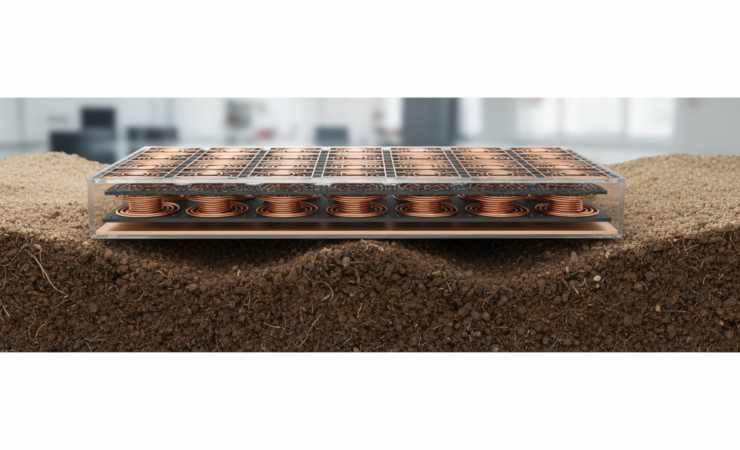
Wireless systems that need to communicate at relatively low radio frequencies face an awkward engineering trade-off. Longer wavelengths can be useful for propagation through difficult environments, including soil and other obstructed settings, but compact antennas operating below 1 GHz often struggle to combine useful bandwidth with positive gain. A newly published study reports a metamaterial-assisted antenna architecture designed to address that problem at three frequencies below 700 MHz.
Writing in Scientific Reports, Vishakha Yadav and colleagues developed an antenna that combines a frequency selective surface with a leaky-wave Fabry Perot type resonator. Instead of treating the metamaterial layer only as a conventional reflector, the design uses both its transmissive and reflective behaviour to create hybrid resonances. The researchers then added a second resonant mechanism to generate another distinct operating band.
Why low-frequency antenna design is difficult
The challenge becomes particularly pronounced below 700 MHz. As frequency falls, wavelength increases, which makes it harder to build physically compact antennas that remain efficient. The authors note that low-frequency antennas can show negative gain and bandwidths of around 1%, even when their radiation patterns remain usable.
That matters for technologies such as wireless sensor networks and cognitive radio, and it can be especially important where signals must travel through or around materials that weaken radio propagation. Underground communication is one example. A practical antenna for such settings needs more than a resonant frequency on paper. It must produce measurable radiation with enough bandwidth to tolerate real operating conditions.
A hybrid resonant architecture
The study’s central idea is to exploit the filtering behaviour of a frequency selective surface, or FSS. These engineered surfaces interact with electromagnetic waves in frequency-dependent ways. In the proposed design, simultaneous transmission and reflection contribute to a hybrid resonance rather than relying on a single conventional antenna resonance.
The researchers also integrated a leaky-wave Fabry Perot type resonator. Fabry Perot resonators use repeated wave interactions between reflecting structures to reinforce particular electromagnetic modes. Here, that additional mechanism was used to produce a separate resonance, broadening the antenna’s useful multi-band behaviour.
The team evaluated the architecture through electromagnetic simulations and physical measurements. This comparison is important because antenna simulations can look promising while fabrication tolerances, material properties, connectors and the measurement environment shift performance in a real prototype. The reported resonances were confirmed experimentally as well as computationally.
Three measured operating bands below 700 MHz
The antenna produced three resonances below 700 MHz. At 462.4 MHz, the reported bandwidth was 2.5% and gain was 1.22 dBi. At 579 MHz, bandwidth increased to 5.9% with a gain of 3.5 dBi. The third resonance occurred at 663.5 MHz, where bandwidth was 1.9% and gain reached 4 dBi.
Those numbers are meaningful in the context the researchers set out to address. Rather than reporting only that the antenna resonates at low frequency, the study shows positive gain at all three operating points. The 579 MHz band is particularly notable for combining the widest reported fractional bandwidth, 5.9%, with positive gain of 3.5 dBi.
The results also illustrate that there is no single performance number that defines a useful antenna. The 663.5 MHz resonance produced the highest gain, while the 579 MHz resonance produced the broadest bandwidth. The lowest-frequency resonance at 462.4 MHz had the smallest positive gain of the three but still operated well below the 700 MHz threshold that motivated the design.
What the findings could mean for underground wireless systems
Sub-700 MHz communication is attractive for sensing and monitoring applications because lower-frequency signals can offer propagation advantages compared with much higher-frequency links in some obstructed environments. The new architecture suggests that engineered surfaces can be used not merely to miniaturise or tune an antenna, but to deliberately create multiple useful resonances through different physical mechanisms.
That could be relevant to buried sensor networks, infrastructure monitoring and other systems where compact radios must operate in propagation conditions that are much less forgiving than open air. Multi-band operation may also provide designers with flexibility to select different channels or functions without requiring a completely separate antenna for each band.
However, the study should not be interpreted as showing that the antenna is ready for every underground deployment. Antenna behaviour depends strongly on the surrounding medium. Soil moisture, composition, burial depth, nearby structures and installation geometry can alter impedance, attenuation and radiation efficiency. Performance demonstrated in a controlled prototype and measurement setting therefore does not automatically translate into identical range or reliability in different soils or field sites.
Simulation and measurement agreement strengthens the result
A useful feature of the work is the combination of simulated and measured validation. Electromagnetic simulation allows researchers to isolate how the FSS and resonator shape the response, while prototype measurements test whether the combined structure retains its intended behaviour after fabrication.
The agreement reported by the authors supports the underlying design concept: hybrid use of transmissive and reflective FSS characteristics can contribute useful low-frequency resonances, while the integrated leaky-wave Fabry Perot structure can add another distinct resonance. This is more informative than a purely numerical demonstration because it shows that the effect survives implementation in hardware.
Important limitations
The work remains an antenna-engineering study rather than a complete communication-system trial. Positive gain and wider impedance bandwidth are important, but they do not by themselves establish data rate, packet reliability, energy consumption or communication range in a deployed underground network.
The reported percentages also represent fractional bandwidth around specific resonances, not continuous broadband operation across the entire sub-700 MHz spectrum. Each band therefore needs to be understood as a defined operating region rather than evidence that the antenna performs uniformly at every frequency below 700 MHz.
Further field testing across different underground conditions would help determine how robust the design is when the electromagnetic properties of the surrounding environment change. Comparisons with alternative low-frequency antennas under identical burial and link-budget conditions would also clarify the practical advantage offered by the hybrid architecture.
A different way to use metamaterials at low frequency
The broader contribution is the design strategy. By using a frequency selective surface for simultaneous transmissive and reflective behaviour and combining it with a second resonant structure, the researchers produced three experimentally confirmed operating bands below 700 MHz with positive gain.
The measured values ranged from 1.22 to 4 dBi in gain and from 1.9% to 5.9% in fractional bandwidth. For low-frequency antenna research, where compact designs often pay a substantial bandwidth and efficiency penalty, those results provide a concrete demonstration of how multiple electromagnetic mechanisms can be combined to improve usable performance.
Source Information
Study: Yadav, V., Chakraborty, S., Annavarapu, S. K. et al. “Metamaterial assisted hybrid response from frequency selective surface roll off and leaky wave resonator integrated antenna for underground applications.” Scientific Reports (2026).
Published: 2 October 2026.
DOI: 10.1038/s41598-026-73867-z.