







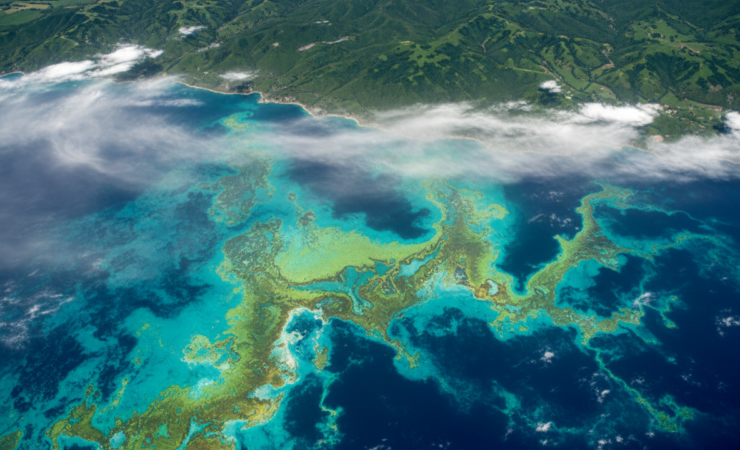
Phytoplankton blooms in the North Atlantic may influence more than marine food webs and the ocean carbon cycle. New research suggests that unusually strong blooms can alter the exchange of energy between the ocean and atmosphere in ways that reach central Europe, where wetter conditions coincide with substantially higher plant productivity.
The study, published in Communications Earth & Environment on 2 October 2026, connects high-latitude North Atlantic chlorophyll variability with European hydroclimate and terrestrial gross primary productivity. During years with stronger blooms, central European growing-season productivity rose by roughly 15–20%. The researchers combined observations with Earth system model experiments designed to test whether chlorophyll itself contributes actively to the atmospheric pathway rather than merely tracking other ocean conditions.
The finding matters because marine and terrestrial ecosystems are often analysed as separate parts of the carbon cycle. Oceans absorb carbon and support phytoplankton growth, while forests, grasslands and crops exchange carbon with the atmosphere on land. The new work points to a physical bridge between these systems: ocean biology can change how sunlight is absorbed near the sea surface, which can alter sea-surface temperature, atmospheric circulation, rainfall and ultimately plant growth hundreds or thousands of kilometres away.
How an ocean bloom could affect plants on land
Chlorophyll is the light-absorbing pigment that allows phytoplankton to photosynthesise. When chlorophyll concentrations rise during a bloom, more incoming shortwave solar radiation can be absorbed within the shallow ocean mixed layer rather than penetrating deeper into the water column. The study found that this enhanced near-surface absorption is associated with additional warming of the North Atlantic sea surface during the relevant season.
That warming is important because the atmosphere responds to spatial contrasts in ocean temperature. In the researchers’ proposed mechanism, warmer conditions near the bloom region accompany higher atmospheric pressure over the North Atlantic and lower pressure over Europe. The resulting pressure pattern strengthens westerly winds, increasing the transport of Atlantic moisture towards the continent.
Central Europe consequently becomes wetter during strong-bloom years. Water availability is a major constraint on photosynthesis and plant growth during the growing season, so increased precipitation can support greater terrestrial carbon uptake when other conditions are favourable. The observed result was a roughly 15–20% increase in gross primary productivity across central Europe during the growing season.
Gross primary productivity, or GPP, measures the total amount of carbon dioxide fixed by plants through photosynthesis before subtracting carbon released through plant respiration. It therefore provides a broad measure of ecosystem photosynthetic activity rather than a direct measure of crop yield, biomass accumulation or long-term carbon storage.
Observations showed a recurring ocean-to-land pattern
The researchers examined variations in North Atlantic chlorophyll alongside sea-surface temperature, atmospheric circulation, European precipitation and terrestrial productivity. The observational patterns were internally consistent with the proposed sequence. High chlorophyll coincided with stronger shallow-ocean heating, circulation changes that favoured enhanced westerly flow, increased moisture transport and higher productivity over central Europe.
Independent productivity indicators strengthened the case that the signal was not limited to a single vegetation dataset. An improved light-use-efficiency estimate of GPP showed large positive anomalies in central Europe during high-chlorophyll years. The study also considered vegetation greenness and agricultural yield information, finding broadly compatible geographical patterns while recognising that crop yields are affected by management, crop choice and many factors beyond rainfall.
The agricultural comparison is therefore supportive rather than decisive. Crop yields cannot be treated as a clean biological readout of North Atlantic chlorophyll because fertiliser use, irrigation, cultivar choice, planting dates, pests and economic conditions can all alter annual production. The central result concerns the coupled ocean-atmosphere-land mechanism and terrestrial productivity, not a claim that phytoplankton blooms determine European harvests.
Model experiments tested whether chlorophyll was an active driver
Observational correlations alone cannot establish the direction of influence. A warm North Atlantic could, for example, influence both chlorophyll and European weather without chlorophyll contributing meaningfully to the atmospheric response. To address this problem, the researchers used a chlorophyll-interactive Earth system model and compared experiments in which chlorophyll could vary with experiments in which chlorophyll was fixed at its climatological state.
This comparison provides the study’s most important evidence for an active biological contribution. Sea-surface temperature anomalies still developed when chlorophyll was held to its climatology, indicating that chlorophyll is not the sole cause of ocean temperature variability. However, the corresponding European terrestrial-productivity response was largely absent. When chlorophyll was allowed to interact with the climate system, the chain linking ocean conditions to atmospheric circulation, precipitation and land productivity was much clearer.
The result supports a feedback mechanism rather than a simple one-variable explanation. Ocean temperature and biological productivity can influence one another, while both interact with radiation and atmospheric circulation. The study therefore does not suggest that chlorophyll independently controls European summer weather. Instead, it identifies chlorophyll variability as a potentially important component of a coupled system.
The productivity increase was substantial but geographically uneven
The headline estimate of roughly 15–20% higher growing-season productivity applies to the central European response highlighted by the researchers. It should not be interpreted as a uniform increase across the continent. Ecosystems differ in their sensitivity to additional rainfall, and regions that are already wet may respond differently from water-limited areas.
The mechanism is especially plausible where summer water availability constrains photosynthesis. In these locations, stronger moisture transport can reduce water stress and allow vegetation to maintain higher carbon uptake. The same rainfall anomaly could have a smaller benefit, no benefit or even adverse effects in a region where moisture is not limiting or where excessive rainfall creates other stresses.
This spatial heterogeneity is important when considering the carbon-cycle implications. A temporary increase in GPP does not automatically translate into an equal increase in net ecosystem carbon storage. Plants and soils also respire carbon, disturbances can release stored carbon, and wetter conditions can alter decomposition. The research establishes a connection to photosynthetic productivity, while the longer-term balance of carbon uptake and release requires additional analysis.
Why the finding changes how ecosystem connections are viewed
Climate research routinely incorporates physical connections across large distances. Sea-surface temperature patterns in one ocean basin can reorganise winds and rainfall elsewhere. What is distinctive here is the proposed role of marine biology within that chain. Phytoplankton are not simply responding to climate conditions. By changing the vertical distribution of solar heating in the upper ocean, their pigments can potentially modify the physical state that helps shape atmospheric circulation.
This creates an ecological connection between two systems that are often studied separately. A biological change in the North Atlantic can contribute to a physical ocean response, that response can influence the atmosphere, and the atmospheric change can alter terrestrial photosynthesis in Europe. The pathway therefore links marine ecology, ocean physics, meteorology and terrestrial ecology.
The work also illustrates why coupled Earth system models increasingly need realistic biological processes. If chlorophyll is prescribed as a fixed seasonal average, a model may reproduce some sea-surface temperature variability while missing downstream responses that depend on interactive ocean biology. The authors’ fixed-chlorophyll experiment provides a concrete example of this possibility.
What the study does not establish
Several limitations constrain how far the findings can be extended. First, the observed relationships occur within a complex climate system containing many interacting modes of variability. The model experiments strengthen the causal interpretation, but models simplify reality and their atmospheric and biological feedbacks depend on how processes are represented.
Second, the study focuses on variability associated with North Atlantic blooms and a European response. It does not establish that comparable ocean-to-land effects operate with the same magnitude in other basins or continents. Different coastlines, prevailing winds, ocean circulation patterns and land ecosystems could produce very different outcomes.
Third, a relationship observed across past or present variability cannot simply be extrapolated into a warmer future. Climate change may alter ocean stratification, nutrient availability, bloom timing, mixed-layer depth, atmospheric circulation and European water stress simultaneously. These changes could strengthen, weaken or reorganise the pathway described in the study.
Finally, the 15–20% productivity increase is not evidence that phytoplankton blooms provide a straightforward climate solution. The carbon consequences depend on the full marine and terrestrial carbon budgets, including respiration and ecosystem turnover. The study identifies a potentially important feedback that should be represented and tested more carefully, rather than a mechanism that can yet be relied upon to offset anthropogenic warming.
A broader view of the carbon cycle
The research adds an unusual dimension to the idea of ecological connectivity. Connections between ocean and land are often discussed through rivers, nutrient transport, fisheries or atmospheric carbon dioxide. Here, the link is mediated by light absorption, sea-surface warming and weather.
That makes the finding relevant beyond the specific North Atlantic case. If biological changes in the ocean can measurably influence atmospheric circulation and terrestrial productivity, then separating marine and terrestrial ecosystem responses too sharply may omit feedbacks that matter for regional climate and carbon-cycle projections.
The next step is to test the mechanism across additional observational periods, models and regions, and to determine how robust it remains under future climate conditions. For now, the evidence indicates that an intense North Atlantic bloom can be more than an ocean event. Through its influence on the upper ocean and atmosphere, it may help shape how much rain reaches Europe and how strongly plants photosynthesise once that moisture arrives.
Source Information
Study: Yang, Y.-M., Park, J.-H., Park, J.-Y. et al. “North Atlantic chlorophyll blooms modulate European hydroclimate and terrestrial productivity.” Communications Earth & Environment (2026).
Published: 2 October 2026.
DOI: 10.1038/s43247-026-04018-5.
Research design: Analysis of observed ocean, atmosphere and terrestrial-productivity variability combined with chlorophyll-interactive Earth system model experiments, including experiments in which chlorophyll variability was suppressed.
Key result: Strong North Atlantic phytoplankton bloom years were associated with wetter conditions and roughly 15–20% higher growing-season gross primary productivity in central Europe. Model experiments supported an active contribution from chlorophyll-mediated upper-ocean heating to the coupled response.