








Computers that process streams of changing information face a basic hardware problem: different signals unfold on very different timescales. A vision sensor tracking movement may need to respond quickly, while biomedical signals can contain slower patterns that demand a longer memory. Researchers in South Korea have now demonstrated a hardware reservoir-computing system whose temporal behaviour can be electrically reprogrammed rather than being largely fixed by the material from which it is made.
The study, published in Nature Communications on 3 October 2026, vertically integrated memristors with thin-film transistors to create an active reservoir array. The researchers report that its temporal response could be tuned experimentally across three orders of magnitude. Circuit configuration extended the accessible range to more than eight orders of magnitude, while the same platform was used for dynamic motion recognition and ultrasound signal classification.
Why hardware memory timescales matter
Reservoir computing is a form of recurrent computing designed for temporal data. Instead of training every internal connection in a large recurrent network, a reservoir transforms an incoming time series into a richer dynamical representation. A comparatively simple readout layer can then be trained to classify or predict from those states.
This approach is attractive for hardware because physical devices can perform part of the temporal transformation directly. The difficulty is that the useful memory of many physical reservoirs is closely tied to an intrinsic relaxation time. A device optimised for one temporal regime can therefore be poorly matched to another. Building a more adaptable reservoir requires a way to change its dynamics without fabricating a different material system for each task.
Memristors and transistors were stacked vertically
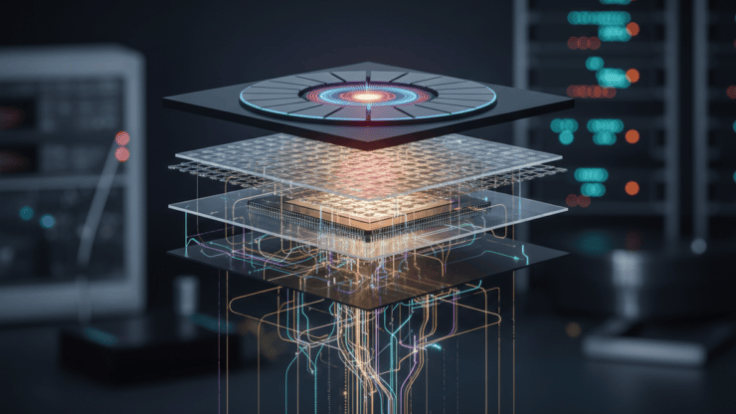
Sung Keun Shim, Wonho Choi and colleagues built their reservoir kernel by vertically and monolithically integrating Ru/HfO2/TiN memristors with thin-film transistors using an In2O3 channel. In this architecture, the transistor modulates the conductance dynamics of the memristor. That coupling gives the researchers an electrical control over how the reservoir responds through time.
The monolithic three-dimensional arrangement is important because it places the two device types in a compact integrated structure rather than treating temporal tuning as an external software operation. The authors also designed the active reservoir array to be compatible with back-end-of-line integration, a manufacturing consideration that matters if neuromorphic components are eventually to be combined with conventional circuitry.
Temporal response shifted by a factor of roughly one thousand
The central quantitative result was the range of programmable temporal dynamics. Experimentally, electrical control changed the temporal response across three orders of magnitude. In practical terms, three orders of magnitude corresponds to a roughly thousand-fold span between timescales.
The researchers then showed that circuit configuration could extend the temporal range to more than eight orders of magnitude. This second result should be distinguished from the directly demonstrated three-order experimental tuning of the device response. Together, the measurements and circuit-level analysis indicate a route towards hardware that is not locked into one narrow temporal window.
The active array also produced reliable spatiotemporal responses, showing that tunability did not merely exist as an isolated device characteristic. The architecture could use those dynamics as a computational resource.
One reservoir was tested on vision and ultrasound signals
To demonstrate that the adjustable dynamics could support meaningful temporal processing, the team applied the system to two substantially different signal domains. One task involved dynamic motion recognition using vision-sensor data. The other involved classification of ultrasound signals.
Both are spatiotemporal problems, but their signal structures are not identical. Demonstrating the platform across these domains therefore addresses a central motivation for tunable reservoir hardware: a single physical system should be able to adapt its effective memory to the temporal characteristics of different inputs.
The study reports high classification accuracy using a simple linear readout layer. That point is important conceptually. Reservoir computing is useful when the physical reservoir performs enough nonlinear temporal transformation that the final decision stage can remain relatively simple. The work therefore focuses not only on whether the devices switch, but on whether their physical dynamics can contribute directly to computation.
What the result changes
The main advance is programmability of time itself as a hardware property. Many neuromorphic devices are evaluated according to switching energy, retention, endurance or classification accuracy. For temporal computing, however, the duration over which a device retains useful information is equally important. A reservoir that forgets too quickly cannot connect widely separated events, while one that relaxes too slowly can blur rapidly changing inputs.
Electrical control offers a way to match the reservoir to the signal instead of forcing every signal through a fixed temporal response. If such architectures scale reliably, that flexibility could be valuable for edge systems processing sensor streams whose characteristic timescales change across applications.
The three-dimensional integration strategy also points towards denser hardware. By stacking the memristive and transistor elements, the researchers avoid treating temporal control as a separate bulky component. Compatibility with back-end-of-line processing could make this kind of architecture easier to integrate above other circuitry, although manufacturability at much larger scales remains a separate engineering challenge.
Important limitations remain
This is a hardware research demonstration, not a commercial processor benchmark. The experiments establish tunable dynamics and demonstrate representative classification tasks, but they do not show that the architecture can yet replace mature digital accelerators across broad workloads.
The more than eight-order temporal range also comes from circuit configuration, whereas the directly demonstrated electrical tuning spans three orders of magnitude. Those results are related but should not be treated as identical experimental claims. Large arrays will additionally have to contend with device variation, endurance, fabrication yield, peripheral circuitry, energy consumption and the difficulty of preserving predictable dynamics as systems scale.
The classification demonstrations likewise establish proof of computational capability rather than universal superiority. Performance comparisons depend on datasets, preprocessing, training protocols and competing hardware baselines. The strongest conclusion from this study is therefore narrower and more useful: the researchers demonstrated a monolithically integrated reservoir whose temporal dynamics can be actively programmed over a wide range and used for more than one type of spatiotemporal signal.
A step towards adaptable temporal hardware
Neuromorphic hardware often seeks to exploit physical dynamics that conventional processors must reproduce numerically. That advantage can become a constraint when the same dynamics are fixed at fabrication. By combining a memristor with an electrically controlling thin-film transistor in a vertically integrated structure, this study shows a way to make those dynamics adjustable.
The result does not remove the scaling and manufacturing challenges facing reservoir computing. It does, however, address a fundamental limitation of physical temporal processors: one piece of hardware no longer has to correspond to only one characteristic memory timescale.
Source Information
Study: Shim, S. K., Choi, W., Cheong, S. et al. Monolithic three-dimensionally integrated memristor-thin-film transistor for electrically programmable multimode reservoir computing.
Journal: Nature Communications.
Published: 3 October 2026.
DOI: 10.1038/s41467-026-78364-5.