









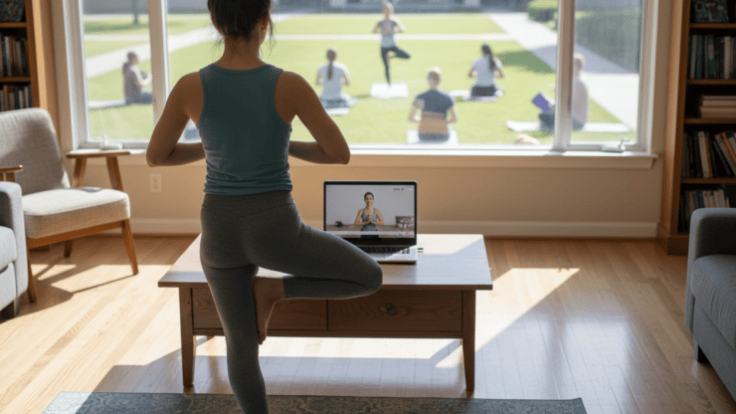
Instructional video has become a routine part of university teaching, but whether students experience video-based lessons differently when a course is fully online, mixed-mode or taught in person remains an important practical question. A new study published in TechTrends compared undergraduate students taking the same yoga course across three delivery formats and found a largely consistent pattern: students reported similar stress, anxiety, mindfulness, attention, relevance and confidence across modalities. The clearest difference appeared in satisfaction, where students in the fully online video condition rated their experience more positively than students in the mixed-mode condition.
The findings do not show that prerecorded video is generally equivalent to live teaching. The study was not randomised, focused on one university yoga course and measured psychological and motivational outcomes rather than actual yoga proficiency. What it does provide is a useful test of whether carefully designed instructional videos can support similar student experiences across different course structures.
A five-week comparison across three course formats
Efren de la Mora Velasco, Shiva Jahani and Steve Haberlin studied undergraduates enrolled in yoga courses at a large research university in the United States during the Spring 2025 semester. The research used a comparative non-equivalent groups design within a quasi-experimental framework. Students were already enrolled in online, mixed-mode or face-to-face sections, so they were not randomly assigned to a learning format.
The study included 274 students in its psychological-outcome analyses. Complete demographic information was available for 150 participants: 57 were in face-to-face classes, 45 in mixed-mode classes and 48 in fully online classes. Among those with demographic data, 61.3% identified as female, 36.7% as male and 2.0% as non-binary or third gender. Most were relatively inexperienced with yoga, with 139 of the 150 students, or 92.7%, reporting no more than 30 hours of previous experience.
Students in the online and mixed-mode groups used instructional yoga videos delivered through the university’s learning management system. The face-to-face group practised the same poses with live demonstrations from the same instructor. Before and after a five-week instructional period, the groups completed measures of perceived stress, anxiety and mindfulness. A smaller group of 86 consenting students also supplied instructional-motivation data.
The videos were deliberately designed rather than simply recorded
An important feature of the research is that the videos were professionally developed with instructional design in mind. The production process involved course faculty, an instructional designer and a university video team. A certified yoga instructor demonstrated the poses in an uncluttered environment with verbal guidance and background music.
The course used six prerecorded videos: an introductory video and five practice-focused videos covering standing sequences, balance, seated and twisting postures, breathing exercises and relaxation. Individual videos lasted approximately 15 to 20 minutes. The researchers report that the material was structured using principles from the Cognitive Theory of Multimedia Learning, including coherence, segmentation, signalling and coordinated visual and verbal information.
This matters when interpreting the results. The study did not compare live instruction with arbitrary or low-quality online material. It compared live demonstrations with purpose-built multimedia instruction designed to reduce unnecessary cognitive load and direct students’ attention towards relevant movement, alignment and breathing cues.
Stress, anxiety and mindfulness did not differ significantly by modality
The researchers used established instruments to measure psychological outcomes, including the Perceived Stress Scale, the State-Trait Anxiety Inventory and the Mindful Attention Awareness Scale. They then used one-way analysis of variance to compare outcomes among asynchronous online, mixed-mode and in-person students.
There was no statistically significant difference in perceived stress across the three formats, with F(2, 271) = 2.40 and p = .093. Mindfulness was similarly consistent across modalities, F(2, 271) = 0.05, p = .950. Anxiety also showed no statistically significant modality difference, F(2, 271) = 1.56, p = .211.
These null differences are important, but they require careful wording. They indicate that the researchers did not detect evidence of different reported psychological outcomes among the three course formats. They do not prove that the formats are identical, nor do they demonstrate that video caused the outcomes. The students belonged to naturally occurring course groups rather than randomly assigned experimental conditions.
Most motivational measures were also similar
For instructional motivation, the researchers used a reduced version of the Instructional Materials Motivation Survey, based on the ARCS framework of attention, relevance, confidence and satisfaction. The analysis used responses from 86 students who consented to the use of their motivation data.
Attention did not differ significantly among the three groups, F(2, 83) = 1.79, p = .173, with an eta-squared effect size of .041. The same was true for perceived relevance, F(2, 83) = 1.29, p = .281, eta-squared = .030, and confidence, F(2, 83) = 1.13, p = .328, eta-squared = .026.
Satisfaction was the exception. The overall group difference was statistically significant, F(2, 83) = 3.60, p = .032, eta-squared = .080. Tukey post hoc comparisons showed that fully online students using video reported mean satisfaction of 4.40 out of 5, with a standard deviation of 0.66. Mixed-mode students using the videos reported a lower mean of 3.81, with a standard deviation of 0.95. That difference was statistically significant at p = .026.
The in-person group, which received live yoga demonstrations, reported mean satisfaction of 4.06 with a standard deviation of 0.85. Its satisfaction did not differ significantly from either the fully online or mixed-mode groups.
Why might online students have been more satisfied?
The researchers suggest that flexibility and self-paced access may help explain the higher satisfaction among fully online students. Prerecorded demonstrations can be paused, repeated and revisited, which may be particularly useful when learners are practising sequences of physical movements. Online students may also expect video to be central to their course, whereas students in mixed-mode formats can experience a different balance between digital and face-to-face components.
That explanation remains interpretive rather than experimentally established. Because students selected or were enrolled in different course modalities, pre-existing preferences could contribute to the satisfaction difference. A student who deliberately chooses an online course may value flexibility more strongly than someone who chooses a mixed or face-to-face format.
The broader pattern is nevertheless noteworthy. Live demonstration did not produce significantly higher ratings of attention, relevance, confidence or satisfaction than the video conditions. This suggests that well-designed instructional media can function as more than a simple substitute when direct demonstration is unavailable. In some settings, it may provide a consistent instructional anchor while allowing teaching staff to devote more time to feedback, coaching and individual correction.
The study does not measure whether students learned yoga better
A central limitation is that the study did not directly test motor performance or yoga proficiency. Similar motivation, stress or mindfulness scores cannot establish that students acquired the same physical skills. A future experiment could combine psychological measures with blinded assessments of posture, sequencing, balance or technique to determine whether similar student experiences translate into similar learning outcomes.
The intervention also lasted only five weeks, which limits conclusions about longer-term motivation or psychological change. The sample consisted of students who had enrolled in yoga courses at one research university, and yoga itself is a distinctive instructional setting involving physical movement, body awareness and relatively low-stakes practice. Results may differ in mathematics, laboratory science, clinical training or other fields with different cognitive and performance demands.
The authors additionally note the burden created by administering several substantial questionnaires. Survey fatigue can reduce completion and potentially affect response quality. Only 86 students contributed the motivation data, although the researchers clarify that this smaller number reflected consent for those particular data rather than conventional study attrition.
What the findings mean for instructional design
The study’s practical message is less about choosing online learning over classrooms and more about the quality of instructional design. The videos were segmented, visually focused and paired spoken explanation with physical demonstration. Those features were intentionally designed around established multimedia-learning principles.
For educators teaching movement-based or demonstrative material, prerecorded video may therefore be most useful when treated as an instructional product rather than merely a recording of a lecture. Clear framing, manageable segments, relevant visual cues and opportunities to pause and practise may help preserve attention and confidence while adding flexibility.
The findings also caution against assuming that in-person delivery automatically creates a better student experience. In this study, most measured outcomes were statistically similar across formats, and fully online students reported greater satisfaction than mixed-mode students. Yet the non-randomised design and absence of objective skill assessment mean the evidence supports a narrower conclusion: thoughtfully produced instructional videos can accompany different learning modalities without obvious disadvantages in the psychological and motivational outcomes measured here.
Source Information
Study: de la Mora Velasco, E., Jahani, S. & Haberlin, S. (2026). Are Instructional Videos Effective Across Learning Modalities? Examining Motivational and Psychological Outcomes. TechTrends.
Published: 2 October 2026.
DOI: 10.1007/s11528-026-01226-w
Study type: Comparative non-equivalent groups study within a quasi-experimental framework.
Participants: 274 undergraduate yoga students for the psychological comparisons, with 86 students contributing instructional-motivation data.