









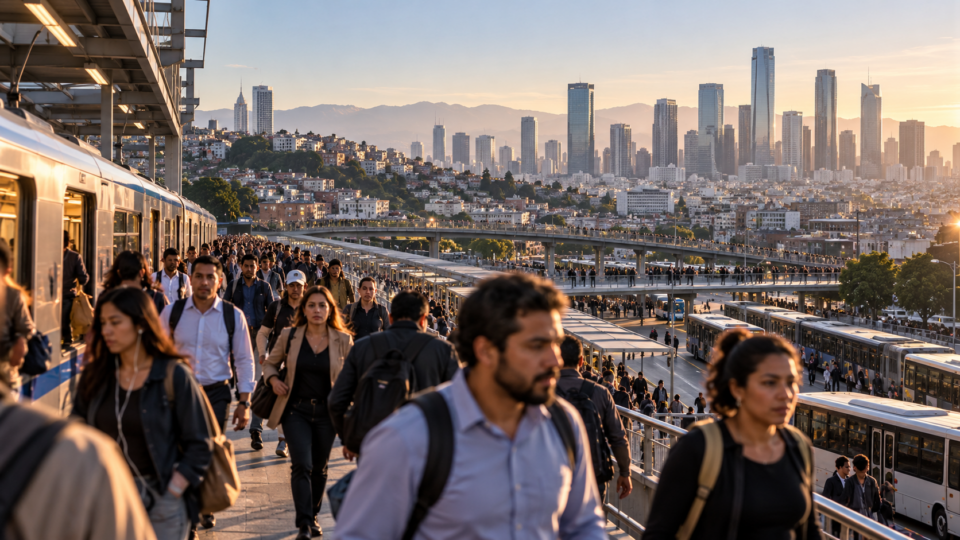
Living close to jobs does not necessarily mean living close to good opportunities.
A new study published in Nature Communications on 7 October 2026 argues that conventional measures of job accessibility can hide important socioeconomic inequalities because they focus heavily on physical distance while treating employment opportunities as if they were interchangeable.
Researchers Ollin D. Langle-Chimal, Steffen Knoblauch and Marta C. González developed a model called WorkReach to examine how workers trade commuting distance against the economic characteristics of the places where jobs are located. They applied it to four large urban regions: the San Francisco Bay Area, Los Angeles, Mexico City and Rio de Janeiro.
Across all four cities, workers generally preferred shorter commutes. But they were also consistently willing to travel farther to reach areas with greater economic complexity, meaning destinations with a more diverse and sophisticated mix of economic activity. The strength of that trade-off varied substantially between cities and socioeconomic contexts.
The findings suggest that urban planners may miss part of the inequality in labour-market access when they ask only how many jobs can be reached within a certain distance or travel time.
Why distance alone can mislead
Traditional accessibility measures often start with a straightforward question: how many jobs are located near a person’s home?
That matters. Long commutes consume time, raise transport costs and can reduce the time available for family, rest and other activities. But two neighbourhoods with the same number of nearby jobs may still offer very different economic prospects if the jobs differ in diversity, formality and the opportunities associated with the surrounding economy.
WorkReach therefore treats commuting as a choice involving several competing features. Distance imposes a cost. Economic complexity can make a destination more attractive. The socioeconomic conditions of a worker’s home area, particularly labour informality, can change the way these factors interact.
The researchers describe the framework as a discrete-choice model. Rather than assuming commuters simply choose the closest available employment, it estimates choices as if workers were selecting the destination that offered the greatest overall utility from the options available to them.
Four cities offered very different labour landscapes
The analysis covered two US metropolitan regions and two Latin American cities: the Bay Area, Los Angeles, Mexico City and Rio de Janeiro.
The underlying data sources differed by location. Employment and commuting information for the US regions was derived from aggregated Replica data. Mexico City combined official economic and population information from Mexican statistical sources with licensed location-based mobility data. Rio de Janeiro used Brazilian employment and census information together with mobility data.
The researchers calculated spatial measures of economic complexity and informality and then compared them with observed commuting flows.
An important regional contrast emerged before the commuting model was even considered. In Mexico City and Rio de Janeiro, neighbourhood informality and economic complexity were moderately negatively correlated, at roughly ρ = -0.4. In practical terms, areas with more informal workers tended to be spatially separated from the more economically complex parts of the city.
In the Bay Area and Los Angeles, that spatial correlation was close to zero. Informality and economic complexity were therefore more spatially mixed than in the two Latin American cases.
Workers travelled farther for economically complex destinations
The model found a consistent preference for economically sophisticated destinations across all four urban regions.
People were willing to tolerate additional distance when a potential work destination had greater economic complexity. However, the size of that trade-off was far from universal.
According to the researchers’ interpretation of the fitted model, a worker in Mexico City was willing to travel almost four times as much additional distance for the same increase in destination complexity as a worker in Los Angeles. Rio de Janeiro showed an even stronger willingness to trade distance for economic complexity.
Mexico City also provides a useful illustration of the cost of distance itself. Holding other characteristics constant, a 1% increase in distance to an otherwise equivalent job destination was associated with about a 3.7% reduction in the probability of choosing it.
These estimates should not be read as universal behavioural constants. They are model-derived relationships from the commuting patterns observed in each city. Their importance lies in showing that distance and economic opportunity interact differently across urban systems.
The importance of distance changed beyond a threshold
WorkReach also allows the relationship between commuting distance and socioeconomic characteristics to change after a city-specific distance threshold.
The model estimated this transition at approximately 16 kilometres in Mexico City and 25 kilometres in Rio de Janeiro. Beyond these distances, the economic characteristics of destinations became more important relative to simple proximity.
In the US cities, the transition occurred much closer to the origin. The authors suggest that differences in urban form, road infrastructure, car dependence and suburban residential patterns may help explain why the distance trade-off behaves differently.
The model does not prove those explanations. It does, however, demonstrate why assuming that every additional kilometre has the same meaning in every city can obscure important differences in how labour markets operate.
Informality changed the commuting pattern in opposite directions
One of the study’s most striking findings was that informality did not relate to commuting in the same way across regions.
In Mexico City and Rio de Janeiro, workers living in areas with higher informality tended to travel farther to reach destinations with high economic complexity. The longest commutes in these cities were particularly associated with movement from high-informality origins towards high-complexity employment areas.
The pattern was reversed in the Bay Area and Los Angeles. There, the longest commutes tended to originate in lower-informality areas, consistent with suburban workers travelling towards major employment centres.
The authors discuss several possible reasons for the Latin American pattern. High-complexity destinations may contain more formal employment with benefits and social protection, while peripheral high-informality neighbourhoods may offer fewer comparable opportunities close to home.
But this is an observational analysis. The study cannot establish that informality itself causes people to commute farther, nor can it determine the individual motivations behind every observed trip.
Job accessibility looked different when opportunity quality was included
The researchers then compared conventional distance-weighted accessibility with a utility-based measure derived from the WorkReach model.
This second measure, described as consumer-surplus accessibility, considers the wider menu of work destinations available from a neighbourhood while incorporating the characteristics that the model suggests workers value.
The comparison changed the picture of inequality.
Using distance-weighted accessibility alone, high-informality neighbourhoods in the two US cities appeared to have comparatively favourable job access. Once the attractiveness and economic characteristics of the available opportunities were incorporated, those neighbourhoods performed worse.
In Mexico City and Rio de Janeiro, high-informality origins were already disadvantaged using the distance measure. The broader utility-based analysis reinforced the conclusion that proximity alone did not capture the quality of the opportunities available.
When the researchers combined the accessibility dimensions, high-informality areas had lower access across all four cities. Peripheral areas were particularly disadvantaged, with western Rio de Janeiro highlighted as an example of a location poorly served by the combined measure.
Why this matters for transport planning
The results challenge a simple interpretation of accessibility policy.
Building a faster transport connection from a peripheral neighbourhood to a major employment centre can clearly improve physical access. But if the surrounding labour market remains highly informal and economically limited, improved transport may simply make a long commute easier rather than creating better opportunities close to where people live.
For Mexico City and Rio de Janeiro, the findings support considering transport investment alongside local economic development, formal employment creation and the spatial distribution of sophisticated economic activity.
The policy implications may be different in Los Angeles and the Bay Area, where physical distance and informality interact differently. The model therefore argues against applying one accessibility strategy to cities with very different labour-market structures.
This complements recent Research Today coverage showing that the value of urban infrastructure cannot always be understood from size or location alone. A recent analysis of parks in Greater Tokyo, for example, found that small neighbourhood parks could deliver stronger walking-related health returns than large destination parks. Both studies illustrate how population behaviour can change the apparent value of urban assets.
The model is not a map of individual motives
WorkReach is designed to make aggregate commuting patterns more interpretable, but several limitations are important.
First, the model reconstructs observed flows using spatial and socioeconomic variables. It cannot know why a particular worker accepted a particular job. Salary, household responsibilities, discrimination, housing constraints, occupation, transport mode and personal preferences can all influence commuting decisions.
Second, the data sources are not identical across cities. The US and Latin American analyses rely on different employment, census and mobility systems, and some of the mobility information is derived from licensed location-based services. Comparisons therefore require care.
Third, economic complexity is a proxy for the characteristics of an employment destination, not a direct measure of the quality of every job within it. A highly complex district can still contain low-paid or insecure work.
Fourth, the results are cross-sectional. They identify relationships in observed commuting systems rather than proving that changing complexity, informality or transport infrastructure would produce a particular behavioural response.
Finally, the four cases cannot represent every city. Urban form, public transport, housing markets, labour regulation and informality differ widely around the world.
Being near jobs is not the same as having access to opportunity
The central insight from WorkReach is simple but consequential.
Workers generally dislike travelling farther, yet distance is not the only characteristic shaping where they work. Across four very different cities, economically complex destinations attracted commuters over longer distances, while informality changed those patterns in ways that differed sharply between the United States and Latin America.
That means a neighbourhood can appear well connected when accessibility is measured only by kilometres or nearby job counts and still offer residents a comparatively weak set of realistic economic opportunities.
For urban policy, the question may therefore need to shift from “How many jobs are nearby?” to a harder one: “What kinds of opportunities can residents actually reach, and what must they trade to reach them?”
Source Information
Study: Langle-Chimal, O. D., Knoblauch, S. & González, M. C. “The WorkReach model for urban work location choices through economic complexity and informality.”
Journal: Nature Communications.
Published: 7 October 2026.
DOI: 10.1038/s41467-026-78293-3
Study design: Comparative urban mobility modelling across the San Francisco Bay Area, Los Angeles, Mexico City and Rio de Janeiro using a discrete-choice framework incorporating commuting distance, economic complexity and labour informality.