



Small ponds, large ecological roles
A pond can look like an unremarkable patch of water, but a new European study suggests that the diversity of life within it is closely associated with how well it performs several important ecological functions.
Researchers surveyed 206 ponds across Europe and analysed roughly 2,500 observations of biodiversity and ecosystem processes. Their findings were published in Nature Ecology & Evolution on 14 October 2026.
The study found a positive association between biodiversity and ecosystem multifunctionality, a term describing the ability of an ecosystem to perform several functions at once.
At the same time, ponds with elevated nutrient concentrations linked to intensive cropland tended to perform less well across multiple functions.
The results highlight why protecting small freshwater habitats involves more than preserving the water itself. The plants, animals and water quality all matter.
What ecosystem multifunctionality means
An ecosystem can perform several jobs simultaneously. It may store carbon, produce plant biomass, break down organic material and provide habitat for other organisms.
These processes do not always respond in the same way to environmental conditions. A pond that supports high plant production may not necessarily perform equally well on every other measure.
Ecologists use multifunctionality to evaluate several processes together instead of treating a single measurement as a complete description of ecological health.
In this study, the researchers considered functions and processes including methane emissions, litter decomposition, carbon sequestration, primary productivity, biomass accumulation and habitat complexity.
These measures describe different aspects of the freshwater environment. Carbon sequestration concerns carbon retained within the system, while litter decomposition reflects the breakdown of organic material.
Methane emissions represent a different dimension because methane is a potent greenhouse gas. Higher values are not automatically desirable, so the interpretation of a combined index depends on how each function is defined and standardised.
That complexity makes it important to avoid describing multifunctionality as a simple score for whether a pond is good or bad.
How researchers studied 206 ponds
The team carried out a large, standardised and stratified field survey of ponds in several European countries.
Rather than concentrating on a single region, the researchers included ponds across different climatic and land-use settings.
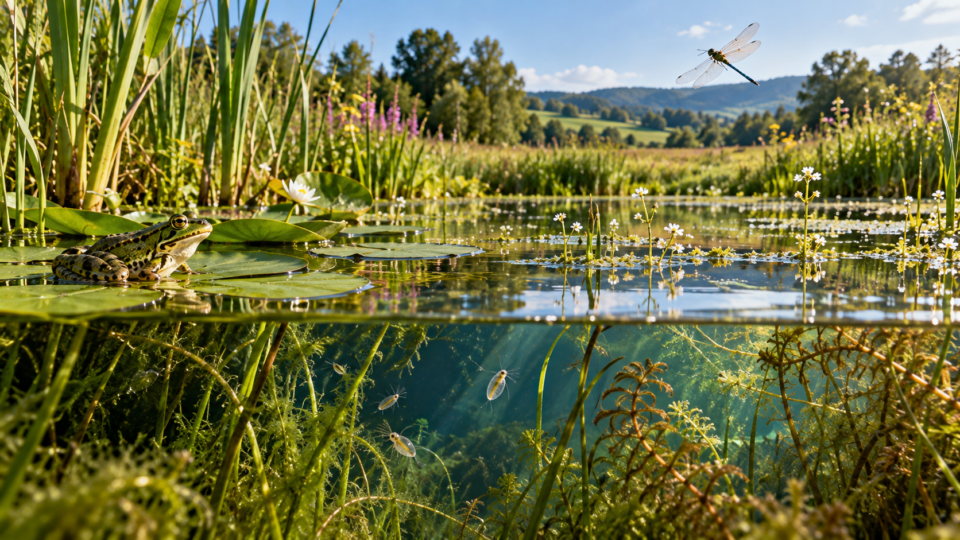
They collected information on aquatic plants, zooplankton, macroinvertebrates and amphibians, covering organisms with different ecological roles.
Aquatic plants provide structure and habitat. Zooplankton include small animals that feed on microorganisms and algae. Macroinvertebrates include insects and other animals large enough to be seen without a microscope.
Amphibians, including frogs and related animals, connect aquatic and terrestrial food webs during different parts of their lives.
By examining these groups together, the researchers could ask whether the richness of several communities related to the performance of multiple pond functions.
The study assembled approximately 2,500 biodiversity observations and measurements of key ecosystem functions and processes.
The researchers also examined environmental conditions, including nutrient concentrations, surrounding land use and aridity.
Statistical models were used to evaluate relationships between biodiversity, environmental pressures and the multifunctionality measures.
Because the survey was observational, it identifies associations across existing ponds rather than experimentally proving that adding species causes every measured function to improve.
Biodiversity was associated with multiple functions
The central finding was that ponds with greater biodiversity tended to show stronger ecosystem multifunctionality across the taxonomic groups studied.
This relationship was not limited to one conspicuous type of organism. The analysis considered several groups within the aquatic food web.
That matters because small freshwater habitats contain interactions among plants, microscopic animals, larger invertebrates and vertebrates.
Different species can contribute to different processes. Some organisms influence nutrient cycling, while others provide habitat or participate in the breakdown of organic material.
A diverse community may therefore be associated with a broader range of functioning than a community dominated by relatively few species.
However, the paper does not establish that each additional species produces the same increase in multifunctionality.
Species identity, interactions and environmental conditions can all affect the relationship, and the researchers evaluated patterns across whole pond communities.
The study supports the importance of considering several biological groups when assessing freshwater conservation. A separate global analysis of 423 studies also explored biodiversity and ecosystem services, although it examined a different evidence base.
Why tiny zooplankton deserve attention
One notable result was that several ecosystem functions were strongly linked to zooplankton richness.
Zooplankton are small aquatic animals, many of which are easily overlooked without specialised sampling equipment.
They occupy important positions in freshwater food webs, often consuming algae and microorganisms while providing food for larger animals.
Changes in their diversity can therefore coincide with changes in other parts of a pond ecosystem.
The findings suggest that monitoring only visible vegetation or larger animals may miss informative signals about ecological functioning.
Zooplankton richness is not a universal diagnostic test, however. A relationship found across the sampled ponds does not establish a fixed threshold for healthy water everywhere.
Local species composition, seasonal conditions and nutrient availability may all influence how zooplankton communities relate to measured functions.
Nevertheless, their prominence in the analysis demonstrates the value of looking below the water surface when assessing pond biodiversity.
Nutrient pollution emerged as a major pressure
The study also found that increasing nutrient concentrations associated with intensive cropland were negatively related to multiple ecosystem functions.
Nutrients such as nitrogen and phosphorus are necessary for biological growth, but excessive inputs can disrupt aquatic systems.
Runoff from agricultural land can transport fertilisers and other materials into nearby ponds, especially during rainfall.
When nutrients accumulate, a process known as eutrophication can alter plant and algal growth, oxygen conditions and the balance of aquatic communities.
These changes may affect the functioning of a pond even when the water body remains physically present on the landscape.
The researchers’ findings therefore reinforce the importance of managing the surrounding land, not just the pond boundary.
Reducing excessive nutrient inputs may support both biodiversity and ecosystem processes, although the study did not test a particular pollution-control intervention.
The association with intensive cropland should not be interpreted as proof that every farm or agricultural practice has the same impact.
Local runoff pathways, soil conditions, fertiliser management and other factors can influence exposure. Related research on rivers near Johannesburg wastewater plants illustrates another water-quality concern, but investigated antibiotic resistance rather than pond multifunctionality.
Drier regions showed an important pattern
The positive relationship between biodiversity and multifunctionality tended to be more pronounced in arid regions.
Aridity describes the degree of climatic dryness and is commonly evaluated in relation to precipitation and atmospheric demand for water.
Small ponds in dry landscapes may face particularly demanding conditions, including limited water availability and strong seasonal fluctuations.
The finding suggests that biodiversity could be especially relevant to understanding ecosystem functioning under these conditions.
However, a stronger statistical association in drier areas does not mean that biodiversity alone can offset severe drought or prevent a pond from drying out.
The study was not a controlled test of future climate change and should not be treated as a precise prediction for every pond under warming.
It does indicate that conservation planning should consider climatic context when interpreting the role of species diversity.
This is relevant beyond Europe, including to regions where small water bodies are exposed to pronounced seasonal rainfall and water scarcity.
Why the findings matter beyond Europe
Ponds are often overlooked in conservation planning because they are small, scattered and sometimes temporary.
Yet many landscapes contain networks of such water bodies that provide habitat and ecological connections.
The European survey offers a useful framework for understanding how biodiversity and environmental pressures may interact in these systems.
South African ponds, farm dams and seasonal wetlands may face some comparable pressures, including nutrient runoff and periods of drought.
However, the study did not sample South African water bodies, so its numerical results cannot simply be transferred to local ecosystems.
Different species, climates and land-use patterns could change the strength or direction of individual relationships.
Local field research would be needed to determine which biodiversity indicators best explain multifunctionality in South African freshwater habitats. Research on mangroves at 400 coastal sites likewise shows why habitat conditions matter, although coastal mangroves differ greatly from inland ponds.
Even so, the broad lesson is relevant: small aquatic ecosystems deserve assessment as functioning habitats, not merely as water-storage features.
What restoration programmes can learn
Restoring a pond can involve improving water quality, reducing pollution, rebuilding natural vegetation and protecting habitat for aquatic organisms.
The new study supports evaluating restoration success across several ecological functions rather than relying on one visible indicator.
For example, a pond may appear greener after restoration without necessarily improving carbon storage, decomposition or the composition of animal communities.
Monitoring multiple organism groups can reveal whether improvements extend through the food web.
The findings also suggest that reducing nutrient concentrations may be an important part of maintaining pond multifunctionality.
However, the analysis does not rank specific restoration techniques or quantify how much improvement any intervention would deliver.
Those questions require experiments, long-term monitoring and comparisons before and after restoration.
Practical decisions should therefore combine this broad evidence with local water-quality measurements and ecological expertise.
What the study cannot prove
The survey included 206 European ponds, a substantial dataset for this type of ecological fieldwork, but it does not represent every pond or freshwater habitat worldwide.
The research was observational, which limits causal interpretation. Ponds with more species may also differ in other ways that support ecosystem functioning.
Statistical models can account for measured environmental factors, but unmeasured influences may remain.
Multifunctionality indices also depend on which processes are included and how they are combined.
The analysis measured associations among biodiversity, ecological processes and environmental conditions, not the direct effectiveness of a specific conservation policy.
The authors reported that the complete underlying database is scheduled for public release in January 2027, with access available on request in the meantime.
Supporting statistical information and analysis code were made available, which can help other researchers examine the approach.
Replication across other climates and continents would strengthen confidence in how widely these relationships apply.
A broader case for protecting small waters
The study adds to evidence that biodiversity is associated with the functioning of ecosystems, extending that perspective to small standing freshwater habitats.
Its scale is notable: 206 ponds, approximately 2,500 observations and several groups of aquatic organisms were considered alongside multiple ecosystem processes.
The results point to two complementary priorities: maintaining diverse biological communities and limiting excess nutrients entering ponds.
They also show why evaluating environmental health through one species or one function can give an incomplete picture.
For policymakers, conservation organisations and land managers, the findings encourage a more comprehensive approach to small-waterbody protection.
The key message is not that every pond needs the same intervention, but that biodiversity and water quality should be considered together.
Small ponds may occupy little space on a map, yet the ecological processes taking place within them can be important to the surrounding landscape.
Source Information
Study: Biodiversity enhances pond ecosystem multifunctionality across Europe
Authors: Maria Cuenca-Cambronero, Manuel Delgado-Baquerizo, Maria Anton-Pardo and colleagues.
Journal: Nature Ecology & Evolution
Published: 14 October 2026.
Methods: Standardised, stratified field survey of 206 European ponds with approximately 2,500 observations of aquatic biodiversity and ecosystem functions.