



A calmer feeling after a museum visit
A trip to a museum can offer more than an opportunity to learn about art, science or history.
For some visitors, it may also coincide with a change in how they feel.
Researchers in Milan have reported lower anxiety and better mood immediately after two kinds of museum activity.
Their study included 135 adults attending the city’s Modern Art Gallery or Natural History Museum.
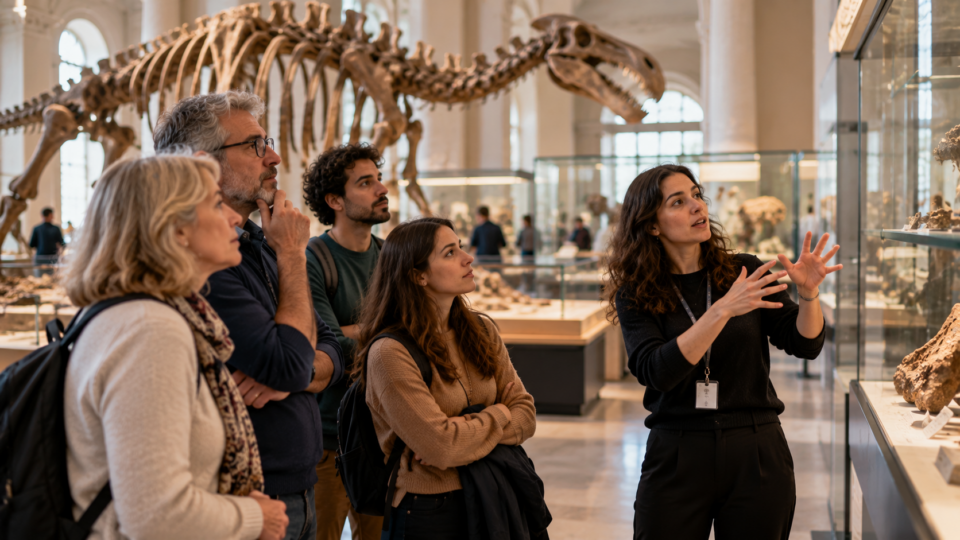
Some participants joined guided tours while others took part in facilitated group discussions of exhibits.
Both groups reported improvements between the beginning and end of their sessions.
The results suggest a promising connection between cultural experiences and short-term wellbeing.
But the study did not include a group that spent the same time outside a museum.
That means the researchers cannot establish whether the museum activities themselves caused the changes.
What the researchers measured
The study was part of a wider project examining anxiety, stress and museum experiences.
Its main outcome was state anxiety, meaning anxiety felt at a particular moment.
Participants completed a standardised anxiety questionnaire before and after their activity.
They also rated mood, stress, calmness, contentment, restlessness and mental clarity.
The researchers were interested in changes over a relatively short period.
They were not measuring whether participants had recovered from an anxiety disorder.
Nor did the study assess long-term mental health outcomes.
The distinction is important because a pleasant afternoon and sustained clinical improvement are different things.
A short-term shift in a questionnaire score can still be interesting without proving a therapeutic effect.
The headline numbers
Across all 135 participants, the average state-anxiety score fell from 35.07 to 29.53.
That represents a reduction of about 5.54 points on the study’s scale.
The authors also used a model accounting for people attending the same session.
That model estimated an anxiety reduction of 5.55 points.
The associated 95 percent confidence interval ranged from a reduction of 6.85 to 4.26 points.
Mood ratings increased by about 1.07 points in the session-adjusted analysis.
These changes were statistically detectable in the study.
They describe differences before and after the activities, not effects relative to doing something else.
Without a non-museum comparison, other explanations remain possible.
Two different museum experiences
The study compared visual thinking strategies with a conventional guided visit.
Visual thinking strategies, or VTS, involves looking carefully at an object and discussing interpretations.
A facilitator encourages participants to explain what they notice and why.
The approach emphasises observation, evidence and listening to other people’s perspectives.
A conventional guided visit takes a different route.
A museum expert explains objects, their context and their significance.
Both activities were designed for education rather than medical treatment.
The researchers wanted to know whether these experiences were followed by similar emotional changes.
They also explored whether visitors described their experiences in different ways.
How the sessions worked
The research involved 11 group sessions at two museums in Milan.
Seven sessions used visual thinking strategies and included 85 participants.
Four were guided visits and included 50 participants.
Each person attended only one session.
The visual thinking sessions lasted approximately one hour.
Guided visits lasted roughly an hour and a half.
Participants selected session dates without knowing in advance which activity would be delivered.
This was not the same as random allocation to treatment groups.
Differences between the groups therefore require caution when interpreting comparisons.
Inside a visual thinking session
Participants first observed a museum object and developed their own interpretations.
They were encouraged to point to details supporting those interpretations.
The facilitator helped connect different ideas without immediately supplying a single correct answer.
At the art gallery, participants discussed paintings and sculpture.
At the natural history museum, objects included a sperm whale skeleton and a diorama.
The process was designed to promote attention and discussion.
Participants could revise their ideas after listening to others.
Only after the discussion did facilitators or museum professionals provide factual explanations.
This made the activity different from simply listening to a prepared presentation.
Inside the guided visits
The conventional visits were led by museum experts.
Guides presented objects and explained their historical, artistic or scientific context.
Visitors could observe displays and ask questions.
The format reflected a familiar museum experience rather than a specialist wellbeing programme.
That matters because the study did not only examine an unusual activity.
It also considered whether ordinary educational tours were followed by changes in mood and anxiety.
Participants in the guided-visit group showed a decrease in anxiety between their two measurements.
Their mood ratings also improved.
The study cannot determine whether those changes were greater than would occur during another enjoyable outing.
Did one activity work better?
Both groups showed reductions in state anxiety.
The average reduction was about 4.76 points in the visual thinking group.
The guided-visit group showed an average reduction of about 6.86 points.
Those figures should not be interpreted as proof that guided visits were superior.
The groups began with different average anxiety scores.
Participants were also not randomly assigned to the activities.
After accounting for baseline anxiety, the researchers did not detect a statistically significant difference between the two formats.
The adjusted difference was only 0.38 points, with substantial uncertainty.
The study therefore offers no convincing evidence that one format outperformed the other.
Changes beyond anxiety
The researchers also asked participants about several aspects of their immediate emotional state.
Across the sample, reported stress declined after the sessions.
Calmness and contentment increased.
Restlessness decreased, while mental clarity improved by a smaller amount.
Mood was measured on a ten-point rating scale.
Its average score rose from 7.02 to 8.08 among participants with complete responses.
These secondary outcomes were exploratory.
They offer additional context but should not be treated as separate clinical findings.
The results are most appropriately described as short-term changes in self-reported feelings.
What visitors said about the experience
After their activities, participants briefly described what stood out to them.
Researchers analysed these descriptions using categories based on their content.
The two formats were associated with different kinds of accounts.
Visual thinking participants more often described learning, reflection or cognitive engagement.
Guided-visit participants more often described aesthetic or emotional experiences.
Social and relational descriptions appeared only in the visual thinking group.
These patterns suggest the activities may feel different even when questionnaire changes look similar.
However, the comments were short and the analysis was descriptive.
The study did not prove that particular experiences caused changes in anxiety.
Why a natural history museum matters
Studies of cultural wellbeing sometimes focus almost exclusively on art.
This research included both an art gallery and a natural history museum.
The natural history setting featured scientific exhibits and representations of nature.
That allowed the researchers to explore museum engagement across different kinds of collections.
Participants at both venues took part in the two educational formats.
The findings suggest that emotional responses may accompany more than one type of cultural experience.
They do not establish that every museum environment will produce similar results.
The museums were both located in Milan.
Visitors elsewhere may have different expectations, backgrounds and responses.
Who took part
The sample included 135 adults between 19 and 89 years old.
Their average age was approximately 45.
Women represented about 82 percent of participants.
The researchers recruited volunteers through online channels and institutional communications.
Many were already frequent museum visitors.
Among those reporting attendance, a substantial share visited museums more than six times per year.
This matters because people interested in museums may be particularly likely to enjoy such activities.
The results may not generalise to people who dislike museums or rarely visit them.
Volunteer recruitment also limits claims about the wider population.
Why the design matters
The researchers measured participants immediately before and after their museum session.
That makes the study useful for detecting short-term changes.
However, time itself can influence mood and anxiety.
Participants may feel more settled after becoming familiar with a new setting.
They might also respond differently simply because they have completed an activity.
A group relaxing in a park or taking part in another social outing might show similar changes.
The study did not include such a comparison.
It therefore cannot separate the effects of museum engagement from these alternatives.
The authors explicitly described their conclusions as preliminary and hypothesis-generating.
What the statistics cannot tell us
A statistically significant before-and-after change does not automatically demonstrate causation.
The anxiety reduction was large relative to the variation in the sample.
Yet the absence of a non-museum control group remains a fundamental limitation.
The study also involved only 11 sessions.
Participants within a session may share influences that are difficult to measure.
The researchers accounted for session grouping in their analysis.
That strengthens the description of the observed changes.
It does not substitute for randomisation or a comparison group.
Nor does it tell us whether benefits lasted beyond the end of the visit.
Could museums support wellbeing?
Museums are increasingly discussed as places for learning, social connection and reflection.
The new study adds evidence that visitors can report more positive feelings after structured activities.
It does not justify prescribing museum visits as treatment for anxiety disorders.
Clinical claims would require different research designs and longer follow-up.
Museums may nevertheless consider whether visitor experiences are welcoming and engaging.
Guided discussion can offer opportunities for participation and shared interpretation.
Traditional tours can offer the pleasure of discovery and expert explanation.
These are valuable educational outcomes in their own right.
Potential wellbeing benefits should be investigated without overstating what one small study proves.
What future studies should examine
A stronger trial could randomly assign participants to museum and non-museum activities.
Researchers could compare a guided visit with a walk, a lecture or a social gathering.
That would help identify whether museums provide something distinctive.
Longer follow-up could test whether changes persist for hours, days or weeks.
Larger samples would improve precision when comparing different visitor groups.
Researchers could also examine people who rarely attend museums.
Studies across countries and museum types would test generalisability.
Such research could distinguish emotional enjoyment from clinically meaningful improvement.
The Milan findings provide a starting point for those questions.
The bottom line
A study of 135 adults at two Milan museums found lower anxiety and better mood immediately after educational activities.
Participants attended either facilitated visual discussions or conventional guided tours.
The two formats were followed by broadly comparable short-term changes.
Researchers did not detect a clear advantage for one activity after accounting for baseline anxiety.
Visitors described different aspects of their experiences depending on the format.
The research had no non-museum control group and did not randomly allocate participants.
Consequently, the changes cannot be attributed confidently to the museum visits.
The findings are promising for future research into culture and wellbeing, but they are not evidence of a proven anxiety treatment.
Source Information
Original study: Museum-based activities and psychological wellbeing: a pre–post study of visual thinking strategies and guided visits across two cultural settings.
Authors: Claudio Lucchiari, Maria Elide Vanutelli, Vincenza Ferrara and Annalisa Banzi.
Journal: Frontiers in Psychology. Published 19 October 2026.
Methods: Pre–post observational comparison of 135 adults across 11 museum sessions in Milan. No non-museum control group; allocation was not randomised.