

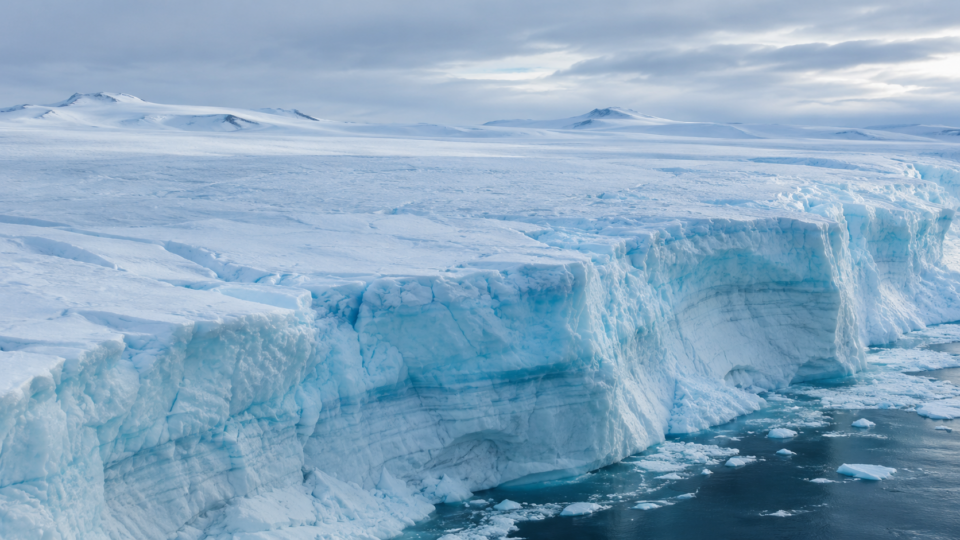
The strange shapes hidden in Greenland’s ice
Deep inside Greenland’s enormous ice sheet, radar surveys have revealed structures that do not resemble the tidy horizontal layering scientists expect from centuries of snowfall.
Some layers curve upward in broad, plume-like forms, disrupting the record of how the ice accumulated.
Their existence has been known for years, but the physical process capable of creating such large disturbances has remained unsettled.
A study published in The Cryosphere examines a surprising possibility: ice near the base might circulate slowly because of temperature-driven differences in density.
The researchers did not discover a new moving plume in real time.
Instead, they used numerical experiments to investigate whether a physical mechanism could produce features similar to those already observed by radar.
That distinction matters. A radar image is evidence that layers have been disturbed, but not a direct film of the process that disturbed them.
Several mechanisms could create related patterns, including freezing water onto the base, moving patches of unusually slippery bedrock, and folding associated with flow.
The new work tests one explanation against plausible physical conditions rather than declaring the question settled.
Why solid ice might circulate
Convection is often associated with a boiling pot or the slow motion of rock within Earth’s mantle.
In both cases, material changes its density as its temperature changes.
Relatively buoyant material can rise while denser material sinks.
The same broad principle could operate in ice, although the motion would be exceptionally slow and its expression would depend on the ice’s mechanical properties.
Ice is solid on everyday timescales, yet it can deform under sustained stress.
Greenland’s ice flows outward under its own weight, while the ice at different depths experiences different temperatures, pressures and stresses.
If the deeper ice is sufficiently soft, a small temperature disturbance could potentially grow into upward movement that bends the surrounding layers.
The central challenge is separating this possible vertical motion from the much larger horizontal flow of the ice sheet.
Snowfall also adds new ice from above and drives downward motion within the column.
Either process could prevent a small rising disturbance from developing into a large plume.
The investigators therefore asked not merely whether convection was mathematically possible, but under what combinations of conditions it could persist.
How the numerical experiments worked
Robert Law and colleagues used ASPECT, a numerical geodynamics package developed to study deformation and convection.
Their main experiments represented a simplified two-dimensional slice through an ice sheet measuring 25 kilometres along the direction of flow.
They also considered a three-dimensional configuration measuring 22 kilometres along flow and 18 kilometres across flow.
The reference ice thickness was 2.5 kilometres.
That scale reflects the depth of a substantial ice column, not a claim that every part of Greenland has the same thickness.
The researchers systematically varied factors including ice viscosity, surface shear, snowfall and the initial thermal disturbance.
This allowed them to identify which conditions favoured a plume and which suppressed it.
The setup intentionally omitted much of the complexity of a real ice sheet.
For example, most simulations did not include snowfall or surface melting unless the experiment specifically tested snowfall.
The model imposed simplified boundary conditions and treated effective stress in a way that made broad comparisons manageable.
These choices helped isolate individual mechanisms, but they also limit how literally any single run can be interpreted.
For wider climate context, a separate study of weather simulation methods highlights why model assumptions require independent testing.
The team drew on temperature information from the NEEM and DYE-3 ice-core locations, which represent contrasting conditions in northern and southern Greenland.
Using those profiles helped connect the idealized simulations to the regional differences visible in radar surveys.
Nevertheless, the study was a model-based investigation of mechanisms, not a continent-wide measurement of actual deep-ice viscosity.
What made plumes more likely
The model results showed that the combination of relatively soft ice and limited horizontal shearing could allow a small thermal disturbance to develop into a large upward plume.
Stronger horizontal shear tended to disrupt or suppress the formation of such structures.
Higher snowfall accumulation also impeded plume development by introducing a competing downward motion.
Those relationships offer a possible explanation for geography.
Large disrupted layers have been reported especially in northern Greenland, whereas the younger and generally higher-accumulation ice farther south contains fewer of the same large features. A mechanism sensitive to snowfall and shear could help explain why the shapes are unevenly distributed rather than appearing wherever the ice is thick.
The authors’ inferred effective viscosity range for parts of northern Greenland was approximately 2 × 10^12 to 3 × 10^14 pascal-seconds.
In context, that is around an order of magnitude lower than values commonly assumed in some modelling approaches.
This is a model-informed bound, not a direct laboratory measurement from every location beneath the ice sheet.
Viscosity describes how strongly a material resists sustained deformation.
Lower effective viscosity means ice can deform more readily under comparable conditions.
However, the relationship between viscosity and total glacier speed is not simple: motion may be distributed between deformation within the ice and sliding at its base.
The study suggests that softer deep ice could be consistent with less basal slip than standard models assume.
A clue to ice physics, not a forecast of collapse
The finding should not be read as a prediction that Greenland will suddenly accelerate or that sea-level rise has been underestimated by a particular percentage.
The paper does not provide such a forecast.
Its contribution is to identify a plausible mechanism and a range of material properties that may need closer attention in ice-flow models.
A useful distinction is between ice deforming internally and the entire ice sheet losing mass. A softer layer can change how stresses and movement are distributed without necessarily producing an equivalent change in the amount of ice flowing into the ocean.
As separate Antarctic modelling reported by Research Today illustrates, snowfall can affect ice-sheet responses to warming.
Surface melting, snowfall, ocean interactions and basal conditions all influence the broader mass balance.
This is why the authors emphasize uncertainty.
If convection helps explain the plumes, the patterns could become indirect clues about deep ice that is otherwise extremely difficult to sample.
But the researchers also acknowledge alternative formation mechanisms and the need to isolate their effects. A plausible numerical reproduction is not proof that the real structures formed in exactly that way.
The study therefore offers a new way to ask an old question.
Rather than treating unusual radar layers only as irregularities to be explained, scientists may be able to use them as evidence about the ice’s hidden thermal and mechanical state.
That could improve future models even if the exact cause of every plume remains disputed.
Why the details matter for projections
Greenland’s ice sheet contains enough frozen water to make its long-term behaviour important for coastal planning.
Projections depend on many processes operating at very different scales, from regional snowfall and summer melting to the mechanics of deformation deep within the ice.
Small errors in representing a process can influence simulations carried forward over decades or centuries.
Researchers often must assign physical properties to places where direct measurements are scarce.
For context, earlier reporting on a Greenland glacier investigation shows how difficult it is to study ice environments directly.
Radar can map internal layers across broad areas, but it cannot automatically reveal the viscosity or temperature history responsible for every bend. A physically grounded model can help translate those patterns into hypotheses that future observations may test.
The study also illustrates the value of looking beyond the most visible signs of climate change.
Surface melt ponds and retreating glacier fronts are easier to photograph than a buried structure several kilometres below the surface.
Yet the ice’s internal properties help determine how it responds to changes at the surface and its margins.
The most useful next steps would be to compare modelled plume shapes and locations more systematically with radar observations, test more realistic ice-sheet geometries, and examine whether basal freeze-on or moving slippery patches can produce similar signatures under the same conditions.
Those comparisons could show where convection is genuinely needed and where another explanation is sufficient.
What the study can and cannot establish
The evidence here is strongest for conditional physical feasibility.
Given specified temperatures, geometry, stresses and viscosity, numerical simulations can produce convection-like behaviour capable of disrupting layers.
The findings are less definitive about how often this occurs in nature or exactly how the process affects the entire Greenland Ice Sheet.
Simplified rheology is another constraint.
The mechanical response of natural ice depends on its temperature, fabric, impurities and stress history, and it need not be captured fully by a single effective viscosity.
The authors discuss these approximations and the consequences of their boundary conditions, which are useful for controlled experiments but do not reproduce every feature of a flowing glacier.
There is also an important difference between estimating a plausible range of properties and establishing one unique solution.
Different combinations of physical mechanisms may create similar radar patterns.
Independent evidence from boreholes, temperature profiles and improved three-dimensional modelling would help narrow those possibilities.
Even with these limits, the research advances the discussion by connecting a long-standing observational puzzle with testable mechanical conditions.
It does not replace established understanding of Greenland’s mass loss.
It identifies an underexplored process that could refine how deep ice is represented in the models used to understand that loss.
Source Information
Study title: Exploring the conditions conducive to convection within the Greenland Ice Sheet
Authors: Robert Law, Andreas Born, Philipp Voigt, Joseph A. MacGregor, and Claire Marie Guimond
Journal: The Cryosphere, volume 20, pages 1071–1086
Publication date: 13 February 2026
Study design: Numerical geodynamics modelling of thermal convection under varied ice-flow, snowfall and rheological conditions
Sample or scope: Idealized 2D and 3D simulations of Greenland-like ice columns, including a 25 km 2D domain with a reference thickness of 2.5 km
Key finding: Large convection-like plumes can develop under sufficiently soft ice and low shear; estimated effective viscosity in parts of northern Greenland spans approximately 2 × 10^12–3 × 10^14 Pa s