

When the shade itself is at risk
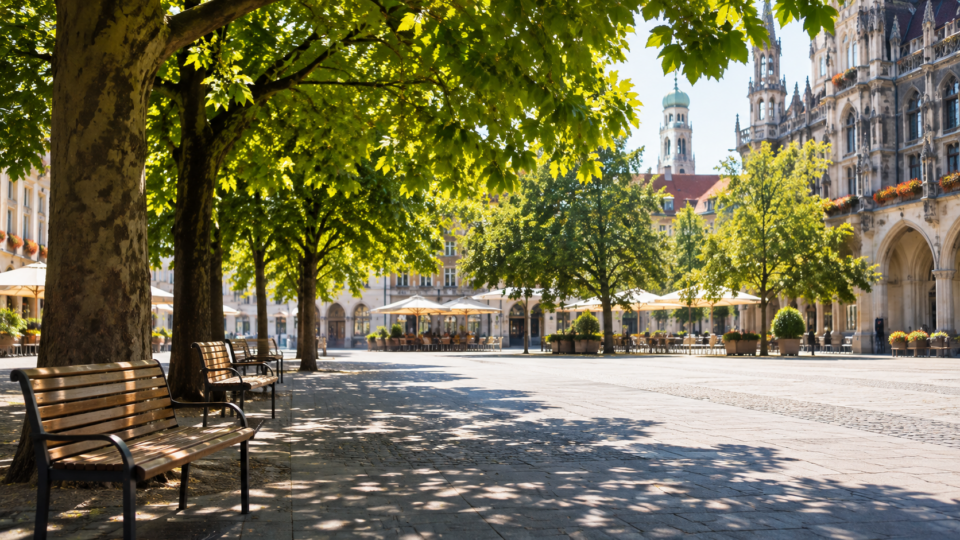
A city square can feel like a refuge on a hot afternoon.
Under a mature tree, sunlight is intercepted before it reaches paving, benches or pedestrians.
But trees are living infrastructure, not permanent fixtures.
They can decline during drought, suffer damage from repeated heat and eventually need replacement. A square that looks green today may offer substantially less protection when future summers become hotter.
That is the problem a new Munich modelling study addresses.
The researchers did not simply compare a park with a paved street.
They asked how the cooling service of two existing green squares might change when climate warming is combined with tree mortality.
This is a particularly relevant question for cities investing in urban greening.
Planting trees can be a long-term strategy, yet the benefits depend on whether those trees survive long enough to provide shade.
The distinction between adding greenery and maintaining its cooling performance matters for planning budgets. A newly planted sapling does not instantly replace the canopy of an established tree.
Species choice, planting conditions, maintenance and the timing of replacements therefore influence how well a city adapts to heat.
The paper offers a scenario-based way to consider those linked decisions.
Two squares, several possible futures
Priscila Weruska Stark da Silva, Tim Sinsel, Denise Helena Silva Duarte and Stephan Pauleit studied Hohenzollernplatz and Bordeauxplatz in Munich, Germany.
Their original research was published in Frontiers in Sustainable Cities on 5 June 2026.
The team used ENVI-met, a microclimate simulation model, to compare existing conditions with future climate and tree-replacement scenarios.
The sites are useful examples of neighbourhood green squares rather than representations of every European urban environment.
The study examined human thermal comfort through Physiological Equivalent Temperature, commonly abbreviated PET. PET translates a combination of environmental conditions into a temperature-like measure of how hot or cold a person may feel.
It accounts for more than the air temperature shown on a weather forecast.
Radiation, wind and humidity also shape thermal experience, especially in exposed public spaces.
The investigators incorporated information on existing trees and their mortality, then tested replacement approaches under climate projections extending to 2050.
Modelling allows controlled comparisons that cannot be observed in the real world decades in advance.
It also introduces uncertainty because future weather, tree growth and maintenance will not follow a single perfectly known path.
The results should therefore be read as conditional projections, not measurements of Munich in 2050.
A striking change in simulated heat stress
The headline result is substantial.
In the researchers’ simulations, intense and extreme heat stress could affect as much as 96% of the squares’ area by 2050 under the modelled climate-change and tree-loss conditions, compared with approximately 75% under present conditions.
The percentages describe area classified into heat-stress categories in the simulation.
They do not mean that 96% of Munich residents will become ill or that every day will experience the same conditions.
The result is striking partly because the sites are already green.
Trees can reduce exposure, but rising background temperatures and a declining canopy can overwhelm part of the existing benefit.
That makes a tree’s continued presence important.
Losing a large crown changes the amount of direct solar radiation reaching pedestrians and surrounding surfaces.
The modelling does not establish that every tree-replacement option performs equally.
The authors examined alternatives because species, size and planting arrangements can produce different microclimatic outcomes. A replacement plan must consider what canopy is lost immediately and what canopy can develop over time. A young tree may ultimately become an effective source of shade, but it cannot necessarily protect a square during the years when it is still growing.
Why shade changes the experience of heat
Air temperature is only one part of outdoor comfort. A person standing in direct sun receives radiation from the sky and from warmed buildings and pavement. A nearby shaded spot may feel dramatically different even when a standard thermometer records similar air temperatures.
This is why planners often assess thermal comfort rather than treating ambient temperature as the only meaningful indicator.
Trees influence that environment through several pathways.
Their crowns block some incoming sunlight, and their leaves exchange water with the atmosphere.
Their shape also changes airflow and the distribution of light.
The net effect depends on local geometry, available water and the weather.
Dense planting can be beneficial for shade, but it is not automatically optimal in every street or square.
Research Today previously reported that greening patterns differed across 55 American cities.
That work concerns urban inequalities rather than Munich’s specific tree-replacement simulations.
Together, the studies illustrate why a useful urban heat strategy must consider where greenery is located, who benefits and whether its cooling function can persist.
The maintenance challenge behind urban greening
Cities often celebrate the number of trees planted, but the number planted is not the same as the number surviving. A replacement programme can look successful in an annual report while the total mature canopy continues to decline.
The Munich study makes this timing problem visible by modelling future tree mortality alongside warming.
Maintenance requirements are also uneven.
Trees planted in compacted soil, close to underground services or amid heavily paved surfaces may have limited room for roots.
Drought and high temperatures can increase stress, while pests and disease add uncertainty.
Selecting species suited to future conditions may reduce some risks, although no single species can guarantee resilience against every hazard.
The study therefore suggests that urban adaptation should not be treated as a one-time construction project.
Long-term care, monitoring and replacement schedules belong in the same discussion as landscape design.
The value of a mature canopy can be lost quickly, whereas rebuilding it takes years.
That asymmetry deserves explicit attention in investment decisions.
How far can the findings travel?
Munich is not Johannesburg, Delhi or Phoenix.
Its seasonal climate, urban form, vegetation and public-space design differ from those of many hotter cities. A scenario that performs well in one square may not deliver the same benefit in a narrow street or an open plaza elsewhere.
The authors’ modelling provides a method for testing local choices, not a universal prescription for the ideal number of trees.
There is another limitation: simulations approximate real microclimates.
The performance of a particular tree in 2050 depends on weather sequences, soil conditions, water availability, pests and human management.
Some of those factors are difficult to predict or represent fully.
Model results can help compare options, but they should be updated as observations accumulate.
The PET measure also describes a modelled thermal environment, not a direct count of heat-related illnesses.
Public-health benefits depend on who uses the space, when they visit and their vulnerability to heat. A study of thermal comfort cannot by itself quantify reductions in hospital admissions or mortality.
Such outcomes would require separate evidence.
What planners can do with a scenario study
The practical value lies in planning before mature trees disappear.
Municipalities can map existing canopy, identify trees at risk and examine whether replacement strategies preserve shade during transition periods.
They can also test whether a square needs additional structures, different paving or changes to the layout of seating while new trees mature.
A related Research Today article found that small neighbourhood parks can matter for walking-related health outcomes.
The Munich work adds a different dimension: a public space must remain comfortable enough for people to use it.
Accessibility and thermal comfort are connected planning goals, even though these studies use different methods.
Tree inventories and microclimate models should inform one another.
Observed mortality can improve assumptions about future canopy, while simulations can reveal where the loss of a particular tree would be especially consequential.
Such analysis may help prioritise limited maintenance budgets rather than distributing resources solely by planting counts.
The lesson is continuity, not simply more trees
A third Research Today report examined how long-term forest management changes tree growth.
Urban squares are not forests, but both cases demonstrate that vegetation outcomes depend on management over time. A photograph of greenery at one moment cannot reveal whether the system will continue providing the desired service.
The Munich study does not predict the exact condition of every square in 2050.
It demonstrates that the combination of warming and tree loss can substantially worsen simulated thermal comfort, and that replacement strategies deserve comparison before decisions are made.
The reported 96% figure is a warning within defined model conditions, not an inevitable forecast.
For residents, the relevant outcome is simple: a square should remain a place where people can sit, walk and meet without excessive heat exposure.
Achieving that goal requires protecting existing trees where feasible, replacing declining ones thoughtfully and recognising the delay before new canopies mature.
The strongest urban-greening plans will be judged by lasting comfort rather than planting-day photographs.
Source Information
Study title: Evaluating tree replacement for thermal comfort in urban green squares: Munich case study and climate projections to 2050
Authors: Priscila Weruska Stark da Silva, Tim Sinsel, Denise Helena Silva Duarte, and Stephan Pauleit
Journal: Frontiers in Sustainable Cities, volume 8
Publication date: 5 June 2026
Study design: ENVI-met microclimate simulation and tree-replacement scenario comparison
Sample or scope: Hohenzollernplatz and Bordeauxplatz, two green squares in Munich, Germany; projections to 2050
Key finding: Simulated intense and extreme heat stress could extend to as much as 96% of square area by 2050, versus approximately 75% under present conditions