


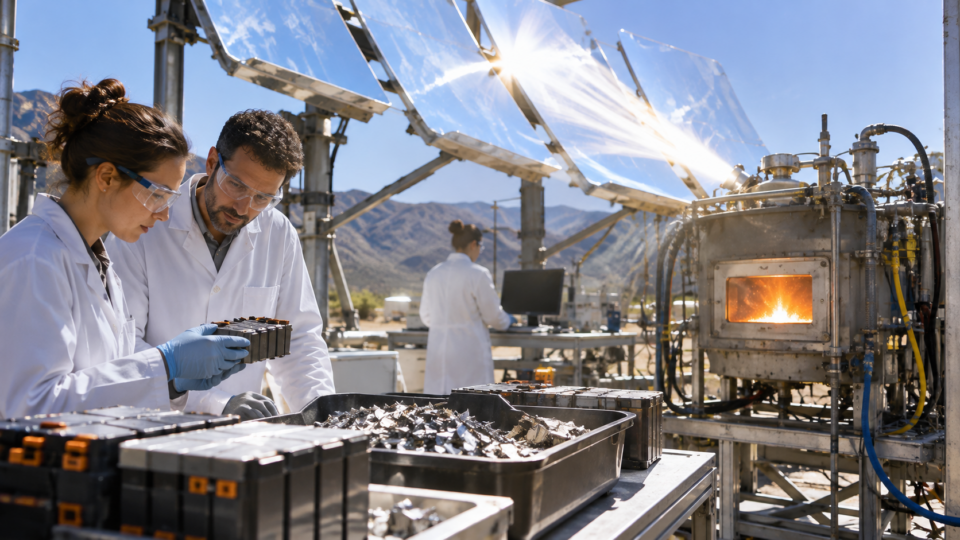
A different way to recover battery metals
Batteries are central to electric vehicles, portable electronics and the storage of renewable electricity.
Their usefulness creates a second problem: what to do with them when they can no longer serve their original purpose.
Used lithium-ion cells contain materials worth recovering, but separating those materials can require energy-intensive processing and substantial chemical inputs. A newly published study explores whether sunlight can supply part of the chemistry needed for that separation.
The researchers developed a photocatalytic leaching process that combines mild organic acids with a reusable catalyst.
Instead of relying on externally supplied oxidising agents, the system uses light to generate reactive chemistry within the solution.
The result is a laboratory demonstration of an alternative pathway for recovering critical metals from several commercial battery cathode materials.
The word demonstration is important.
The study reports experiments, repeated operation and modelling of possible economic and environmental performance.
It does not establish that every battery recycler can immediately switch to a sunlight-powered process or that industrial facilities will achieve identical results.
Why conventional recycling is difficult
Lithium-ion batteries are complex manufactured objects.
Their cells contain electrodes, electrolyte, separators, current collectors and packaging.
Different cathode formulations use different combinations of lithium and other metals, making recycling more complicated than melting down a uniform metal object.
The first steps often involve safe collection, discharge, disassembly and preparation of material for recovery.
Existing approaches include high-temperature treatment and wet-chemical processing.
Each has strengths, but energy requirements, reagent consumption and the purity of recovered materials can affect cost and environmental performance. A process that works on one cathode chemistry may need adjustment for another.
The new research addresses the chemical extraction stage rather than every task in the recycling chain.
It is therefore not a complete blueprint for collecting, sorting and processing entire batteries from households or electric vehicles. A successful leaching reaction still needs to be integrated with upstream preparation and downstream separation of recovered metals.
Research Today has covered a recyclable flow-battery design tested over repeated laboratory cycles.
That technology differs from conventional lithium-ion cells, but both stories show why end-of-life recovery should be considered alongside battery performance during use.
How sunlight becomes part of the chemistry
Sunghyun Ko, Jinha Jang and colleagues reported their findings in Nature Communications on 6 November 2026.
The paper describes a photocatalyst that absorbs light and helps produce hydrogen peroxide in the leaching solution.
Ultraviolet components of sunlight then help activate the peroxide, supporting reactions that release metals from cathode materials.
This is not the same as heating a tank with solar electricity.
Photocatalysis uses photons to drive chemical reactions.
In the proposed framework, light participates directly in generating and activating a reactive species.
Mild organic acids provide the surrounding chemical environment, while the catalyst can be reused across cycles.
The distinction matters because some conventional processes depend on externally supplied chemicals to perform related reactions.
Generating a useful reagent in situ could reduce dependence on those inputs.
Whether that translates into lower cost or emissions depends on the efficiency of the full process, including the catalyst, equipment and any subsequent purification.
The researchers describe a two-part mechanism involving peroxide generation across the solar spectrum and further activation by ultraviolet light.
The method is scientifically interesting because it seeks to make fuller use of natural sunlight rather than relying on one narrow component alone.
Testing more than one cathode chemistry
Commercial lithium-ion batteries are not chemically identical.
Some cathodes contain nickel, manganese and cobalt, while others use iron phosphate-based formulations.
This diversity is a major challenge for recycling systems because a facility may receive mixed material from many products and manufacturers.
The paper reports recovery from diverse commercial cathode materials.
That breadth matters: a technique demonstrated only on a highly purified laboratory powder might be difficult to apply to real recycling streams.
Testing different chemistries is a step towards evaluating versatility, although it does not prove that the method handles every possible mixture or contamination level.
The authors also examined performance across repeated operation cycles. A reusable catalyst must retain enough activity to remain practical. A process that performs impressively once but degrades rapidly may have poor economics when scaled.
The reported consistency across multiple cycles therefore strengthens the case for further development.
However, repeated laboratory operation is not equivalent to years of industrial service.
Large-scale systems must handle variable sunlight, changes in temperature, impurities, maintenance and continuous throughput.
These questions remain important even when the underlying chemical mechanism is promising.
What the environmental assessment adds
A chemical process can appear environmentally attractive when judged by a single input.
Using sunlight, for example, sounds preferable to using purchased energy, but equipment manufacture, reagent production, water use and material transport can also create environmental impacts.
The researchers therefore included techno-economic and life-cycle assessments alongside the laboratory experiments.
Their analysis suggested lower energy inputs and reduced greenhouse-gas emissions relative to conventional recycling methods under the assessed conditions.
Those are model-based comparisons, not measured emissions reductions from a commercial network of facilities.
Their reliability depends on assumptions about energy sources, process yields, operating costs and scale.
The study also presents the process as economically promising.
That conclusion should be read as a scenario-dependent assessment rather than a guaranteed profit margin for every operator.
Recycling profitability is sensitive to recovered-metal prices, the cost of obtaining spent batteries and the quality of products recovered.
A related Research Today report on electric-vehicle life-cycle emissions illustrates why environmental comparisons should extend beyond the use phase.
The battery study examines one part of that broader life cycle: how valuable materials might be recovered after use.
The challenge of moving from a bench to a plant
Industrial battery recycling involves large volumes of material and strict safety requirements.
Cathode powders can vary in composition and may carry impurities from earlier processing.
Light must reach the reactive solution effectively, which becomes more difficult as equipment grows or liquids become opaque.
Reactor design can therefore determine whether a laboratory photocatalytic reaction remains efficient at scale.
Natural sunlight also changes through the day and across seasons.
An industrial process may need storage, supplementary lighting or flexible scheduling to maintain throughput.
Each solution introduces costs and potentially additional energy consumption. A method described as sunlight-driven must still be evaluated under realistic weather and operating conditions.
The reusable catalyst introduces its own questions: how is it manufactured, how often must it be replaced and how is it separated from processed material?
The answer could affect both environmental impacts and economic viability.
The study’s modelling is valuable because it begins to address these questions, but a pilot plant would provide a different level of evidence.
Demonstrations with actual mixed waste streams, continuous operation and independent cost tracking would help establish how robust the approach is outside controlled experiments.
Why recovering metals matters strategically
Battery recycling is not only a waste problem.
Metals used in energy storage can be expensive, geographically concentrated and exposed to supply-chain disruptions.
Recovering them from used products can reduce demand for some primary extraction and diversify the sources available to manufacturers.
Yet the contribution depends on collection rates, recovery quality and the amount of material returning from products already in circulation.
Even a technically efficient leaching process cannot recover batteries that are never collected.
Product design, consumer take-back systems, transport and regulations therefore shape the potential benefits.
Technologies must work within a functioning recycling network.
Research Today has also discussed advances in sodium-ion battery cathodes.
New chemistries could change the future composition of battery waste, making flexibility valuable for recycling research.
The market may not converge on a single battery type.
A versatile recovery system could be useful in such a landscape, but versatility must be demonstrated for each relevant material.
The new paper offers evidence across several commercial cathodes without settling the performance of every future formulation.
What the study establishes—and what remains open
The strongest evidence is for a chemical mechanism and laboratory performance under the conditions investigated.
The researchers show that sunlight-driven photocatalysis can support metal leaching using mild organic acids and a reusable catalyst.
They also present assessments suggesting potential economic and environmental advantages.
The paper does not show that all industrial recycling will become sunlight-powered, nor does it demonstrate a particular percentage reduction in global mining or emissions.
Those outcomes would require adoption at scale, functioning collection systems and comparisons across different electricity grids and industrial processes.
The results are promising partly because they connect reaction chemistry with practical constraints such as reuse and the economics of processing.
But pilot-scale testing, assessment of variable sunlight and independent verification of life-cycle assumptions remain necessary before broad commercial claims can be justified.
The broader lesson is that cleaner battery recycling may emerge from improvements to individual stages rather than a single breakthrough that replaces the entire system.
Light-driven leaching could become one component of that effort.
For now, it is a credible research direction whose ultimate value will depend on performance beyond the laboratory.
Source Information
Study title: Full-sunlight-driven photocatalytic recovery of critical metals from spent lithium-ion batteries via organic acid leaching
Authors: Sunghyun Ko, Jinha Jang, Janghoon Kang, Wonyong Choi, Ung Lee, Da Hye Won, Jiheong Kang, Giyeong Son, Chang Hyun Kim, Chan Beum Park, and Changsoo Kim
Journal: Nature Communications
Publication date: 6 November 2026
Study design: Experimental photocatalytic leaching study with catalyst-reuse testing, techno-economic and life-cycle assessments
Sample or scope: Multiple commercial lithium-ion battery cathode materials evaluated in laboratory leaching experiments
Key finding: Sunlight-driven peroxide generation and activation supported recovery of critical metals using mild organic acids and a reusable photocatalyst