







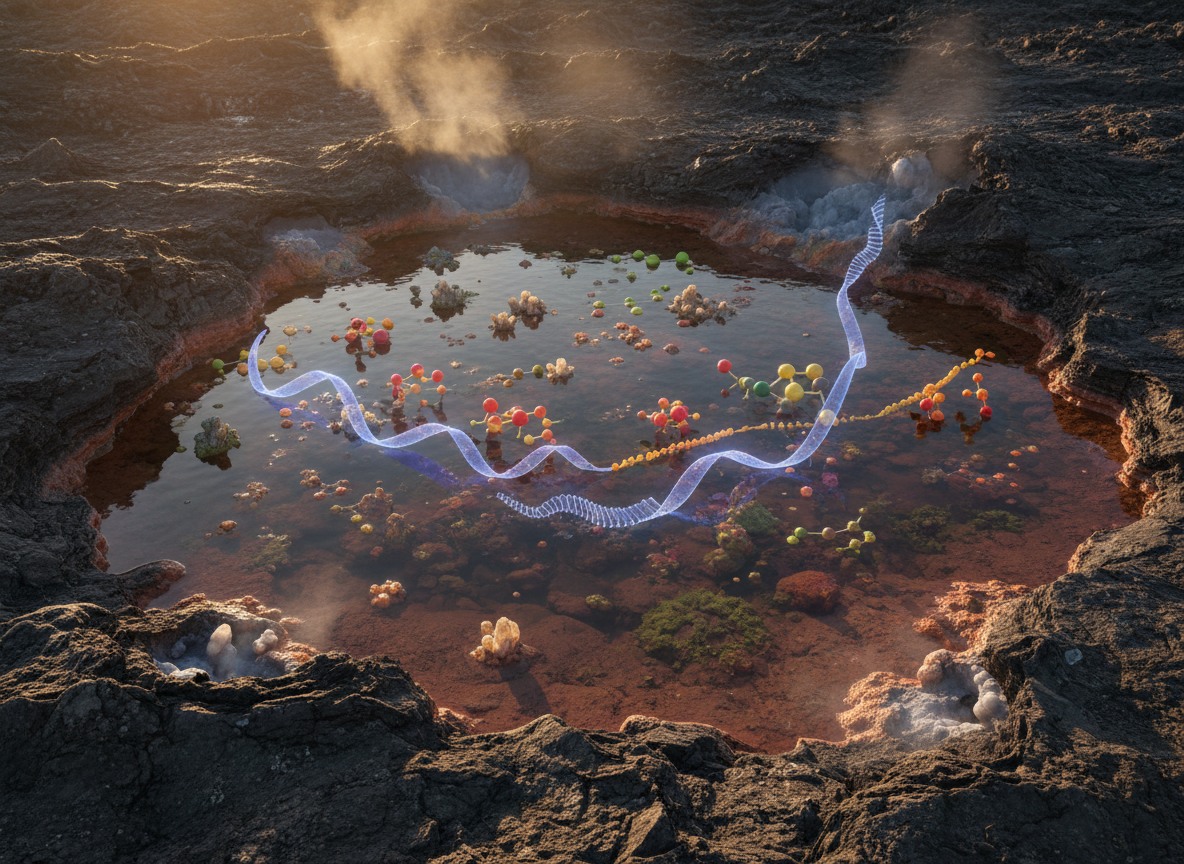
One of the biggest questions in science is how the chemistry of the early Earth crossed the enormous gap between simple molecules and the first systems capable of storing information, building proteins and eventually reproducing.
New laboratory research has now demonstrated a surprisingly cooperative chemical pathway that may have helped bridge part of that gap.
Scientists at the Indian Institute of Science Education and Research in Pune found that RNA-related molecules and amino acids can promote each other’s assembly under conditions designed to resemble plausible prebiotic chemistry. When the researchers placed nucleotide molecules and amino acids together in a single reaction, they produced both short RNA-like chains and peptides, the small chains of amino acids that ultimately make up proteins.
The work, published in Communications Chemistry on 19 September 2026, does not recreate the origin of life. It does, however, address a long-standing problem in origin-of-life research: how two of biology’s most important molecular systems may have begun interacting before enzymes, ribosomes and modern cells existed.
Life today depends on a partnership between RNA and proteins
Modern biology is built around a deeply interconnected molecular system.
DNA stores genetic information. RNA helps copy, regulate and interpret that information. Proteins carry out much of the chemistry and structural work needed to keep cells functioning.
But this creates a classic origin-of-life puzzle.
Proteins are assembled by complex molecular machinery that depends on RNA. Yet much of that machinery is itself made from proteins. If each system depends on the other today, which came first?
One influential explanation is the RNA world hypothesis, which proposes that RNA-like molecules once performed both informational and catalytic roles before modern protein-based biology emerged.
Even within that framework, however, researchers still need to explain how amino acids and primitive peptides became integrated with RNA chemistry.
The new study explores a possible route by allowing the two chemical families to react together rather than treating their origins as completely separate events.
The experiment combined nucleotide molecules with amino acids
Researchers Raya Roy, Anupam A. Sawant and Sudha Rajamani focused on molecules that could plausibly have been present in the chemical environment of the early Earth.
They used nucleotide-related compounds including ATP and cyclic AMP, or cAMP, together with amino acids such as glycine.
ATP is familiar today as the main energy-carrying molecule used by cells. In the experiment, however, its importance was more basic: it already contains phosphate groups that can participate in the chemistry needed to join smaller molecules together.
The researchers placed these compounds into one-pot reactions under conditions intended to be relevant to prebiotic chemistry.
Instead of requiring modern enzymes to carefully assemble the molecules, the reactions were allowed to proceed chemically.
The result was the simultaneous production of peptide chains and oligonucleotides, which are short chains of nucleotides related to RNA.
The two molecular systems appeared to help each other
The most interesting result was not simply that both types of molecules formed.
The researchers found evidence of what they describe as cross-catalytic enhancement.
Under certain reaction conditions, the presence of both nucleotide and amino-acid components increased the relative abundance of oligomers compared with reactions in which the components were allowed to polymerise separately.
In simpler terms, bringing the two chemical systems together sometimes made it easier to build longer molecular chains.
This is significant because the origin of life probably did not involve one perfectly isolated chemical pathway developing on its own before interacting with others.
Early Earth chemistry would have contained mixtures of many different molecules competing, reacting and occasionally helping one another.
A process in which one class of biomolecule improves the formation of another could therefore have provided a natural route toward increasing molecular complexity.
A reactive intermediate may be the key
The researchers traced the enhancement to the formation of an intermediate molecule known as aminoacylated AMP, or AMP-aa.
This is where the chemistry becomes especially interesting.
In modern biology, aminoacylation is fundamental to protein production. Cells attach amino acids to transfer RNA molecules before the ribosome uses them to build proteins.
The modern process is highly controlled and depends on specialised enzymes.
In the new experiments, however, an amino-acid-linked AMP intermediate formed without enzymes.
That intermediate could then participate in reactions that promoted the formation of longer peptide and nucleotide chains.
The researchers argue that this kind of chemistry could represent a very primitive precursor to the molecular relationships later used in translation.
The experiment hints at chemistry before the ribosome
The ribosome is one of the most sophisticated molecular machines in biology.
It reads genetic instructions carried by messenger RNA and links amino acids together in the correct order to form proteins.
Nothing approaching a modern ribosome would have existed at the beginning of life.
Researchers therefore search for simpler chemical systems capable of performing small parts of the same job.
The non-enzymatic formation of aminoacylated nucleotide intermediates is interesting because it links nucleotides and amino acids directly.
If similar chemistry occurred naturally on the early Earth, it could have provided a starting point from which increasingly organised systems of amino-acid selection and peptide formation evolved.
The authors describe the results as being compatible with the emergence of primitive aminoacylation or even a very simple single-nucleotide translation system.
That is far removed from modern protein synthesis, but it points toward a chemical bridge between an RNA-dominated world and one in which peptides began playing a larger role.
The researchers tested more than one amino acid
Glycine provided an important starting point because it is the simplest amino acid and frequently appears in prebiotic chemistry experiments.
The team then extended the reaction strategy to amino acids with different side chains.
This allowed them to investigate which chemical properties favoured the formation of the aminoacylated AMP intermediate.
Not every amino acid behaves identically.
The ability of certain amino acids to participate more readily than others could have mattered in the earliest stages of biochemical evolution.
Long before cells possessed genetic codes and enzymes capable of selecting the correct amino acid with high precision, basic chemical preferences may have influenced which molecular combinations were most likely to form.
Why making longer molecules matters
Joining simple building blocks into longer chains is one of the central challenges in origin-of-life chemistry.
Amino acids on their own do not automatically become useful proteins. Nucleotides do not automatically assemble into long functional RNA molecules.
Both processes require chemical bonds to form repeatedly.
Modern cells solve this problem with enzymes and energy-rich molecular machinery.
The early Earth had none of those systems.
Researchers therefore look for environmental conditions, mineral surfaces, energy sources and reactive intermediates that could have promoted polymerisation before biology existed.
The new study adds a different possibility: the building blocks themselves may have participated in reaction networks that helped one another assemble.
If that occurred in natural settings, mixtures of molecules could have become chemically more productive than any one ingredient in isolation.
Mass spectrometry confirmed the products
The team used mass spectrometry to analyse the products formed in the reactions.
This technique allows researchers to identify molecules by measuring their mass-to-charge ratios and is particularly useful for detecting complex mixtures of reaction products.
The analysis showed the presence of oligomers and allowed the researchers to compare how abundant those products were under different reaction conditions.
The authors report increases in relative abundance for some peptide and nucleotide oligomers when the molecular systems were combined.
Those measurements provided the evidence behind the proposed cross-catalytic enhancement.
This does not mean scientists have recreated the origin of life
Origin-of-life research is especially vulnerable to overstatement because successful laboratory chemistry can sound much closer to creating life than it really is.
This experiment did not create a living cell.
It did not produce self-replicating RNA, a genetic code or a functioning translation system.
The reactions were designed and controlled by researchers, and the conditions represent plausible chemical scenarios rather than a definitive reconstruction of one specific location on the early Earth.
Scientists also do not know exactly which nucleotide compounds, amino acids, temperatures, wet-dry cycles or environmental settings were present when life first emerged more than three billion years ago.
What the study demonstrates is narrower but still valuable: under relevant laboratory conditions, nucleotide and amino-acid chemistry can become directly coupled and can generate intermediates capable of promoting molecular growth.
The study challenges the idea that early biomolecules evolved separately
Much of the public discussion around the origin of life asks whether RNA, proteins or some other type of molecule came first.
Real prebiotic chemistry may have been messier.
Rather than one molecular system becoming fully developed before the next appeared, several chemical networks may have emerged together and influenced one another from an early stage.
The new experiments fit that view.
RNA-related molecules and amino acids were not passive neighbours in the reaction mixture. Their interaction created a new intermediate and changed the way oligomers formed.
That kind of cooperation could help explain how simple chemistry gradually acquired the interconnected character seen in biology today.
A small chemical link with a very large implication
Modern translation depends on an extraordinary chain of molecular events.
Amino acids must be activated, attached to the correct transfer RNA, matched to genetic instructions and joined together in sequence.
The system is so elaborate that it can be difficult to imagine how evolution reached it from a world without enzymes or cells.
The new work provides one possible answer for a very early step.
Before sophisticated biological machinery existed, simple nucleotide chemistry may already have been capable of activating amino acids and encouraging both peptide and nucleotide growth.
From there, natural selection would still have faced an enormous journey toward true biological translation.
But complex systems do not need to appear fully formed if simpler chemistry can perform some of their functions first.
That is what makes the result significant.
The study does not solve the origin of life. It shows that two of life’s central molecular families can interact in a way that makes both more chemically productive, under conditions that do not require living enzymes.
For researchers trying to understand how chemistry became biology, that kind of cooperation may be an important piece of the puzzle.
Source Information
Study Title: Simultaneous formation of peptides and RNA via prebiotic cross-catalytic enhancement
Authors: Raya Roy, Anupam A. Sawant and Sudha Rajamani
Journal: Communications Chemistry
Published: 19 September 2026
Institution: Indian Institute of Science Education and Research, Pune, India
Main finding: Nucleotide molecules and amino acids reacted together under prebiotically relevant conditions to form peptides and oligonucleotides, with an aminoacylated AMP intermediate contributing to enhanced oligomer formation in some reaction conditions
DOI: 10.1038/s42004-026-02212-2