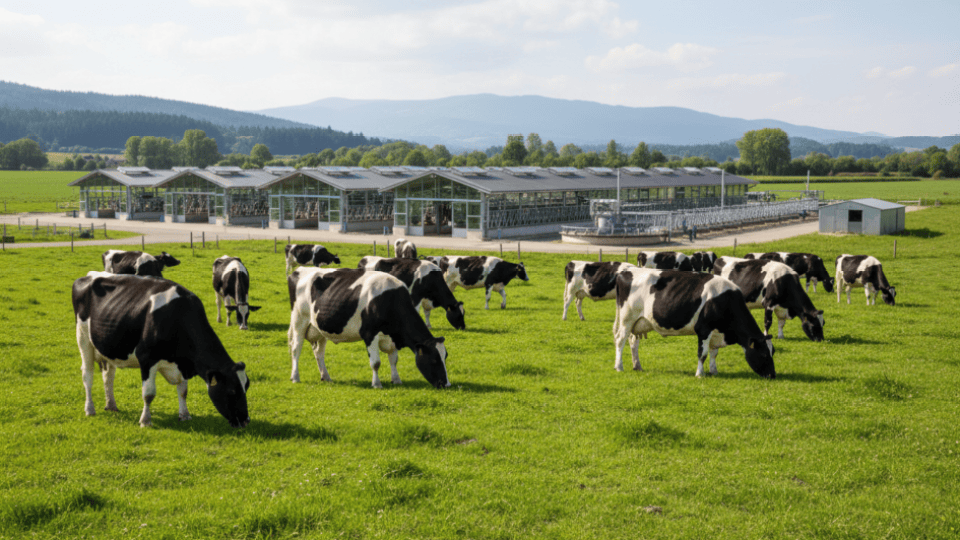
A crowded production map may reveal economic strength
When dairy farms, suppliers, processors and specialists become concentrated in the same region, their proximity can make work more efficient.
The same concentration might also expose an industry to shared risks if resources, logistics or policy conditions change.
A new study of 30 Chinese provinces examined which of those patterns appears in dairy farming.
It reported a positive association between dairy-farming agglomeration and a measured index of dairy industry resilience, with additional statistical evidence involving technological innovation, regional industrialisation and neighbouring provinces.
The conclusion is not that grouping farms together automatically protects them from every shock.
It is that clustering deserves attention as one possible part of a resilience strategy, while causation and distributional consequences remain uncertain.
What resilience means beyond total milk output
Industry resilience is broader than production volume in a single year.
A resilient dairy system must be able to respond to changes in demand, disease pressure, input costs, transport disruptions and other uncertainties while maintaining useful productive capacity.
The study used an index constructed from provincial indicators, with weights derived from an entropy-based method.
That allows several dimensions to contribute to one quantitative outcome but also means results depend on the selection and weighting of indicators.
It is not a directly observed count of farms surviving a specific disaster.
The research offers a regional statistical representation of resilience, not a universal score that could be assigned to an individual milk producer.
The Chinese panel over thirteen years
Junguo Hua, Junting Geng, Juan Wang and Chunhui Ma assembled provincial panel data covering 30 Chinese provinces from 2012 to 2024.
That period captures changes in dairy-farming geography and in regional industrial capacity.
The analysis compared variation across provinces and over time rather than randomly assigning farmers to relocate.
The authors used baseline regressions, mediation-style models and spatial econometric specifications to examine the relationship between clustering and their resilience index.
This approach provides a way to explore multiple dimensions of an industry, but provincial averages cannot reveal exactly what every dairy cooperative, family farm or processor experienced.
Nor can they directly establish how an individual firm would fare after opening a new facility in a cluster.
What the researchers mean by agglomeration
Industrial agglomeration describes the geographic concentration of related economic activity.
In dairy farming, it can include production locations with large herds, access to feed and labour markets, specialised services, processors and networks of farms.
Clustering might lower some coordination costs by bringing complementary activities closer together.
The same geography can also reflect natural resource advantages or past public policy.
This makes interpretation delicate.
Regions that attract more dairy investment may already possess stronger roads, finance, skills and institutions.
A statistical link between clustering and resilience could partly represent those pre-existing conditions, unless the models successfully account for the relevant differences.
The strongest geographic patterns
The researchers described a highly uneven Chinese production landscape.
Leading dairy-farming regions strengthened their position over the period, with the upper bound of the high-agglomeration index reaching 8.297 in 2024.
Inner Mongolia and Heilongjiang were highlighted among regions with stronger concentration, while some provinces such as Sichuan, Anhui and Zhejiang remained in a lower-agglomeration tier.
The index itself is an analytical measure rather than an amount of milk or a percentage of farms.
Differences in land availability, regulation and industry scale can shape where dairy farming concentrates, so a rising index does not necessarily imply that smaller farms everywhere have gained from that pattern.
The principal statistical finding
The study reported that higher dairy-farming agglomeration was significantly associated with greater dairy industry resilience in the provincial panel models.
It interpreted this relationship as consistent with a positive resilience-enhancing effect.
An important qualification is that the design is observational.
Panel regressions can adjust for some persistent provincial characteristics and shared changes over time, but may still be influenced by unrecorded investment decisions or policies that affect both clustering and industry outcomes.
The results offer evidence of a relationship within this dataset, not an experimental demonstration that moving a set number of farms closer together would increase resilience by a known amount.
Technological innovation as a possible route
A key part of the authors’ framework was the possibility that concentrated dairy activity supports technological innovation.
A specialised cluster may give producers access to advice, equipment suppliers, skilled workers and the demonstration of new techniques.
The study’s mediation-style analysis identified technological innovation as an important statistical transmission channel between agglomeration and resilience.
That is a plausible explanation but not a proven sequence established by randomised interventions.
Innovation could also attract more farms into a region, or better-resourced provinces could invest in both technology and production capacity.
The resulting indirect association is therefore better read as a hypothesis about how local economic ecosystems develop than as a measured causal pathway.
Industrialisation changed the strength of the association
The paper reported a positive moderating role for the wider level of industrialisation.
In other words, the relationship between dairy-farming concentration and resilience appeared stronger in provinces with more developed industrial conditions.
Such a pattern makes economic sense if processors, logistics providers and service industries complement farm production.
Yet it also warns against a one-size-fits-all cluster policy.
Concentrating farms in a region without adequate processing, veterinary services or reliable infrastructure may not reproduce the same outcome.
The study did not evaluate a controlled programme in which otherwise comparable regions received different levels of industrial investment.
Its evidence points to context dependence rather than a guaranteed recipe.
Large-scale dairy areas differed from other provinces
Heterogeneity analysis suggested the agglomeration-resilience relationship was more pronounced in already highly concentrated regions and areas with larger-scale dairy farming.
That can be interpreted in several ways.
Existing clusters may have the resources to benefit from additional firms, or they may have accumulated technology and infrastructure that make further concentration more useful.
But a more favourable regional coefficient does not tell us whether a small producer within that region shares equally in the gains.
Future work should examine distribution within clusters, including whether access to finance, input suppliers and markets changes differently for large and small farms.
A strong average association can coexist with uneven outcomes across households and businesses.
Neighbouring provinces may also be affected
The analysis included spatial econometric models to investigate whether concentration in one province was related to resilience in others.
The researchers reported a positive spatial spillover association, meaning dairy clustering appeared to relate not only to outcomes in the same region but also to those of neighbouring regions.
Possible explanations include shared supply chains, knowledge transfer and market connections, although the empirical approach does not separately prove any one mechanism.
Spatial estimates are sensitive to the assumed relationships between places and to variables omitted from the model.
A spillover coefficient is not direct evidence that one region’s new dairy farms caused measurable gains in a specific neighbouring factory.
Why concentration is not automatically safer
Geographic concentration can increase efficiency while also making participants more exposed to common disruptions.
An animal-health outbreak, prolonged drought or transport interruption in a highly concentrated production area could affect many firms at once.
The study’s positive average association does not rule out such tail risks, nor does it describe how dairy systems behaved during every individual shock.
Economic resilience includes the ability to absorb and recover from adverse events, which may require diversity, contingency planning and robust networks beyond a single hub.
Policymakers therefore need to consider both economies of agglomeration and the possibility that excessive geographic reliance creates new vulnerabilities.
What this means for policymakers
The findings suggest that agricultural development policies should consider more than subsidies to isolated producers.
Investment in reliable electricity, cold-chain transport, veterinary services, technical training and specialised processing could influence whether regional clusters function effectively.
But the paper did not test the cost-effectiveness of these particular interventions.
Its statistical evidence cannot tell a policymaker how much funding to allocate or which province should host the next processing plant.
A sound programme would identify the local bottleneck first, evaluate alternative investments, and monitor both aggregate industry performance and the inclusion of smaller producers.
Concentration should be a means toward better outcomes, not an objective pursued solely to raise an index.
A resilience story with broader parallels
Other Research Today work has considered vulnerabilities and adaptation in production systems.
A study estimating the economic burden of parasitic weeds on African maize farming illustrates how exposure can create costs across agricultural regions.
Research on local sales after hurricanes shows that apparent recovery can conceal lasting economic losses.
Neither paper validates the Chinese dairy results.
They provide methodological context for distinguishing resilience from one outcome measured at one point in time, and for asking whether a system can maintain functions under disruption rather than simply expanding when conditions are favourable.
What the models cannot resolve
The authors’ observations end in 2024, and the country-specific institutional setting matters.
A resilience index constructed through entropy weighting may respond differently to changes in the underlying indicators than a directly observed business-survival measure.
Province-level results also hide differences in farm size, cooperative organisation and household livelihoods.
A spatial model can estimate associations between neighbours but cannot necessarily separate knowledge sharing from broader economic trends.
The reported mediation and moderation patterns rely on the selected variables and model structure.
Consequently, applying the results mechanically to another country’s dairy industry would require new local evidence and careful reconsideration of the measures.
The next research questions
Independent follow-up could track specific clusters through well-defined disruptions and compare otherwise similar farming areas with different infrastructure and integration levels.
Researchers could use firm-level data to examine whether technology adoption precedes improvements in resilience, and whether less-resourced farms benefit or lose market power when production becomes more concentrated.
It would also be valuable to test how far benefits travel through supply chains and whether transport barriers limit them.
Quasi-experimental evaluations of particular policies, where justified, could help distinguish the effect of cluster-building interventions from the regional advantages that attracted firms in the first place.
Such work would turn a useful panel association into a more actionable understanding of the conditions under which clustering helps.
The measured takeaway
The Chinese study finds that dairy-farming agglomeration was positively associated with a measured dairy industry resilience index across 30 provinces from 2012 to 2024.
Technological innovation appeared as a relevant statistical pathway, while wider industrialisation and the scale of existing concentration shaped the association.
Spatial estimates were also compatible with benefits extending to neighbouring regions.
These results are important clues about how regional agricultural ecosystems function, but they do not establish that clustering alone causes resilience or that every farm benefits equally.
The defensible conclusion is to investigate industry networks and supporting capabilities together, while retaining careful measurement of shocks, costs and distributional effects.
Source Information
Study title: Industrial agglomeration and dairy industry resilience enhancement: evidence from China
Authors: Junguo Hua, Junting Geng, Juan Wang, Chunhui Ma
Journal: Frontiers in Sustainable Food Systems
Publication date: 10 November 2026
Study design: Observational provincial panel analysis using baseline regressions, mediation and moderation models, and spatial econometric models
Sample or scope: Panel data from 30 Chinese provinces over 2012–2024
Key finding: Dairy-farming agglomeration was positively associated with a resilience index, with technological innovation, industrialisation and spatial spillover patterns appearing in the models