



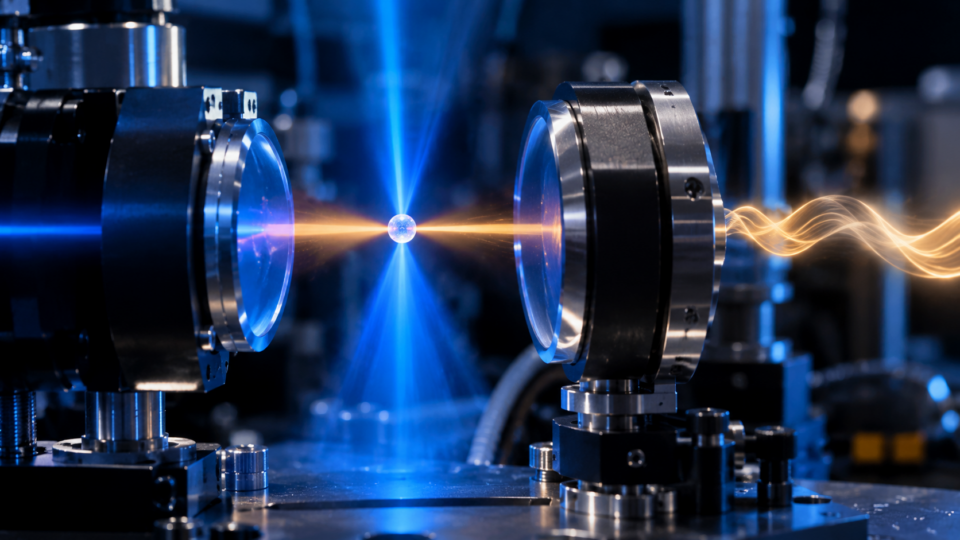




A tiny glass sphere suspended by laser light has become part of a quantum connection that extends beyond the apparatus holding it. In an experiment published in Science, researchers in Florence, Italy, reported entanglement between the motion of a levitated nanosphere and a travelling optical field. The experiment operated at room temperature, a notable achievement in a field where delicate quantum correlations have often required extreme cooling.
The result is not a demonstration of instant communication, a practical quantum internet or a sphere visibly behaving like an object in science fiction. It is a carefully measured laboratory result: the correlations between a mechanical oscillator and light leaving an optical cavity crossed a mathematical boundary that separable, non-entangled quantum states cannot cross. That distinction is central to understanding why physicists find the work important.
Why connecting a moving object to light matters
Quantum entanglement describes relationships between quantum systems that cannot be reproduced by treating their states as independent. Two systems can share correlations that exceed the possibilities of a separable quantum description, even when they are physically different. Photons are especially useful because they can carry quantum information away from the location where an interaction occurs. Mechanical oscillators, by contrast, can remain in place and interact with their surroundings or other devices.
Connecting these two kinds of systems is therefore a compelling goal. A mechanical oscillator might one day act as a stationary component of a quantum network, while light could transfer correlations between separate locations. Researchers also want to know how far quantum behaviour can be extended toward objects that are much larger than atoms and individual photons.
Yet mechanical motion is difficult to keep quantum-coherent. Random interactions with the environment can obscure the delicate correlations under investigation. Earlier experiments have used very cold, mechanically supported devices and other specialised platforms. Levitated optomechanics offers another route: instead of attaching an oscillator to a physical support, researchers hold a tiny particle in place using light.
How the experiment worked
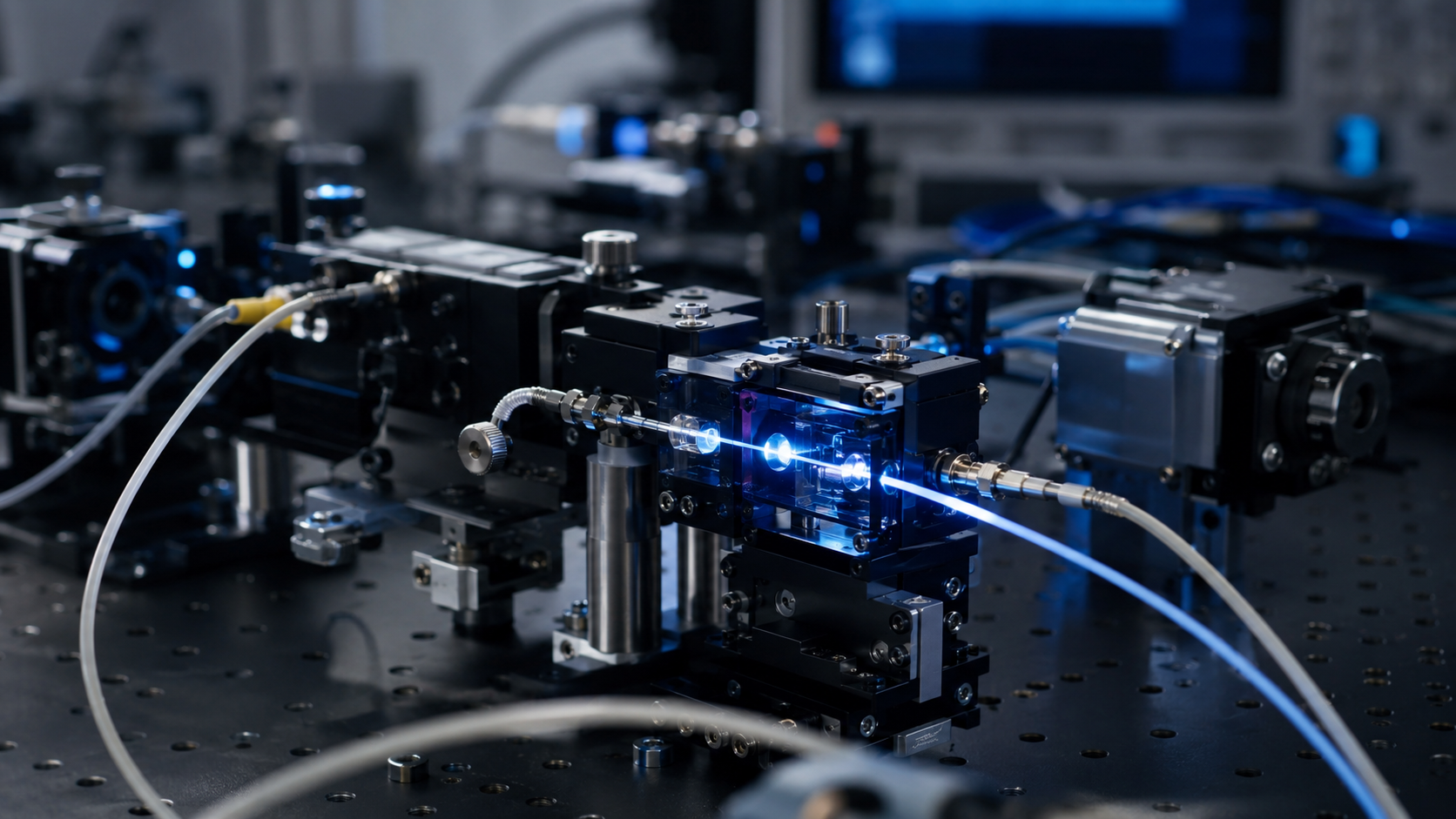
The research team, Q. Deplano, A. Pontin, F. Marino and F. Marin, worked with a dielectric nanosphere levitated in an optical tweezer inside an optical cavity. An optical tweezer uses the forces exerted by a tightly focused laser beam to trap a small object. The cavity provides a controlled environment in which light interacts repeatedly with the particle’s motion.
The crucial mechanical variable was the nanosphere’s centre-of-mass motion. This is the motion of the particle as a whole, rather than the movement of its constituent atoms individually. When the trapped particle moves, it changes how light is scattered into the cavity. In turn, the light influences the motion. This mutual interaction is the basis of optomechanics.
The authors used a configuration involving coherent scattering, in which light from the optical tweezer couples the mechanical oscillator to an optical cavity mode. The apparatus was designed to create and reveal quantum correlations between the mechanical motion and the electromagnetic field. The important final step was to examine a propagating optical mode, meaning a component of the light travelling away from the region where the particle and cavity interact.
This distinction separates the result from a demonstration of correlations confined entirely inside a cavity. A travelling mode can, in principle, serve as a link to another optical system. Showing that the relevant quantum correlations survive beyond the interaction region is a meaningful step toward that wider objective.
What the researchers actually measured
Entanglement is not something the scientists could photograph. They inferred it from measurements of the optical field and a reconstruction of the relationships between optical and mechanical variables.
The team used heterodyne detection, an established optical measurement technique that compares a signal with a reference light field. This makes it possible to extract information about different components, or quadratures, of the optical field. The authors reconstructed a full set of optomechanical correlations and applied separability bounds, mathematical criteria that distinguish certain entangled states from states that could be described as unentangled.
The measured correlations violated those bounds. Within the experiment’s model and analysis, that violation is the central evidence for entanglement between the nanosphere’s motion and the outgoing light. The result is stronger than simply observing that the sphere moved when light changed, because ordinary classical systems can also exhibit correlated fluctuations. The quantum claim rests on the specific structure and strength of the measured correlations.
In the published abstract, the authors describe the entanglement as stationary. Here, stationary refers to the sustained operating regime of the optomechanical system, not to a particle that never moves. The trapped sphere oscillates; the achievement is that the apparatus can maintain the relevant entanglement-generating conditions rather than relying solely on a single brief event.
Three important experimental results
First, the researchers reported entanglement between two physically different kinds of degrees of freedom: mechanical motion and a travelling electromagnetic field. This is an interface between a relatively massive, localised object and light that can leave the device.
Second, the experiment was conducted at room temperature. The apparatus still required precise optical control and environmental isolation, but the result did not depend on cooling the entire experimental platform to the extremely low temperatures associated with many earlier quantum-mechanical demonstrations. Room-temperature operation is not the same as having no cooling or no noise-management requirements: laser-based techniques and the optical environment remain essential.
Third, the authors found that the entanglement remained robust across a broad range of operating parameters. The preprint describes robustness across detunings on the scale of the cavity linewidth. Detuning is the difference between relevant optical frequencies. A result that appears only at one exceptionally narrow setting can be difficult to reproduce or incorporate into a larger device. Robustness across a useful operating range is therefore significant, although it does not establish industrial reliability or long-term stability.
These are the findings the accessible published abstract supports. The abstract does not provide a universal numerical entanglement strength, device efficiency, communication distance or commercial performance figure. Reporting such figures without checking the full experimental data would give readers a false impression of precision.
How small is the mechanical system?
The object was a nanosphere, not a bead large enough to see with the naked eye. At nanometre dimensions, it is many orders of magnitude larger than an individual atom but still far smaller than ordinary dust grains. That scale makes it scientifically interesting: the particle contains a great many atoms, yet its collective motion can be prepared and interrogated with quantum-sensitive optical methods.
Some popular descriptions of the experiment refer to a glass sphere roughly 100 nanometres across. The central result, however, does not depend on a reader remembering an exact diameter. What matters is that a material particle with collective mechanical motion was coupled to light strongly and cleanly enough for entanglement to be detected.
The result should also not be confused with showing that an everyday visible object can be put into an arbitrary quantum superposition. The experiment probed selected degrees of freedom of a carefully isolated nanoscale oscillator. Extending the technique to substantially larger objects, different geometries or less controlled settings remains a separate challenge.
Why room temperature is notable, but not a complete solution
Thermal noise is one of the main obstacles to observing quantum behaviour in mechanical systems. At higher temperatures, environmental fluctuations generally become harder to separate from the effects researchers want to measure. Reaching the relevant quantum regime without cooling an entire apparatus to cryogenic temperatures can reduce one category of engineering complexity.
However, the phrase room temperature can easily mislead. It does not mean the experiment was performed on an ordinary laboratory bench without specialised equipment. Optical trapping, cavity alignment, signal detection, mechanical isolation and careful statistical analysis remain demanding. Nor does it mean that every mechanical degree of freedom was in its ground state or that a finished room-temperature quantum communication device now exists.
Instead, the achievement is narrower and more defensible: under the reported laboratory conditions, the authors demonstrated a particular kind of mechanically mediated quantum correlation that could be detected in a travelling light field.
Potential applications and what still needs to happen
The immediate relevance is to continuous-variable quantum information. Unlike approaches that encode information only in discrete quantum states, continuous-variable methods use properties such as the amplitudes and phases of optical fields. Mechanical systems that interact with these fields may eventually help researchers connect different components of quantum devices.
For a useful network, however, entanglement must be generated, transferred, preserved and verified with adequate efficiency. The present study demonstrates a crucial physical ingredient, not an end-to-end network. A future system would need to deal with transmission losses, interfacing to other devices, reproducibility, control overhead and the rate at which useful quantum states can be produced.
The work also has implications for fundamental physics. Quantum mechanics describes matter at every scale, but experiments involving increasingly massive systems can test where technical noise ends and genuinely quantum behaviour begins. A levitated particle is attractive because it avoids some mechanical contact with a support. Researchers can explore how well isolation, control and measurement work as the complexity of the object increases.
Those ambitions should not be presented as results already achieved. The current paper concerns a specific nanosphere, an optical cavity and the correlations detected in that system.
What the experiment does not prove
Entanglement does not allow messages to travel faster than light. The fact that an outgoing optical mode shares quantum correlations with a mechanical oscillator does not remove the need for ordinary communication and control in quantum information protocols.
The result also does not imply that a floating glass sphere was simultaneously observed in two visible locations. The measured quantum properties concerned collective motion and optical field variables. They were inferred through precision measurement and a separability test, not through direct visual observation.
Finally, the experiment does not establish that practical quantum computers will become cheaper or faster. Quantum sensing, networking and fundamental tests may ultimately benefit from optomechanical interfaces, but each requires further device-level demonstrations.
Limitations and unanswered questions
The study reports one experimental platform operated under carefully controlled conditions. How broadly the result can be reproduced across laboratories, particle sizes and cavity designs remains to be tested. Its ability to connect with distant quantum systems, survive realistic optical losses and perform useful network tasks also requires separate evidence.
Entanglement certification depends on accurate measurement, calibration and modelling of the relevant correlations. The authors’ violation of separability bounds is compelling evidence within that framework, but readers should distinguish it from device-independent verification or a demonstration of a complete communication protocol.
The accessible journal abstract supports the principal findings and broad robustness claim but does not itself supply all of the detailed numerical experimental settings and uncertainties. This article therefore avoids inventing numerical effect sizes or performance metrics. Readers seeking the full mathematical treatment should consult the original publication and accompanying preprint.
A useful step from trapped motion to travelling light
Perhaps the most consequential aspect of the experiment is the connection it makes between something that remains in one place and something that can travel. A laser-held nanosphere is a localised mechanical system. Light leaving its cavity can carry correlations away from that location.
By demonstrating entanglement across that boundary at room temperature, the Florence team has added a new experimental capability to quantum optomechanics. Whether it becomes a practical technology will depend on further advances, but the underlying achievement is already substantial: quantum correlations generated through the motion of a material object were identified in light that had left the interaction region.
Source Information
Original research: Stationary entanglement of a levitated oscillator with an optical field.
Authors: Q. Deplano, A. Pontin, F. Marino and F. Marin.
Journal: Science, volume 394, issue 6819, pages 113–117.
Publication date: 1 October 2026.
Research type: Peer-reviewed experimental quantum optomechanics study.
DOI: 10.1126/science.aeh1375.
Additional accessible version: arXiv preprint 2602.03456.