







Gravity is one of the most familiar forces in everyday life, yet it becomes remarkably difficult to describe once physics reaches the quantum scale.
Einstein’s general theory of relativity explains gravity with extraordinary success, while quantum mechanics describes the behaviour of atoms and other tiny particles. Both theories work exceptionally well in their own domains, but physicists still do not have a single framework that comfortably brings them together.
An international team of researchers has now taken a carefully controlled step into the space where these two descriptions of nature meet. In an experiment published in Science Advances, they allowed part of a quantum wave to fall freely under gravity while holding another part in place, then measured how the two had changed relative to each other.
The result agreed with what Einstein’s equivalence principle predicts.
Making an atom fall in two different ways
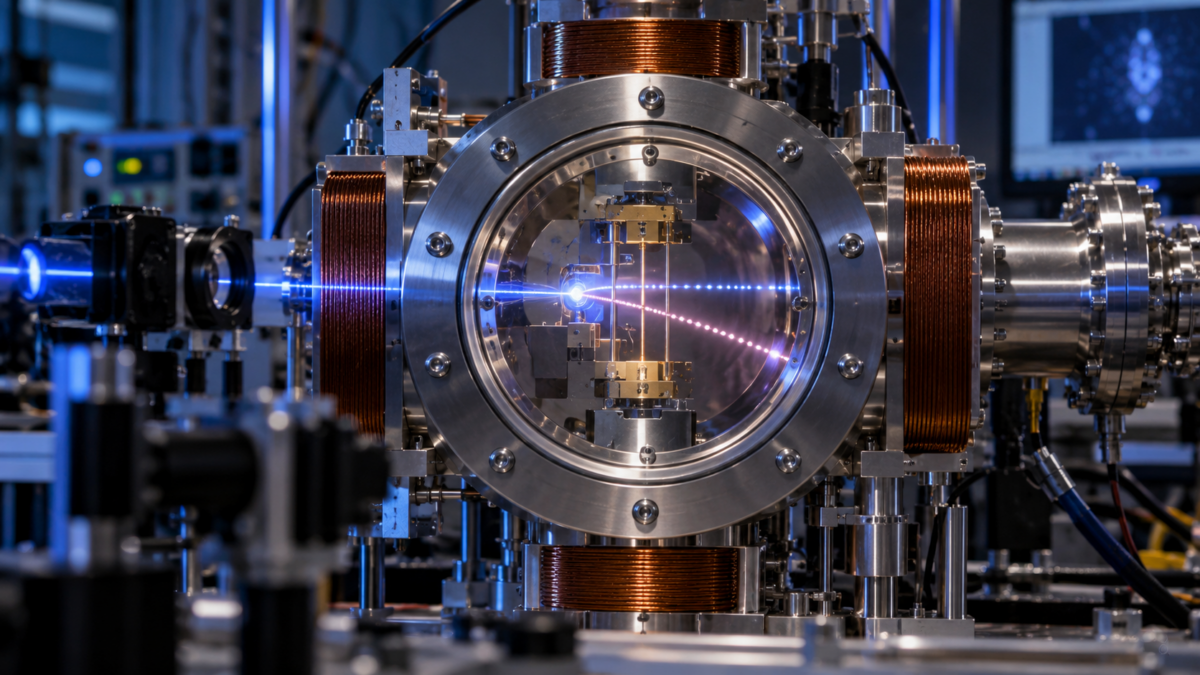
The experiment was conducted at Ben-Gurion University of the Negev using clouds of rubidium atoms cooled to temperatures just above absolute zero. At such low temperatures, the atoms can be manipulated with enough precision for their quantum behaviour to become experimentally useful.
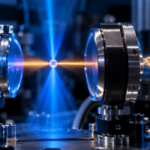
The researchers built what they call the Quantum Galileo Interferometer. Using microwave pulses, they placed the atoms into a quantum superposition, allowing the wave associated with an atom to follow two different paths.
One part of the atomic wave was controlled using magnetic fields generated by tiny electrical wires on an atom chip. The magnetic force was adjusted to counteract gravity, effectively keeping that part of the wave stationary relative to the laboratory.
The other part was allowed to move freely under gravity.
Afterwards, the researchers brought the two parts back together. Because quantum objects behave as waves, the reunited paths produced an interference pattern. That pattern allowed the team to measure the difference in quantum phase that had accumulated between the stationary and freely falling parts.
Gravity left the expected mark
Quantum phase is not something we experience directly in everyday life, but it is fundamental to how quantum waves behave. Two waves can begin together and gradually shift relative to one another as they experience different conditions. When they are recombined, that shift becomes measurable through interference.
In this experiment, the phase accumulated by the freely falling wave matched the phase expected when Einstein’s equivalence principle is applied in the quantum domain.
The equivalence principle is one of the foundations of general relativity. In simple terms, it says that someone in free fall should locally experience gravity as disappearing. The familiar example is an observer inside a freely falling lift: both the observer and the lift fall together, producing a temporary experience similar to weightlessness.
The principle has survived extremely precise tests involving ordinary matter. The difficulty has been finding an experimental way to examine its consequences when matter is behaving unmistakably as a quantum wave.
Atom interferometers have been used to study gravity before. The distinction here is that the researchers directly measured the predicted quantum phase associated with free fall by comparing a falling wave packet with one deliberately held stationary.
This does not solve quantum gravity
The experiment touches one of the largest unresolved questions in physics, but its result needs to be kept in proportion.
It does not provide a unified theory of quantum mechanics and general relativity. It also does not demonstrate that gravity itself is a quantum force, nor does it show what a hypothetical particle of gravity might look like.
What the researchers demonstrated is narrower and experimentally important: within the low-energy conditions they tested, the behaviour of the quantum system remained consistent with Einstein’s equivalence principle.
That distinction matters. A result can be significant because it places another precise constraint on nature without having to overturn an existing theory.
The harder tests are still ahead
The atoms used in the experiment were extremely light, and their quantum states were maintained over comparatively small distances and short periods. Some proposals about the relationship between gravity and quantum mechanics predict that unusual behaviour might only emerge when far more massive objects are placed into quantum superpositions for longer periods.
One such idea has been associated with study co-author and Nobel laureate Sir Roger Penrose, who has argued that gravity may eventually play a role in the breakdown of quantum superposition for sufficiently massive systems.
The new experiment does not reach the mass or timescale required to test that possibility.
The researchers nevertheless see the interferometer as a platform that could make more demanding experiments possible. Work is already moving towards tests involving much heavier objects, including nanodiamonds, where gravitational effects and quantum behaviour may become more difficult to separate.
A new way to ask an old question
For more than a century, the tension between quantum mechanics and gravity has largely been discussed through theory and through experiments that probe different pieces of the problem.
The significance of the Quantum Galileo Interferometer is therefore not that it has suddenly joined the two great theories of modern physics. It is that researchers now have another experimental way of forcing them into the same carefully controlled situation and asking whether their predictions remain compatible.
In this first test, they did.
The more interesting question is how far scientists can now push the experiment before nature gives them a different answer.
Source Information
Primary study: Or Dobkowski et al., Observation of the quantum phase of free fall and the consistency with the equivalence principle, Science Advances, published 2 September 2026.
DOI: 10.1126/sciadv.aec8045
Research institutions: Ben-Gurion University of the Negev, University of Ulm, University of Oxford, University of Southampton, German Aerospace Center, Texas A&M University and collaborating research institutes.
Supporting source: University of Oxford Department of Physics, Scientists observe Einstein’s gravity in the quantum world, 3 September 2026.