




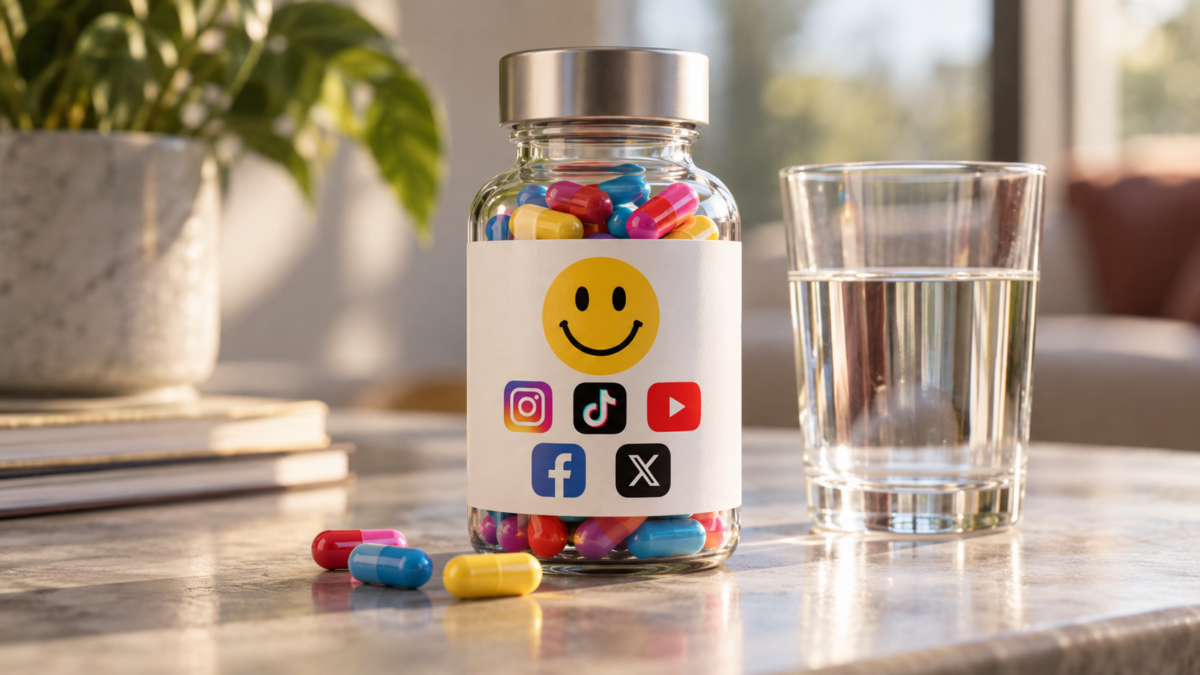




Removing social media, web browsing and games from a phone can quickly reduce how often people use it.
That does not mean the change will automatically make them happier.
A 2026 study involving 166 young adults found that switching from a smartphone to a minimal mobile phone for one week reduced both general phone use and social-media use. However, improvements in psychological wellbeing appeared only among participants who had already expressed a strong interest in trying the simpler device.
Participants who were assigned to use a minimal phone without having volunteered enthusiastically experienced the same technological restriction, but did not report significant improvements in wellbeing.
The finding suggests that a device can successfully change behaviour without producing the same psychological outcome for every user.
A Phone Designed to Do Less
Minimal phones, sometimes called “dumbphones”, retain basic communication functions while excluding many of the features associated with modern smartphones.
Users can generally make calls and send messages, but cannot continuously move between social platforms, games, websites and entertainment feeds.
The technology’s main intervention is therefore not an advanced feature.
It is deliberate absence.
Instead of asking users to resist an available application, the device removes access or makes the activity substantially less convenient. The design introduces friction between the impulse to check a platform and the ability to act on that impulse.
The study, titled Going Light: The Effects of Minimal Mobile Phone Adoption on Young Adults’ Well-Being Depend on Motivation, was published in the proceedings of the 2026 CHI Conference on Human Factors in Computing Systems. It compared three groups over one week.
One group consisted of highly interested volunteers who used minimal phones. Other participants were randomly assigned either to use the simpler device or to continue using their usual smartphones.
This structure allowed researchers to separate the effect of the technology from the effect of already wanting to change.
The Hardware Worked
The minimal phones achieved their most direct purpose.
Participants using them spent less time on their phones and social media. Removing applications and browsing functions made repeated checking more difficult, regardless of whether participants had originally wanted the device.
This is important because many digital-wellbeing tools depend on software controls placed inside the same smartphone environment they are trying to regulate.
A user may activate screen-time reminders, application limits or focus modes, but can often dismiss them within seconds. A minimal phone changes the environment more fundamentally by removing the tempting function from the device itself.
The research therefore provides evidence that device-level restrictions can influence usage behaviour more reliably than intention alone.
However, reduced use was not equivalent to improved wellbeing.
Motivation Changed the Result
Only the highly interested volunteers reported significant reductions in stress and fear of missing out, alongside improved life satisfaction.
Participants who had been assigned to use the minimal phone did not show the same wellbeing changes.
The most reasonable interpretation is that motivation acted as a boundary condition.
For someone already dissatisfied with their smartphone habits, a minimal phone may support a personally chosen goal and increase their sense of control.
For someone who does not want the restriction, the same device may feel inconvenient rather than freeing.
This distinction matters for the wider technology market. Products marketed as solutions to distraction often assume that fewer features will produce a better experience for everyone.
The study suggests that the relationship is more conditional. Hardware can remove a behaviour opportunity, but it cannot guarantee that the user values what replaces it.
Why the South African Trade-Off Is Different
In South Africa, a smartphone is often more than an entertainment device.
Mobile access is used for communication, banking, navigation, employment searches, education, government services and everyday transactions. Statistics South Africa reported that 78.9% of households could access the internet using mobile devices in 2025.
Moving to a phone without web access or applications may therefore carry greater practical costs for users who rely on one device as their primary connection to digital services.
A minimal phone may be realistic for someone who also has reliable access to a laptop, home internet and alternative banking or navigation tools.
It may be far less practical for someone whose phone is their main route into the internet.
This does not make the technology irrelevant locally. It means the more useful design question may be whether smartphones can offer stronger, user-controlled minimal modes without removing essential services.
A South African user might want to retain banking, transport, messaging and emergency functions while temporarily blocking entertainment feeds and attention-driven applications.
What the Study Cannot Prove
The research lasted only one week and focused on young adults in a residential United States university environment.
It cannot establish whether changes in usage or wellbeing would continue over several months, or whether similar effects would appear among older adults, working populations or users in countries where smartphones serve different economic functions.
The design was also partly quasi-experimental because the highly motivated volunteers were not randomly placed into that motivational category. Their improved wellbeing may reflect characteristics connected to their willingness to change, rather than the phone alone.
The study nevertheless separates two claims that are often treated as identical.
Minimal phones appear capable of reducing smartphone and social-media use.
Whether that reduction improves someone’s life depends partly on why they wanted to disconnect in the first place.
Source Information
Study Title: Going Light: The Effects of Minimal Mobile Phone Adoption on Young Adults’ Well-Being Depend on Motivation
Authors: Angela Y. Lee, Anja Stevic, Georgia Walker-Keleher, Caroline Qi-Ao Chen, Emma Charity, Ross Dahlke and Jeffrey Hancock
Publication: Proceedings of the 2026 CHI Conference on Human Factors in Computing Systems
Published: 13 April 2026
DOI: 10.1145/3772318.3791723