
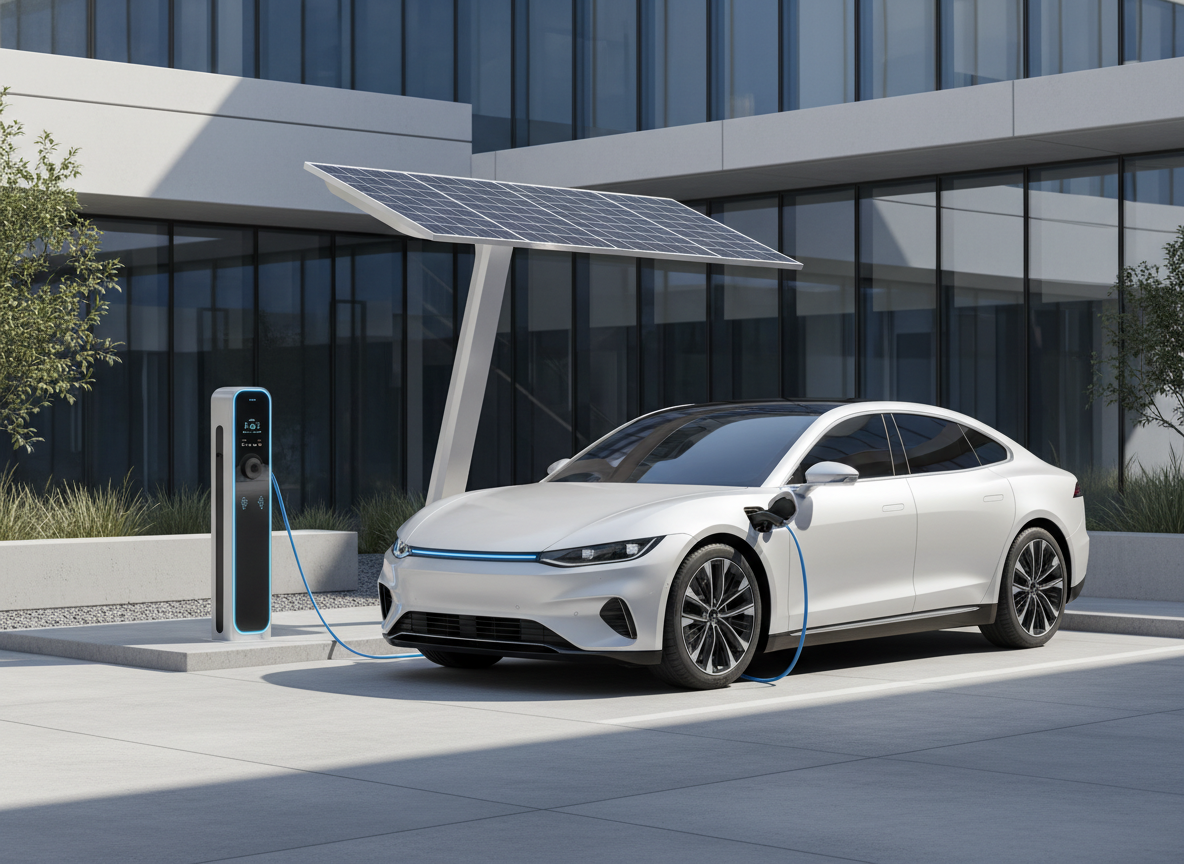


A newly published engineering study reports that an artificial intelligence-based electric vehicle charging system substantially reduced simulated grid demand, charging costs and estimated carbon emissions when solar generation and battery storage were coordinated with predictive control.
Researchers R. Santhoshkumar and S. Suresh developed an AI-Based Smart Load Balancing Electric Vehicle Charging Hub, or AI-SLBECH, that combines solar photovoltaic generation, lithium iron phosphate battery storage, grid electricity, Internet of Things monitoring, demand forecasting and reinforcement learning. In a 30-day co-simulation, the system reduced peak grid demand by 38.1% compared with a conventional grid-only charging scenario.
Peak demand fell from 42.3 kW to about 26.3 kW
The researchers compared the AI-controlled system with a grid-only baseline. Peak grid demand declined from 42.3 kW to approximately 26.3 kW, representing a 38.1% reduction. Total grid electricity imported during the 30-day simulation fell from 1,842 kWh to 712 kWh.
The model also increased renewable energy utilisation to 48.4% of the charging energy delivered. Estimated monthly carbon dioxide emissions declined from 921 kg to 356 kg, a reduction of 61.3% under the emission assumptions used by the researchers.
Average charging cost per session decreased from INR 88.43 in the grid-only scenario to INR 61.20 with the proposed system. This corresponds to a reported cost reduction of 30.7%.
The system combines forecasting with reinforcement learning
The proposed framework uses three complementary control components. A finite state machine determines how energy should be dispatched between solar power, battery storage and the electricity grid. A two-layer long short-term memory neural network forecasts charging demand 15 to 30 minutes ahead. A Proximal Policy Optimization reinforcement learning agent then schedules charging while considering urgency, cost and fairness between users.
The LSTM network contained layers of 64 and 32 cells and was trained using 12 months of NASA POWER solar irradiance data for Chennai, India, together with synthetically generated charging demand. The data were divided chronologically into 70% training, 15% validation and 15% testing sets.
On the test data, the demand forecasting model achieved a normalised root mean squared error of 7.2% and a mean absolute percentage error of 6.8%. The researchers reported that predictive control reduced reactive mode-switching events by about 34% and peak grid-import spikes by about 21% compared with reactive threshold control.
Reinforcement learning reached a fairness index of 0.94
The reinforcement learning scheduler was trained for 10,000 episodes. Its rolling reward was considered converged from episode 8,200, and the final 30-day evaluation produced a Jain’s Fairness Index of 0.94. Values closer to one indicate a more even allocation of service among simulated charging users.
The researchers also designed the models for edge deployment rather than continuous cloud processing. After quantisation, the LSTM model required approximately 78 KB of flash memory. LSTM inference took about 47 milliseconds and the reinforcement learning policy approximately 2 milliseconds on the modelled ESP32 implementation, giving a combined computational overhead of about 49 milliseconds within a one-second control cycle.
Performance remained positive across sensitivity tests
The study tested the framework under nine sensitivity conditions that varied factors such as solar irradiance, charging load and battery capacity. Peak-demand reductions ranged from 29.3% to 45.8% across the tested conditions.
Across these conditions, mean peak-demand reduction was 37.9% with a standard deviation of 5.9%. A one-sample t-test against zero improvement produced t(8) = 19.39 and p < 0.001, with a 95% confidence interval from 33.4% to 42.4%. A Wilcoxon signed-rank test produced p = 0.004.
Mean renewable energy utilisation across the sensitivity conditions was 47.7%, with a standard deviation of 8.8%. The corresponding one-sample t-test produced t(8) = 16.29 and p < 0.001, with a 95% confidence interval from 40.9% to 54.4%.
Scaling tests extended the simulation to 16 charging bays
Additional simulations examined configurations containing four, eight and 16 charging bays. Peak-demand reduction declined modestly from 38.1% in the four-bay configuration to 34.2% with 16 bays. Control-loop latency increased from 49 milliseconds to 58 milliseconds, remaining below the one-second control interval specified by the researchers.
The authors also conducted a preliminary economic assessment using Indian pricing and tariff assumptions. However, these calculations depend heavily on equipment costs, utilisation, electricity tariffs and other assumptions that can change substantially between locations and over time. They should therefore not be interpreted as a guaranteed financial return.
The findings are based on simulation rather than a working charging hub
The most important limitation is that the reported operational improvements were produced in software co-simulation. The researchers did not build and field-test a complete physical charging hub, and the system has not yet undergone Hardware-in-the-Loop validation.
Although the simulation incorporated real solar irradiance data, charging demand was synthetically generated. Real charging stations may encounter user behaviour, equipment failures, sensor noise, network interruptions, weather variation and grid conditions that are not fully represented in a simulation.
The cybersecurity architecture was designed but not penetration-tested, and scalability was quantitatively assessed only up to 16 charging bays. The authors therefore identify physical prototyping, field trials, cybersecurity testing and larger-network validation as important next steps.
Why the findings matter
Electric vehicle charging can create concentrated periods of electricity demand, particularly when many vehicles charge simultaneously. Systems that can forecast demand and coordinate solar generation, battery storage and grid electricity could reduce these peaks while making greater use of renewable energy.
This study provides quantitative evidence that combining forecasting and reinforcement learning can produce substantial improvements in a controlled simulation. Its edge-computing approach is also notable because it was designed to operate on comparatively inexpensive hardware rather than relying entirely on cloud infrastructure.
The results nevertheless represent a technology demonstration rather than evidence from a deployed public charging network. Physical trials will be necessary to determine whether the reported reductions in demand, costs and emissions persist under real operating conditions.
Source Information
Study: AI-based smart load balancing for sustainable electric vehicle charging hubs using LSTM forecasting and reinforcement learning
Authors: R. Santhoshkumar and S. Suresh
Journal: Discover Electronics
Publication date: 25 September 2026
Article number: 134, Volume 3
DOI: 10.1007/s44291-026-00288-7
Research type: Simulation-based engineering study