








Helping another person is one of the most familiar forms of human cooperation, yet much of what researchers know about its development comes from children interacting with adults in Western settings. A new cross-cultural experiment suggests that helping between children is remarkably widespread, while also showing how age and local social experience can shape the form that help takes.
Researchers studied 336 children aged four to nine across six culturally diverse populations in Europe, Africa and South America. The children came from Germany, Wichí communities in Argentina, Quechua communities in Bolivia, ≠Akhoe Hai||om communities in Namibia, and Samburu and Kikuyu communities in Kenya. Across these settings, children reliably stepped in to help peers, particularly when the peer faced a problem for which assistance was genuinely useful.
The study, published in the Proceedings of the National Academy of Sciences, is notable because it shifts attention from the better studied question of whether children help adults to the dynamics of peer-to-peer cooperation. That distinction matters. In many communities, children spend substantial time learning, working and playing alongside other children, making peers an important part of everyday social development.
A comparable helping task across very different communities
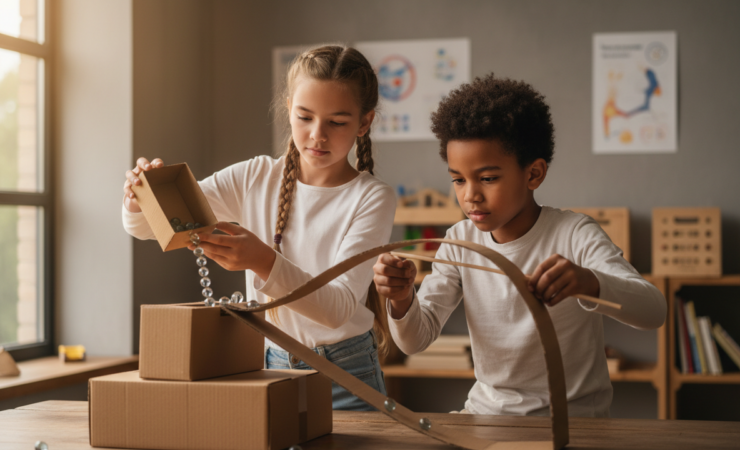
The research team designed a standardised marble game that could be used across all six populations. Children participated in same-age pairs and took turns in the relevant roles. One child encountered a problem while the other, who already knew how to solve it, had an opportunity to respond.
The problems differed in how much help was actually needed. In one situation, a child struggled with a box that would not open, creating a clear opportunity for useful intervention. In another, marbles spilled onto the floor, a problem the child could more readily solve alone. This allowed the researchers to examine not simply whether children acted, but whether they adjusted their helping to the recipient’s need.
Children could also help in different ways. They could provide instrumental help by physically solving part of the problem, offer information by explaining how the peer could solve it, or combine practical assistance with an explanation. The design therefore captured both the frequency and form of spontaneous peer helping.
Helping appeared across all six cultures
The strongest result was the consistency of helping across the six populations. Children in every setting offered assistance to peers. The researchers found that they were more likely to help when the task created a genuine need for assistance than when the peer could easily manage alone.
This sensitivity became more pronounced with age. Younger children tended to help in both kinds of situations at more similar rates. Older children became more selective, increasingly directing their assistance toward situations where it was more clearly useful. In other words, development involved not only a willingness to help but greater calibration of that help to the other child’s circumstances.
The form of assistance also shifted with age. Younger children relied more heavily on instrumental action, such as doing the difficult part of the task for the peer. As children grew older, they increasingly supplied information about how the problem could be solved. This pattern suggests a developmental movement from directly fixing a peer’s problem toward enabling the peer to solve it.
The researchers reported no meaningful overall difference between boys and girls in helping behaviour. This is important because it indicates that the broad developmental pattern was not driven by one sex. Instead, age and the nature of the helping situation were more informative for understanding how children responded.
Culture influenced helping style more than the basic tendency to help
The cross-cultural differences were smaller than the similarities, but they were not absent. German children were especially likely to combine practical assistance with verbal information, simultaneously helping with the task and explaining what to do. Kikuyu children, by contrast, were somewhat less likely to provide instrumental help than children in the other groups.
The authors interpret these differences cautiously in relation to children’s everyday learning environments. In some rural and subsistence-based communities, children often learn through observation and participation with comparatively little explicit verbal instruction. In settings such as Germany, adults may more often combine demonstrations with detailed verbal explanation. Children’s peer-helping styles may therefore reflect familiar local interaction patterns.
That interpretation does not mean that each culture has a single fixed way of helping. The study found substantial common ground across populations, and the culture-specific effects were described as modest. The more defensible conclusion is that a broadly shared capacity for peer helping can be expressed through somewhat different social practices.
Why peer helping matters for understanding cooperation
Developmental research has long used helping as a window into prosocial behaviour, but adult-child experiments can blur several influences. Adults have greater knowledge, authority and physical ability than children, and children may have learned strong expectations about responding to adult requests. Peer interactions create a different social problem because the potential helper and recipient occupy more comparable positions.
Finding spontaneous helping across six populations therefore strengthens the evidence that cooperation with peers is not restricted to one particular schooling system or industrialised social environment. At the same time, the age-related increase in informational help suggests that social development changes the strategy children use. Helping can become less about taking over a task and more about transferring useful knowledge.
The need-sensitive result is equally important. Prosocial behaviour is not necessarily more effective simply because more help is provided. Unnecessary intervention can interfere with another person’s autonomy or effort. Older children’s greater selectivity may reflect an improving ability to judge when intervention is useful and what kind of intervention fits the problem.
What the findings do not establish
The study’s breadth is a major strength, but six populations cannot represent the full range of human cultures. The participating communities differed substantially from one another, which improves the comparison, yet thousands of other social and economic environments remain untested.
The experiment also measured behaviour in a structured task rather than every form of real-world helping. Children may respond differently when helping carries a meaningful cost, involves a close friend or rival, requires sharing valuable resources, or occurs without an observing researcher. The results should therefore be interpreted as evidence about spontaneous helping under a controlled and comparable set of circumstances.
Nor can the observed cultural patterns by themselves establish which parenting, teaching or community practices caused differences in helping style. The proposed connection between everyday learning practices and children’s behaviour is plausible and theoretically informative, but direct causal tests would require additional research.
Even with those qualifications, the study provides unusually broad experimental evidence that children in diverse societies respond to peers’ difficulties in recognisably similar ways. What changes most clearly is not whether children help, but how selectively they help and whether assistance takes the form of direct action, information, or both.
Source Information
Study: Children from six cultures reliably help their peers – but in different ways
Authors: Henriette Zeidler, Marie Schäfer, Esther Herrmann, Patricia Kanngiesser, Luke Maurits, Daniel Haun and Michael Tomasello
Journal: Proceedings of the National Academy of Sciences
Online publication: 2 October 2026
DOI: 10.1073/pnas.2515233123