




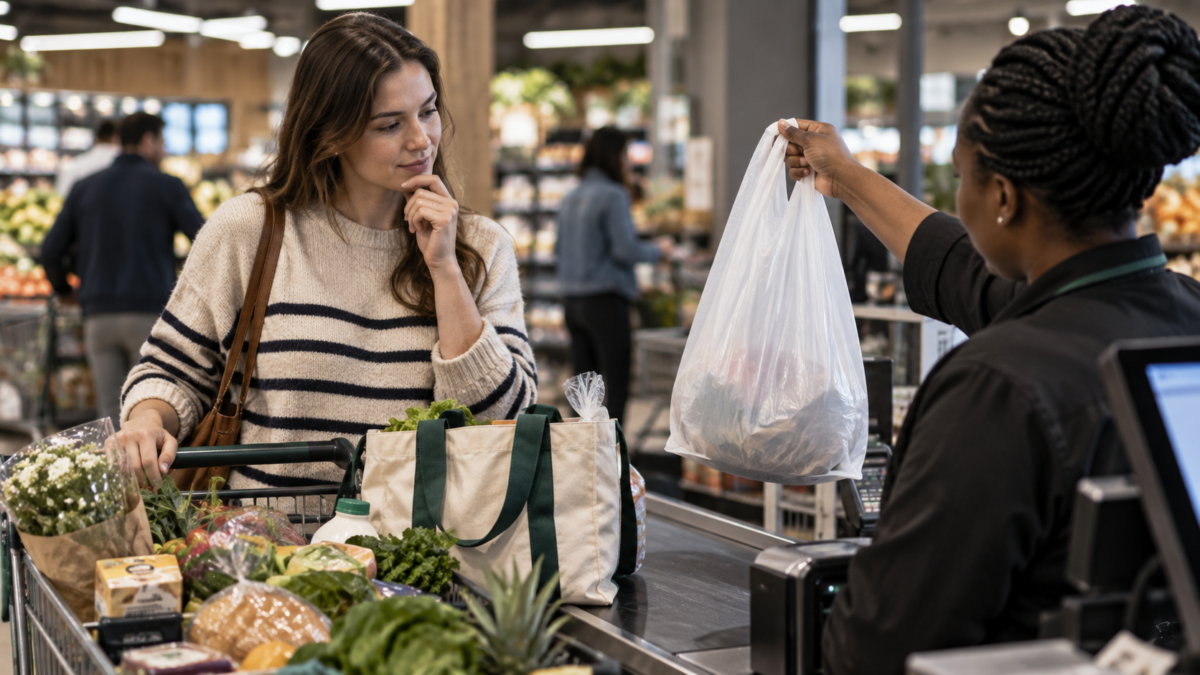
For more than two decades, South Africans have been expected to pay for plastic shopping bags in an attempt to reduce how many are used and discarded.
Yet a new study suggests that the price of the bag may be only one part of what happens at the till.
Researchers studying shoppers in South Africa, Norway and Germany found that seemingly minor features of the checkout interaction were strongly associated with whether customers bought a plastic bag. In South Africa, approximately 66% of customers bought a bag when the cashier asked whether they wanted one, while the proportion increased to almost 86% when packing began without the customer first being asked.
When there was no bag-related intervention from the cashier, plastic bag purchasing was substantially lower.
The study, published in the Journal of Environmental Psychology, combined survey responses from 1,607 people with direct observations of another 838 shoppers at supermarkets in South Africa, Norway and Germany.
The findings suggest that reducing plastic bag use may depend not only on environmental concern or financial levies, but also on something much more ordinary: what shoppers see other people doing and what happens during the few seconds they spend at the checkout.
The researchers watched what people actually did
Research on environmentally friendly behaviour often relies on questionnaires asking people what they believe, what they intend to do or what they remember doing.
That creates an obvious difficulty. People may genuinely care about the environment while still forgetting their reusable bags, buying plastic ones out of convenience or inaccurately recalling how frequently they use them.
The researchers therefore combined two approaches.
First, 1,607 adults completed surveys examining factors such as social norms, habits, convenience, knowledge of alternatives, financial barriers and intentions to reduce plastic bag use.
The South African survey included 569 people, while 540 participants came from Norway and 498 from Germany.
The researchers then went into supermarkets and directly observed checkout behaviour among another 838 customers.
Of those observations, 327 took place in Potchefstroom, South Africa, 285 in Trondheim, Norway, and 226 in Stuttgart, Germany.
This allowed the team to compare what people said influenced their behaviour with what shoppers actually did when they reached the till.
What the cashier did was associated with a large difference
The South African observations produced one of the study’s most striking findings.
The researchers recorded whether cashiers left the decision entirely to the customer, explicitly asked whether a bag was required, or began packing the shopping without first asking.
Bag use increased as the cashier became more involved.
When South African customers were asked whether they wanted a plastic bag, 139 bought one, representing approximately 66.2% of those interactions.
When the cashier moved directly into packing without first requiring the customer to make an active choice, 48 shoppers bought bags, representing approximately 85.7% of those observations.
Statistical testing confirmed that customers experiencing no bag-related prompt bought significantly fewer plastic bags than those who were asked about a bag or had their purchases packed directly.
The finding is important because nothing about the customer’s stated environmental beliefs necessarily changed during those few seconds.
The situation changed.
Simply asking may make the bag feel like the normal option
There are several possible reasons why a cashier’s question could be associated with greater bag uptake.
One is that asking, “Do you need a bag?” makes taking one an immediate and legitimate option.
The customer no longer has to initiate the purchase themselves. They only need to agree.
The question may also create a subtle social expectation. A shopper carrying several groceries may interpret the offer as a signal that buying a bag is what customers normally do in that situation.
When packing begins automatically, the effect could be stronger still because refusing the bag now requires interrupting an action already underway.
Behavioural researchers often describe these seemingly minor elements of a decision environment as choice architecture.
The available options have not necessarily changed, but the way those options are presented can make one behaviour easier, more visible or more normal than another.
The Norwegian checkouts showed a similar pattern
The Norwegian observations provide an especially clear comparison.
Among the 50 shoppers who were not asked whether they wanted a plastic bag, none bought one.
When cashiers did ask, almost half did.
Of 235 customers who received the question, 112 purchased at least one bag, equivalent to 47.7%.
The situation in Germany was completely different.
Germany has moved towards stronger structural restrictions on lightweight plastic shopping bags, and the researchers recorded no plastic bag purchases in either the standard cashier or self-checkout conditions that they observed.
That contrast illustrates an important point.
Psychology matters most within the choices that a system makes available.
If disposable plastic bags remain highly accessible, small social and situational cues can influence whether people take them. If the option is largely removed through regulation, the checkout interaction becomes much less important.
South Africans were particularly influenced by what other people do
The survey portion of the research revealed another result with direct relevance to South Africa.
Among South African participants, social norms were particularly strongly associated with bringing reusable bags.
Social norms refer broadly to what people believe others around them do and what they think other people expect them to do.
If bringing reusable shopping bags becomes visibly normal among family members, friends and other shoppers, individuals may become more likely to adopt the same behaviour.
If arriving at the checkout without a bag remains completely ordinary, there is much less social pressure to prepare differently.
The researchers found that the relationship between social norms and reusable bag use was stronger in South Africa than in Germany.
This creates an interesting possibility for environmental policy.
Changing what people believe their community normally does may sometimes be more effective than repeatedly telling them that plastic pollution is harmful.
Knowing something is environmentally harmful is not always enough
This is a recurring problem in environmental behaviour.
A person can believe that plastic waste is harmful, intend to use fewer bags and still arrive at the supermarket without a reusable one.
The decision is then made under very different circumstances from the calm situation in which someone answers a survey.
They may be carrying several items, rushing home, managing children or simply following a familiar routine.
At that moment, convenience can outweigh an intention formed hours or days earlier.
The new study found that perceived convenience was associated with reusable bag behaviour in both South Africa and Norway.
Intentions to reduce plastic use were also positively related to bringing reusable bags in all three countries, showing that motivation still matters.
But motivation clearly operates alongside habits and the immediate environment.
South Africa has been charging for bags since 2003
South Africa introduced its plastic bag regulations in May 2003, combining minimum thickness requirements with a charge intended partly to discourage unnecessary consumption.
The intervention initially produced a dramatic reduction in plastic bag use.
Earlier economic research, however, found that much of this effect weakened over time as consumers became accustomed to paying for bags and consumption began increasing again.
This is a familiar challenge with financial incentives.
A charge that initially makes shoppers stop and reconsider a purchase can eventually become incorporated into the normal cost of shopping.
Once that happens, the behavioural effect of the price may become weaker even though the levy technically remains in place.
South Africa continues to impose an environmental levy on qualifying plastic carrier and flat bags, with SARS administering the levy through manufacturers.
The new research therefore asks an important question more than 20 years after the original intervention: if shoppers have become accustomed to paying for bags, what else could change their behaviour?
Changing the default may cost almost nothing
One possibility suggested by the researchers is to change the environment at the checkout rather than relying exclusively on customers to make environmentally motivated decisions.
Plastic bags could be kept less visibly available.
Cashiers could avoid automatically offering them.
Stores could make “no bag” the implicit starting point and allow shoppers who genuinely need one to request it.
Reusable bags could also be positioned more prominently before customers reach the till, allowing people to make the decision before the pressure of checkout.
These interventions are comparatively inexpensive because they do not require a completely new waste-management system or a large financial subsidy.
Instead, they alter the small sequence of decisions through which millions of bags eventually enter circulation.
The supermarket may be communicating a norm without realising it
Consider two checkout experiences.
In the first, a customer reaches the cashier and sees plastic bags immediately beside the till. The cashier asks whether bags are needed, and a packer is ready to use them.
Everything about the environment communicates that taking bags is routine.
In the second, no bag is offered automatically. Reusable alternatives were visible before checkout, and customers who require a disposable bag have to request one.
The plastic bag remains available, but the social meaning of the choice has changed.
In one environment, declining the bag requires action.
In the other, taking the bag requires action.
The environmental consequence of that apparently tiny difference becomes substantial when repeated across thousands of tills and millions of shopping trips.
Norway shows why habits can survive expensive bags
The survey also found that habitual behaviour played a particularly important role in Norway.
Norwegian consumers already face comparatively high prices for plastic bags, yet established routines remained associated with whether people brought reusable alternatives.
This provides another warning against assuming that price alone will permanently change behaviour.
Once an action becomes habitual, people may repeat it with relatively little conscious deliberation.
Someone who has bought a plastic bag with every grocery shop for years may continue doing so even after the financial incentive changes.
Breaking that habit may require changing the physical or social cue that triggers it.
Germany shows what happens when policy changes the structure itself
Germany represented the opposite end of the spectrum in this study.
Reusable bag use was highest among German survey participants, and plastic bags were essentially absent from the checkout observations.
This does not necessarily mean German consumers are inherently more environmentally conscious.
The regulatory environment is different.
When a product is no longer routinely available, consumers adapt and alternative behaviour becomes normal.
Over time, bringing a reusable bag can shift from being an explicitly environmental decision to simply being how shopping is done.
That may be one of the most powerful outcomes of environmental policy: the sustainable option stops requiring a conscious moral decision every time.
The study does not prove that the cashier caused the purchase
The results should still be interpreted carefully.
The checkout component was observational rather than a randomised experiment.
The researchers recorded what cashiers and customers did in real supermarkets, but they did not randomly assign every shopper to receive a particular checkout treatment.
It is therefore possible that other factors contributed to the differences.
Cashiers may be more likely to offer bags when customers have larger purchases, for example, and those shoppers may already be more likely to need a bag.
The researchers’ observations show a strong relationship between the checkout interaction and bag purchasing, but a controlled experiment would provide stronger evidence that changing the cashier’s behaviour directly causes the reduction.
The three national samples were also collected differently
Another limitation is that the surveys were not conducted in exactly the same way across countries.
South African respondents were recruited through in-store intercept surveys, while Norway and Germany used online consumer panels.
The data were also collected during different periods between 2022 and 2024.
The researchers adjusted questionnaires to fit each national context, but these methodological differences mean that comparisons between countries should not be interpreted as perfect like-for-like measurements.
The South African observations were also concentrated in Potchefstroom, meaning the findings cannot automatically be assumed to represent shoppers in Johannesburg, Cape Town, Durban or rural areas.
Still, the finding changes where responsibility for plastic use is placed
Environmental campaigns often place responsibility almost entirely on the individual consumer.
Remember your reusable bag.
Make the responsible choice.
Pay attention to what you buy.
Those messages have value, but the new study illustrates why behaviour is also shaped by the environment businesses and policymakers create around that consumer.
If a store repeatedly presents a disposable bag as the effortless default, it should not be surprising when many shoppers accept it.
The same person may behave differently when the reusable option is visible, socially normal and easier to choose.
The decision lasts seconds, but the bag can last far longer
A plastic shopping bag is often chosen during one of the least memorable moments of a shopping trip.
The decision may take only seconds.
But multiplied across a population, those seconds determine how many additional plastic bags move through shops, homes, waste systems and eventually the wider environment.
The new study suggests that reducing this flow may not require convincing every shopper to become deeply committed to environmentalism.
Sometimes the more effective intervention may be much smaller.
Change what is normal at the checkout.
Make reusable bags easier to remember.
Stop presenting disposable bags as the automatic next step.
South Africa has spent more than two decades trying to change plastic bag behaviour through price.
The latest research suggests that the next gains may come from paying closer attention to what happens before the customer ever reaches for their wallet.
Source Information
Primary Study: At the checkout: A multi-methods study on the psychological and situational predictors of plastic bag consumption
Authors: Wencke Groeneveld, Isabell Richter, Nicolas E. Neef, Claudine Roos and Kapandu Shihepo
Journal: Journal of Environmental Psychology
Volume: 114
Published: September 2026
Article: 103138
Survey sample: 1,607 participants across South Africa, Norway and Germany
Behavioural observations: 838 supermarket customers
South African survey sample: 569 participants
South African checkout observations: 327 customers in Potchefstroom
DOI: 10.1016/j.jenvp.2026.103138
Supporting South African Research: Analysis of the plastic-bag levy in South Africa
Authors: Johane Dikgang, Anthony Leiman and Martine Visser
Journal: Resources, Conservation and Recycling
Volume: 66
Pages: 59–65
Published: September 2012
DOI: 10.1016/j.resconrec.2012.06.009