









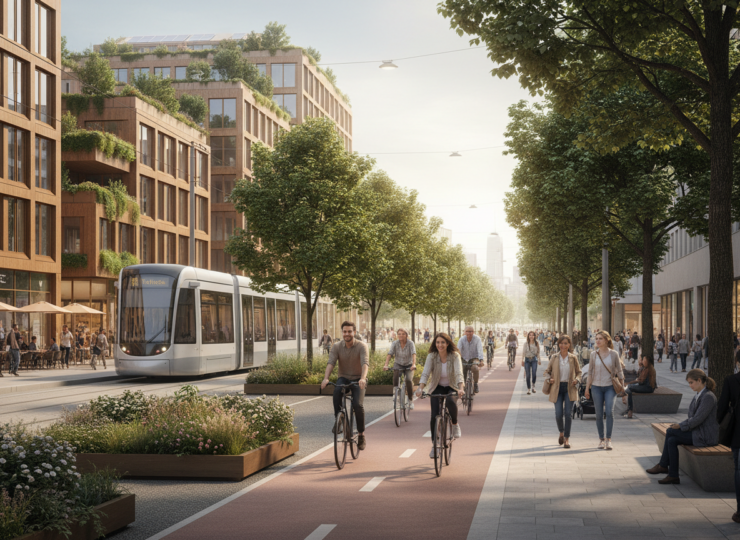
Cities are often presented as one of the most promising places to tackle climate change and improve public health at the same time. Cleaner transport can reduce air pollution and encourage physical activity. Better housing can cut energy use while protecting residents from cold and heat. Greener neighbourhoods can moderate temperatures and support well-being. Yet a new synthesis suggests that the evidence base behind this appealing vision remains much thinner than policymakers might assume.
A peer-reviewed umbrella review published in Nature Cities on 29 September 2026 examined the evidence from systematic reviews of implemented urban actions intended to address climate change and health. The researchers identified 5,550 records, assessed 198 reports in full text and critically appraised 60 systematic reviews. After evaluating confidence in those reviews, 49 were included in the main synthesis.
The central finding is both encouraging and sobering. Urban climate interventions can produce health co-benefits, particularly through active transport, improved housing, cleaner air and changes to urban form. But most of the evidence concerns relatively modest interventions in individual sectors. The review found no published empirical evidence of city-wide, cross-sectoral transformative action of the kind required for deep decarbonisation and large-scale health gains.
A broad review of what cities have actually implemented
The study was designed as an overview of systematic reviews, sometimes called an umbrella review. Rather than estimating what a hypothetical policy might achieve, the researchers focused on reviews of actions that had actually been implemented at city level. Eligible interventions had to relate to climate mitigation or adaptation and also have a health impact or a pathway with clear health relevance.
The evidence covered transport, buildings, waste, food and urban form. Transport and urban form dominated the literature. Twenty-five reviews addressed transport and 27 addressed urban form, while 13 covered buildings. Only three reviews each dealt with food and waste. Most reviews drew on studies from high- or middle-income countries, while evidence from low-income settings was much more limited.
This imbalance matters because the fastest urban growth is occurring in many places where infrastructure, exposure to climate hazards and public-health capacity differ substantially from the settings that dominate the existing research. A policy that performs well in a wealthy, highly regulated city cannot automatically be assumed to produce the same effects elsewhere.
Transport and housing show some of the clearest benefits
Transport interventions offered some of the most consistent pathways linking climate policy with health. Measures such as traffic restrictions, congestion charging, improved public transport and urban designs that support walking and cycling were associated with reduced emissions, improved air quality or increased physical activity. The precise benefits depended on factors including intervention scale, baseline emissions, journey distance, urban density and access to destinations.
Some quantitative findings illustrate both the potential and the complexity. Switching to electric vehicles was reported to reduce carbon dioxide emissions per vehicle kilometre by as much as 20%, even where electricity was generated from coal. Low-emission interventions were associated with reductions in PM10 concentrations of up to 17% in some evidence. Yet a switch from petrol to natural gas increased PM10 by 15% in one study, showing that an intervention labelled as cleaner does not guarantee improvement across every environmental outcome.
Housing interventions also produced tangible health pathways. Energy-efficiency improvements were associated with better thermal comfort and related health gains. Evidence concerning coal bans included reported mortality reductions of 5% to 10%, while some component studies reported reductions of up to 70% in particulate matter and black smoke. Sustainable building design and construction showed carbon footprints with a median value 52% lower than comparators, although those results were not measured at whole-city scale.
The evidence becomes weaker when the question gets bigger
The difficulty is that isolated improvements are not the same as transforming an urban system. Of the included reviews, only 19 described actions spanning more than one sector. Seventeen covered two sectors and just two covered three. The researchers found no empirical documentation of the broad, city-wide transformation that climate targets ultimately require.
The quality of the evidence was another concern. Of the 60 critically appraised systematic reviews, only six were rated as providing medium or high confidence. Forty-three were rated low confidence and 11 critically low. The critically low reviews were excluded from the substantive synthesis.
Reporting practices frequently limited what could be concluded. Only 37 of the 60 reviews, or 60%, clearly reported a Population, Intervention, Comparison and Outcome framework. Twenty-six, or 43%, reported independent screening by at least two reviewers, while only 20, or 33%, reported independent data collection. Although 48 reviews had searches judged adequate, only one formally tested for publication bias. Just seven reviews, 12%, calculated comparable effect sizes or used meta-analysis.
These weaknesses do not mean urban climate interventions are ineffective. They mean confidence about their magnitude, transferability and combined effects is often lower than the volume of published literature might suggest.
Equity is frequently discussed but rarely measured well
The review also examined whether climate and health policies distribute benefits fairly. Twenty-two reviews considered equity, but 16 concluded that the underlying studies contained inadequate information to assess it properly. Three housing reviews suggested that interventions targeted at lower socioeconomic or vulnerable groups could reduce inequity. In contrast, three reviews indicated that built-environment changes designed to increase physical activity might benefit better-off groups more strongly.
This is an important warning for urban policy. An intervention can improve an average city-level outcome while leaving existing disparities unchanged or even widening them. Measuring who benefits is therefore different from measuring whether an intervention works overall.
The missing link may be governance rather than technology
The authors identify four major gaps. First, cities lack evidence for transformative systems approaches that connect sectors over long periods. Second, policy assessments often fail to account for externalities and trade-offs across health, climate, social and economic outcomes. Third, rigorous evaluations are too rarely built into implementation. Fourth, community-driven initiatives are often fragmented or insufficiently integrated into formal city planning.
This shifts the discussion away from a simple question of which technology works. Cities may already know many of the individual actions that can help. The harder problem is coordinating transport, housing, public health, planning, environmental policy and finance so that interventions reinforce rather than undermine one another.
The review therefore argues for governance structures that institutionalise cross-sector collaboration. It also calls for policy evaluation to begin when interventions are designed, rather than being added after implementation. Standardised measures could make it easier to compare health gains, emissions reductions and equity effects across places and over time.
What the findings do and do not establish
The synthesis provides strong evidence that urban climate policy can create useful health co-benefits, but it does not establish a single package that every city should adopt. The interventions, settings and outcome measures varied substantially, and many underlying studies were methodologically weak. The review also necessarily lags the newest primary research because evidence must first accumulate into systematic reviews before it can enter an umbrella review.
Language and publication practices may also distort the available picture. Many systematic reviews were restricted to peer-reviewed English-language studies and excluded grey literature. Large municipal programmes may be evaluated internally rather than published academically, which means some real-world implementation could be absent from the evidence base.
Still, the absence of robustly evaluated transformative interventions is itself consequential. If governments intend to justify large-scale urban climate programmes partly through health benefits, those benefits need to be measured with the same seriousness as emissions and infrastructure outcomes. Without that evidence, policymakers risk knowing a great deal about individual projects while knowing far less about whether those projects add up to meaningful urban transformation.
Source Information
Study: Systematic overview of climate actions for health in cities
Journal: Nature Cities
Published: 29 September 2026
Authors: Emma Hutchinson and colleagues
DOI: 10.1038/s44284-026-00515-y
Study type: Umbrella review of systematic reviews of implemented city-level climate and health actions