


Europe’s geothermal opportunity may begin with heating
A new energy-system modelling study suggests that enhanced geothermal technology could find a substantial European market by supplying heat, even before drilling becomes cheap enough to compete widely in electricity generation.
Published in Nature Communications on 16 October 2026, the research estimates that plants producing heat, sometimes alongside electricity, could support approximately 20 to 30 gigawatts of thermal capacity at present-day drilling costs.
The authors also find that drilling cost reductions of roughly 60% compared with 2020 levels could open much larger electricity-market opportunities.
These are results from scenarios of a carbon-neutral European energy system, not forecasts that Europe will install a particular amount of geothermal capacity by a fixed date.
The distinction matters because geothermal resources, infrastructure, costs and competition from other clean technologies vary considerably across locations.
What makes enhanced geothermal systems different
Conventional geothermal projects generally depend on naturally occurring combinations of underground heat, water and permeable rock.
Enhanced geothermal systems, or EGS, aim to make heat extraction possible in geological settings where natural permeability is insufficient.
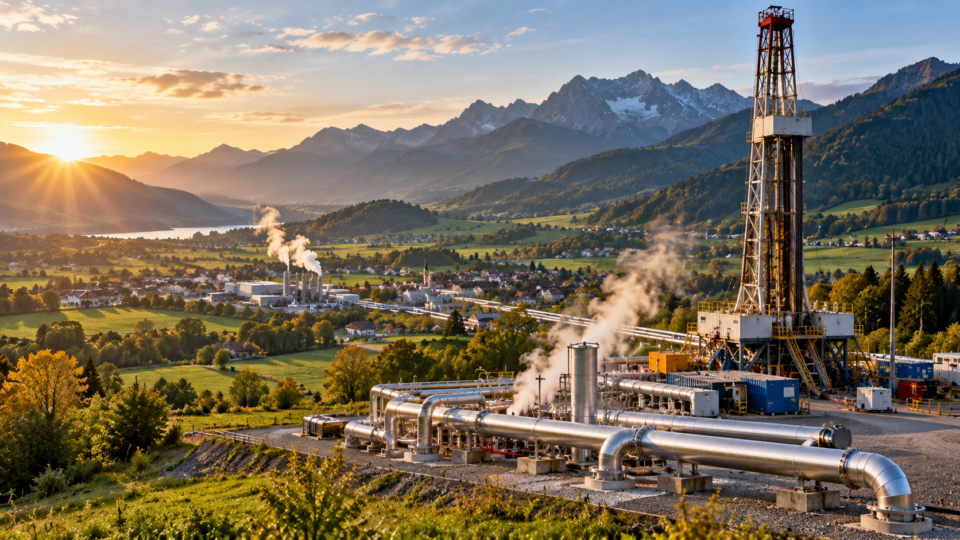
Projects may involve drilling into hot rock and engineering pathways that allow fluids to circulate and transport heat to the surface.
That heat can be delivered to a district heating network or used to produce electricity, depending on temperature, system design and local demand.
Unlike solar and wind power, geothermal plants can potentially supply energy continuously rather than only when sunlight or wind is available.
However, drilling deep wells can be expensive and carries geological and engineering uncertainty. These costs strongly influence whether a project can compete with alternatives.
The study therefore examined not only whether the resource exists, but whether it has a viable role within a broader energy system.
How the researchers tested future markets
Lukas Franken, Elisabeth Zeyen, Orestis Angelidis, Tom Brown and Daniel Friedrich analysed scenarios for enhanced geothermal systems within a carbon-neutral, multi-sector European energy system.
Multi-sector modelling considers interactions among electricity, heating and other energy demands rather than evaluating a single power plant in isolation.
That approach is important because a technology may be valuable in one sector even when it struggles to compete in another.
The researchers explored how drilling costs, geothermal resources, alternative renewable technologies and district heating needs shape deployment.
They also considered the geographical overlap between places with favourable underground conditions and places where other low-carbon energy options are relatively limited.
Such scenarios can reveal economically plausible pathways under specified assumptions. They cannot establish which individual projects will secure financing, planning approval or community support.
The model is therefore a tool for understanding potential markets and trade-offs, rather than a substitute for site-specific engineering studies.
The 20 to 30 gigawatt heating result
One of the study’s central findings is that heat-producing enhanced geothermal plants could support around 20 to 30 gigawatts of thermal capacity at current cost levels.
A gigawatt of thermal capacity describes a rate of heat supply, not a quantity of electricity generation.
Consequently, the estimate should not be compared directly with gigawatts of solar or wind electricity capacity without accounting for how each system operates.
The principal source of demand in this scenario is district heating, in which centralised facilities supply hot water or heat to multiple buildings through a network.
District heating can provide a consistent customer for geothermal heat, especially where infrastructure already exists or can be developed economically.
Geothermal heat may be particularly attractive where buildings require substantial heating over much of the year.
However, network construction, customer density and local energy prices can determine whether a technically feasible resource becomes a commercially viable project.
The modelled capacity therefore represents an opportunity under assumptions, not a guarantee of deployment.
Why drilling costs are decisive for electricity
The analysis indicates that enhanced geothermal electricity becomes much more competitive when drilling costs decline substantially.
Specifically, the researchers identify reductions of approximately 60% relative to 2020 costs as an important threshold in their scenarios.
Lower drilling expenditure would reduce the upfront investment needed to access underground heat.
That could allow geothermal electricity to compete in a wider range of places, particularly where alternative renewable resources are less favourable.
But the 60% figure should not be interpreted as a universal engineering target or a guaranteed break-even point for every well.
Actual project economics also depend on underground temperatures, drilling depth, flow performance, financing costs and electricity-market conditions.
Technological learning could lower costs through improved drilling practices, equipment, project experience and more efficient operations.
Whether those improvements materialise at the modelled scale remains an important uncertainty.
Geography creates a difficult mismatch
The researchers highlight a tension between the geographical patterns of heat and electricity markets.
District heating opportunities are dispersed across European communities, creating a potentially broad market for heat-oriented projects.
By contrast, the most competitive electricity projects depend on a narrower overlap of strong geological potential and relatively weak alternatives from other renewable sources.
An area can have useful underground heat yet still be a poor choice for electricity generation if cheaper low-carbon electricity is readily available.
Conversely, favourable geology does not guarantee a local heating market if demand is too small or distribution infrastructure is absent.
This spatial mismatch means that a single Europe-wide deployment strategy would miss important local differences.
It also suggests that planning should distinguish projects designed primarily for heat from projects aimed at the electricity system.
Each pathway faces different market constraints and may benefit from different infrastructure and policy measures.
Why cooperation could matter
The study argues that much of the longer-term market potential depends on technological learning across Europe.
Experience gained in one project may improve equipment, methods and costs for projects elsewhere.
But early projects often face higher costs and greater uncertainty, creating a challenge for developers deciding whether to invest.
Coordinated research, shared operational experience and credible development pathways may help address this problem.
That does not mean every country should subsidise geothermal projects or that public support will necessarily produce the required cost reductions.
Any policy would need to weigh expected benefits against costs, technical risks and competing energy investments.
The researchers’ conclusion is narrower: because future competitiveness relies heavily on learning, isolated project decisions may not capture all potential system-wide benefits.
Collaboration between researchers, developers, policymakers and heat-network operators could therefore be relevant.
A complement rather than a replacement
Geothermal energy has an appealing characteristic: a plant may deliver energy steadily when variable renewable output changes.
Yet the research does not suggest that enhanced geothermal systems should replace solar, wind, storage or other technologies.
Instead, it examines where geothermal could fit economically alongside those options in a low-emissions system.
Electricity grids can draw on several technologies, and the value of a reliable source depends partly on the rest of the energy mix.
Similarly, heating systems can combine geothermal heat with heat pumps, waste heat and other low-carbon sources.
An integrated assessment is therefore more informative than comparing technologies solely by their standalone production costs.
The results illustrate why the same geothermal resource may be economically attractive for heating but not for electricity.
What the findings mean outside Europe
The research specifically models a European energy system and should not be presented as a deployment forecast for South Africa or other regions.
Different climates, electricity markets, heating demand and geological resources could produce very different results.
European district heating infrastructure is also an important part of the study’s findings, while many warmer regions have different building-energy needs.
Nevertheless, the wider economic question applies internationally: geothermal projects must be assessed against local energy demand and available alternatives.
Countries considering deep geothermal development could benefit from separating heat and electricity business cases.
They would also need geological surveys, environmental assessment and project-specific cost estimates before drawing conclusions.
The study provides a useful analytical framework, but it does not establish the size of South Africa’s enhanced geothermal market.
Limitations and unanswered questions
The study is based on modelled scenarios, not a controlled field experiment or a survey of operating plants across all potential sites.
Its findings depend on assumptions about future technology costs, energy demand, competing technologies and system configuration.
The 20 to 30 gigawatt thermal estimate and the roughly 60% drilling-cost threshold are scenario-specific results.
Real-world deployment could be affected by permitting delays, financing conditions, local opposition, environmental constraints and geological surprises.
Engineered geothermal systems may also require careful management of induced seismicity and subsurface fluid circulation.
The modelling does not demonstrate that every technically promising site can be developed safely or profitably.
Future research and demonstration projects will be needed to test cost-learning expectations and identify which commercial models perform best.
Clear reporting of project outcomes would help distinguish achievable improvements from optimistic assumptions.
The bigger picture
The study offers a more nuanced view of enhanced geothermal energy than a simple claim that underground heat will transform electricity supply.
At current costs, its strongest modelled European opportunity lies in heat production, particularly for district heating.
Major drilling cost reductions could broaden the electricity market, but geography and competition from other renewables remain important.
The results suggest that heat networks and technological learning deserve attention alongside electricity-generation ambitions.
For energy planners, the practical lesson is to match the technology to the local market rather than assume one development model works everywhere.
Enhanced geothermal systems may become a useful part of a carbon-neutral energy mix, but their contribution will depend on costs, infrastructure and careful implementation.
Source Information
Study: Market Integration Pathways for Enhanced Geothermal Systems in Europe
Authors: Lukas Franken, Elisabeth Zeyen, Orestis Angelidis, Tom Brown and Daniel Friedrich.
Journal: Nature Communications
Published: 16 October 2026
Methods: Scenario modelling of enhanced geothermal deployment in a carbon-neutral, multi-sector European energy system, considering drilling costs, district heating demand and competition with alternative energy technologies.